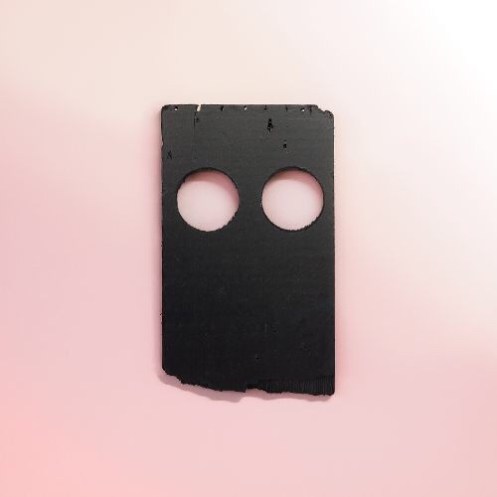
My introduction to Low was their 2005 masterpiece The Great Destroyer. That album was blessed five years later by Robert Plant covering two of its songs on his Band of Joy album: “Monkey” and “Silver Rider.”
AllMusic describes Low accurately as a:
Indie trio from northern Minnesota who pioneered slowcore with beautiful, atmospheric songs marked by long, unsettling silences.
Double Negative is on the more experimental side of Low’s repertoire. It is filled with noise and stuttering edits. Yet these sharp edges do nothing to diminish the fundamental beauty of Low – they enhance the beauty. It reminds me of the jagged beauty of a frozen Lake Superior winter shoreline. The weave of Sparhawk and Mimi Parker’s voices are beautiful as always. The beauty of those voices, juxtaposed with industrial noise highlights and enhances those voices.
Low’s Alan Sparhawk stated in City Pages that the album is a reaction to our fractured times:
“This is very much a reaction to what was going on,” Sparhawk says. “It’s very much an expression of… sometimes despair, sometimes confusion, sometimes anger. There’s one line in the album [from “Dancing and Fire”] that I keep coming back to: ‘It’s not the end. It’s just the end of hope.’ A lot of the music on the record feels to me like, it’s very obvious that everything is completely flawed, and we are in a dire and almost traumatic situation here. How do you keep breathing? Once our fight with hope has ended, what now? What then?”
This is not easy listening music, but these are not easy times.
Postscript: I recently attend a Low in store performance at the Electric Fetus. They played a short semi unplugged set. Mid-set Alan Sparhawk solicited questions from the audience. After a little Q&A, I shouted out “Beatles or Stones?” Sparhawk thought a second – I am paraphrasing here – and endorsed the Beatles. He said that whenever he is struggling for composition inspiration, he pulls out the Beatles’ songbook and plays a few tunes. Not to copy them, but to immerse himself into their songwriting genius and to remind himself how it is done – to be inspired by the boys. Pretty interesting take.


Question: What is tube rolling?
Answer: Tube rolling is the process of trying out a number of tubes in the same spot in an amplifier and selecting the one that sounds best to you. This can be very helpful in optimizing the tone of the amplifier. Tung-Sol
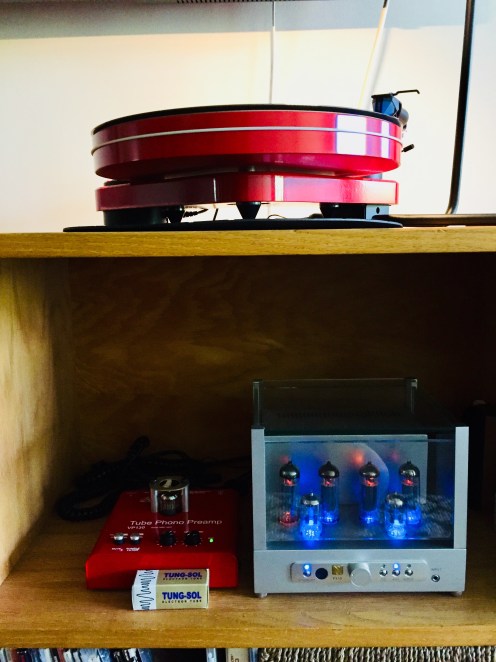
Several years ago I got into tube HiFi gear. It was a game changer. Tube amplification is gorgeous. It is tender on the ears and gives music a unique character. Sound reproduction always adds an opinion. So you want an opinion that will enlighten you and not annoy you. Tubes make music smooth and soft. There are no sharp edges. If you think about pairings (a meal and drink), tubes are the perfect complement to LPs (vinyls as you kids call them). It’s an analog on analog love affair.
My first exposure to tubes was with an ancient guitar amp I bought. It never helped my guitar playing, but the tone was sure cool. I instantly understood why real guitar players would dig tubes.
My real tube experience came when I got a Jolida Glass FX 10 integrated stereo amp. It’s a 7 by 8 inch cuboid of 10 watt goodness. I have had lots of stereo equipment over the years, but this is the most life changing piece of gear I have every owned. The sound was nothing short of amazing. It has been a solid foundation to my rig for several years now. My only complaint is that it doesn’t have a headphone stage.

My next tube addition was a phono preamp. I chose the Bellari VP130 Tube Phono Preamp because it was tube based, reasonably priced and as a bonus it has a headphone stage (as noted the FX 10 did not – so this filled a big hole in my rig).

When we moved into a condo with a very open concept the headphone amp on the Bellari became a key feature in my listening.
I have been wanting to upgrade my equipment, but it is not in the budget (and not really necessary) so I thought maybe I should do an inexpensive upgrade – roll the tube on the Bellari (a single 12AX7).
I went to the Needle Doctor and picked up a Mullard. I swapped it out and my system sounded instantly better. Brighter without being harsh. A bigger sound stage. Overall lusher.
After a month my right channel got quiet – about 75% of the volume of the left. I started to diagnose and to cut to the chase it was the Mullard tube in the Bellari. For the last few weeks I have been back to the stock tube. I returned it to the Needle Doctor and they accepted the return without hassle. I decided to take it up a notch and bought a Tung-Sol Gold Pin.
I listened to the new Paul McCartney (Egypt Station) album with the stock tube and then replayed the McCartney via the Tung Sol. Sounds amazing. Super lively. Like the Mullard, it has a bigger sound stage than the stock tube. What a fun way to upgrade your rig for less than $50. Per Tung-Sol:
The Ultimate 12AX7 enhanced with Gold Pins. Big, warm, and musical. High Gain, ultra-low microphonics, and superb linearity with a dynamic 3-D sound.
Tubes are not for everyone. They are not without hassles, like the Mullard going bad after a month. But this is why you work with reputable dealers like the Needle Doctor.
I don’t know much about the esoterica of tubes. Both tubes I rolled were manufactured in Russia – which is where things like this still get made. Sometimes it helps to be a backwards country. Maybe someday I will be more knowledgeable, but I have a feeling you don’t need to know much. Rolling tubes is like trying on walking shoes. Keep trying until you find something that fits comfortably. So far the 12AX7- Tung-Sol Gold Pin is feeling pretty comfy.

The first hint that Sir Paul had something special up his sleeve was his appearance on James Corden’s Carpool Karaoke. The next hint was a preview single “Come On To Me” – the single was solid.
Egypt Station is the best thing Macca has done in twenty years. Great songs, great production and he has still has his singing chops.
Greg Kurstin produced the album. I did not know this guy, so I scrolled through his credits. Wow. This is an interesting matchup. Kurstin is a pop guy, he is more than a knob turner, he is a serious musician. How much fun do you think these two studio rats had?
Per McCartney, this is a concept album: each cut is a train station and thus each cut should sound different. You are rolling down the tracks checking out each station. Not much of a concept – but if it inspired McCartney who cares – we are the beneficiaries.
On Egypt Station he sounds like classic McCartney, yet completely current. The contemporary production does not overpower or seem awkward. It seems like an appropriate update of McCartney’s sound. You can hear McCartney borrowing from his own disciples: U2, Coldplay, Sting, Spoon, etc. I guess you can do that when you have been in the game nearly sixty years.
McCartney is not leaning on his silly love songs, but rather he is sharing wisdom from his 76 years on the planet. How to handle bullies (“Who Cares”), cheerleading (“Do It Now”), Trump (“Despite Repeated Warnings”), etc.
It is great to see a master create yet another masterpiece late in his career. He is not content to coast on his hits – he has a need to make new creations. Egypt Station is a completely successful album. Congrats Sir Paul!
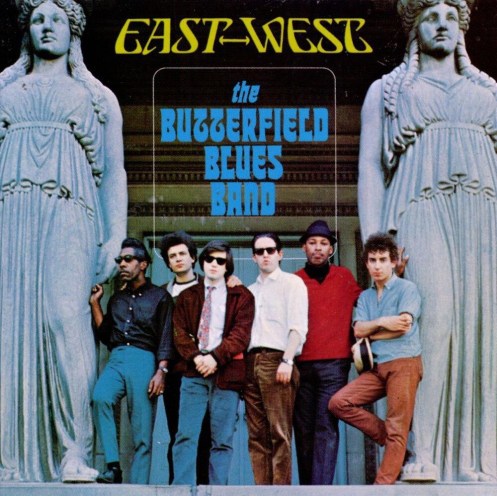
I have had The Paul Butterfield Blues Band anthology on CD for many years and my favorite song on that collection is “East-West.” So I jumped on the opportunity to buy a vintage LP of the source of that cut: 1966’s East-West. I was browsing the fresh used wax at the Electric Fetus when I saw it and nabbed it. I checked out the grooves and they were clean. Ten bucks – I am in. One thing I really appreciate about the Fetus is they have fair prices – not a discounter – a fair price. They stand by their stuff too. Not to mention the store has a funky vibe – Prince shopped at the Fetus.
Back on topic. What a great album. The Paul Butterfield Blues Band were pioneers foreshadowing the psychedelic blues and acid rock. This was 1966 – it predates Jimi’s Are You Experienced by a year, Cream was hatching at the same time across the pond and the Grateful Dead’s debut was a year away.
If you love the Allman Brothers you are going to love this. Dueling guitars: Michael Bloomfield and Elvin Bishop. If you love classic rock – this is as foundational as the Stones, The Band, The Doors and most importantly: electric Dylan. Bloomfield was the guitarist on Highway 61 Revisited (arguably Dylan’s greatest LP).
This is a very cool blues take. These were the most legitimate white blues interpreters in America – overshadowed by the Brits – these guys were directly schooled by Chicago Blues royalty: Muddy & Howlin’ Wolf – to name drop two. This band is a little below the radar – they deserve more of a reputation – to have a broader audience – especially with rock minded millennials.
I have to admit, beyond the titular cut I am not that knowledgeable about their catalog. I know Bloomfield from Dylan. I just missed this – too much good music and too little time.
This is amazing stuff. Chicago Blues waiving its freak flag. At times, it is knocking on the jazz fusion door. British Blues had such a huge market share and lasting influence that Americans like this band are overlooked (although they were inducted into the Rock And Roll Hall of Fame).
Bloomfield is amazing. Per The Paul Butterfield Blues Band entry on the Rock And Roll Hall of Fame’s website:
Michael Bloomfield became one of the era’s first electric-guitar heroes, right there with Eric Clapton in terms of taking blues guitar to a new level. The gunpowder in the band’s equation, Bloomfield was a musician who saw no boundaries, only possibilities, and approached songs like they were vessels to be filled with his hugely impressionistic soundscapes. Joining the group for its first recording sessions, Bloomfield fit seamlessly with original guitarist Elvin Bishop, and together they built a sound perfect for Butterfield’s vocals and harmonica.
This album is a magic moment in the rock and roll timeline. It is great that after all these years, there are still hunks of gold to stumble on. I will be listening to this frequently over the next few months. I have found a new rabbit hole.
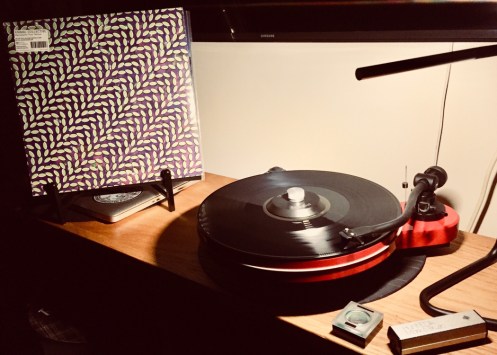
 I recently picked up a used vinyl copy of Animal Collective’s Merriweather Pavilion. The Electric Fetus is my main record store. I went there for a couple of new releases (The Internet and Charles Lloyd) and couldn’t resist this one. I had completely forgotten about this album and how good it is. I had a nicely packaged CD from when it came out in 2009. Loved it then, but it slipped off my radar and I have not been hooked by any of Animal Collective’s other albums – so it was really off my radar.
To be honest I did not really crate dig this one. The LP was displayed on the “Fetus wall” (staff picks from the recent crop of used records and highlights the best catches). So it easily caught my attention.
When I got home there was no question what the priority was. I dropped the needle on Animal Collective: bliss.
I love finding original used LPs from the CD era. They are almost always issued with care. They tend to be expensive ($15 to $20), but they are high quality stamps. So it is worth it. The year 2009 was early in the vinyl renaissance, so should not be a surprise that a sound oriented act like Animal Collective were going to make sure the wax was perfectly executed. This is one of the best sounding albums from the last ten years. The LP sounds clean. It is more organic and softer than the WAV file.
This is a well-tended LP, but well-played. I wonder what the sad story is? How is it that this got in a crate? According to Discogs the version I found is an original US edition from 2009. The Fetus staff knew this was a high-profile item so it was on “the wall” and not in the crates. The Fetus had it at market rate at $15.99, but I had a $3 off coupon to make it a deal/steal.
If you have not checked out Animal Collective – I am speaking to my generation – think Peter Gabriel era Genesis. If you like The Lamb Lies Down On Broadway, you will probably like this. Another reference would be the weirder side of Lindsey Buckingham and Pink Floyd’s Meddle.
Merriweather Pavilion sounds like the the late aughts, it would not be out-of-place on a playlist with The Shins and Vampire Weekend. But it is on the weirder end of the alternative spectrum. This is thinking man’s pop-rock.
This is classic headphone music. The music swirls around you and is more sound effects than melody. The band has almost Beach Boys harmonies over ambient rhythmic keyboards. If you ever wondered what Pet Sounds would sound like in the 21st Century check out Animal Collective’s Merriweather Pavilion.

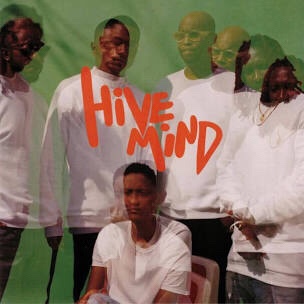
This band has not been on my radar despite the success of their 2015 release Ego Death that was nominated for a Grammy (for Best Urban Contemporary Album).
On Fridays, I always read the Electric Fetus’s new release post on their website. The profile on Hive Mind caught my attention and I gave it a listen and liked it. I dig the funk, neo-soul, hip hop and jazz stew. Most of these are silky slow jams.
The band is made up of Syd (Sydney Bennett vocals and member of the hip hop collective Odd Future), Matt Martians (keyboards, drums and vocals – also member of Odd Future), Patrick Paige II (bass and keyboards), Christopher Smith (drums and percussion) and Steve Lacy (guitar, bass, vocals, drums and keyboards – the 20-year-old wunderkind has produced tracks for Kendrick and J. Cole). Syd handles most of the lead vocals (I have noted where she does not).
I recently read a preview of a new book, Playing Changes by Nate Chinen, that speaks to the current state of jazz. For awhile now I have been thinking the state of jazz is pretty good. My optimism started with Kamasi Washington in 2015, but even before that, the ample sampling of jazz by hip hop artists encouraged me. Although, contemporary music is more fractured then ever, I am pretty convinced that hip hop is the dominant genre of the moment. My wishful thinking is the prominence of hip hop will infect a new generation with a love of jazz.
Which brings me back to Hive Mind, which is certainly not jazz, but it is jazzy.
“Come Together” kicks off the album with a monster bass riff that could be off a Thundercat album. The track has a nice smooth jazz feel without becoming saccharine.
“Roll (Burbank Funk)” has a P-Funk groove. Lacy’s voice is the lead here.
“Come Over” has a Prince meets Stevie Wonder vibe.
“La Di Da” is a nice dance floor jam that would not have sounded out-of-place on Michael’s Off The Wall album.
“Stay the Night” is a quiet ballad that again reminds me of Stevie Wonder.
“Bravo” has a herky-jerky beat and Lauren Hill feel.
“Mood” has a Marvin Gaye Midnight Love groove.
“Next Time/Humble Pie” is two songs in one, just as the title suggests. The first song is about getting up the nerve to ask someone out and in the second song the relationship is tired – an interesting juxtaposition.
“It Gets Better (With Time)” is a gorgeous slow jam. It has a great rap section by guest Big Rube and ends with a rap by The Internet band member Patrick Paige II.
“Look What U Started” is a slo-mo dance floor burner. Classic quiet storm.
“Wanna Be” is a catchy mid paced ballad.
“Beat Goes On” would not sound out-of-place on a late 80s Sting album. Steve Lacy sings the first half of song and Matt Martians sings the second half.
“Hold On” ends the album on a particularly dreamy note.
Overall, this is a very unconventional and adventurous R&B album. It can be mellow background music, but if you listen carefully you will be rewarded with some deep and thoughtful grooves.
I picked up the vinyl edition, but for this review I listened via Tidal Hi Fi. The vinyl emphasizes how slick The Internet are. They are Fleetwood Mac slick. Hive Mind is on par with D’Angelo’s Voodoo as far as production values. It shares Voodoo’s ambition of reinventing R&B. Vinyl releases of new music can be a mixed bag. This is a quality analog mix and a quiet clean pressing.
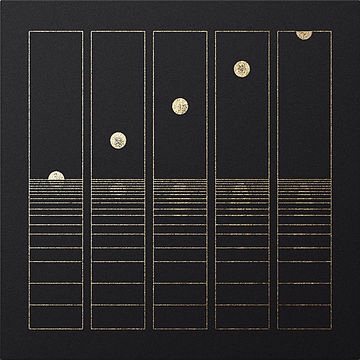
First off this is one badass cover. You can’t appreciate it in a photo, you got to feel it – hold it and stare at it. Subtle and elegant.
I have been anticipating this release. I was late to the party for their 2015 debut. It was a Grateful Dead, specifically Jerry inspired, meditation. I wanted to be the first guy on the block to hear the sophomore album – would it be a step forward or disaster? It is a step forward.
The background on the band is that in 2015 the remaining members of the Grateful Dead put on a set of mega concerts called Fare Thee Well. Neal Casal (Chris Robinson Brotherhood, Ryan Adams, etc.) was asked by the concert’s video director, Justin Kreutzmann, to compose and record more than five hours of original music to be played along with the visuals Kreutzmann was preparing for the Fare Thee Well intermissions.
Casal pulled together a studio band of keyboardist Adam MacDougall (a fellow member of the Chris Robinson Brotherhood), bassist Dan Horne (Beachwood Sparks and Jonathan Wilson) and drummer Mark Levy (The Congress). They basically improved/jammed in the studio and came up with some Dead inspired instrumentals.
Casal assumed it was a one time project and did not expect anything to come of it. The music captured the audience’s attention and became a minor sensation in the Deadhead world. Casal ended up releasing an album and touring with Circles Around the Sun – AKA CATS. It was enough of “a thing” that the band was motivated to create a second album.
Where the first album has a strong Dead feel, this new album is not a full on departure, but it is a significant evolution. It still has a improvisational jam band feel, but feels more composed and tighter. This album seems inspired by the jazzy side of Jerry, but it just uses that as a launching point. The band took their original raison d’être and left it in the dust. This is full on jazz/rock/funk/fusion.
Casal’s playing is amazing – he plays in several tones and styles. The same guys are in the band as the last album, but now they really sound like a band. The rhythm section puts down a rock solid foundation and Casel’s guitar and MacDougall’s keyboards engage in a fascinating conversation. I hear so many references: The Dead and Jerry Garcia solo of course, but also Bitches Brew era Miles, Pink Floyd, 70s jazz fusion (the L.A. Express and Return To Forever came to mind particularly), Santana, etc. Garcia did a lot of cool stuff outside the Dead and my favorite is the jazz fusion. I assume Casal and the boys dig that stuff too.
This CATS album sounds like a real band with it own personality and voice. As much as I loved the debut, it was very much a tribute to the Dead and Jerry. CATS is now very much its “own thing.” I appreciate they felt the need to evolve the concept, it would have been easy to milk the original concept.
“More than anything, what you hear on this album is a band growing into its own sound,” Casal says.
Kudos to Rhino Records for the high quality pressing, the LP sounds great.
This is going to be one of my favorite albums of 2018. Somebody needs to make a movie just to use this album as a soundtrack. I have not fully digested the LP yet, so you might hear a follow up post. My favorite feature of the album is how funky it is.
I would love to see these guys live, but they have a pretty limited tour schedule given they have full time jobs in other bands. For now you will have to settle for You Tube.

I went to my regular tea store (yup I am one of those annoying nerds who has a tea store – it even has a pretentious name: La Société Du Thé) to get some lapsang souchong and pu’er. My guy, who normally has a good inventory, did not have any lapsang souchong. I said it must be Trump’s fault – you know trade war/tariffs. That set my guy off with some opinions. Someday I will have a long cup of tea with him. Seems like a well-informed and opinionated chap.
Anyway what’s my alternative? He recommends Genghis Khan, which is lapsang souchong with jasmine. He says he can only sell me three ounces – there is a shortage. I respect the customer advocacy. You don’t want to disappoint your regulars.
I previously posted about my obsession with lapsang souchong. Per Wikipedia lapsang souchong is distinct from all other types of tea because lapsang tea leaves are traditionally smoke-dried over pinewood fires, taking on a distinctive smoky flavor.
Well, I brewed it up and it is real good. It is smokey, bitter (in a good way like an IPA) and FLORAL. Weird, but good. A nice change-up. It tones it back to almost a straight black tea, but a really good black tea. I think this will be part of my regular tea repertoire.

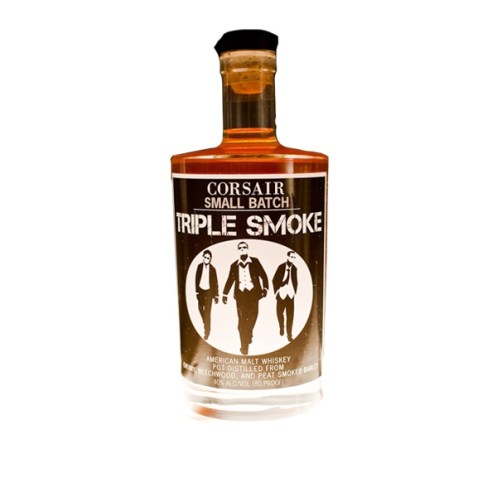
I discovered Triple Smoke a couple of years ago when our family visited the Corsair Distillery in Nashville TN. Within our family, we label this kind of spirit “brown juice” – a catch-all for whiskeys of any kind. My preference in brown juice is Bourbon and Islay Scotch – as different as sweet and sour. Triple Smoke merges my preferences into a single masterpiece.
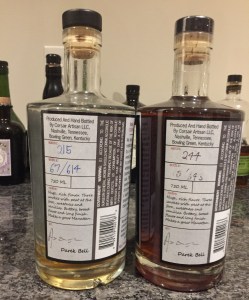
I rarely mix quality whiskey in a cocktail. I prefer it neat or over a substantial rock of ice. For this taste test, I am drinking the whiskeys neat. My gimmick for this taste test is I have a bottle of Triple Smoke with about a shot left. For small batch spirits I like to keep that last shot until I have replacement bottle. Then I can compare batches. Tonight I am comparing batch 215 with batch 244.
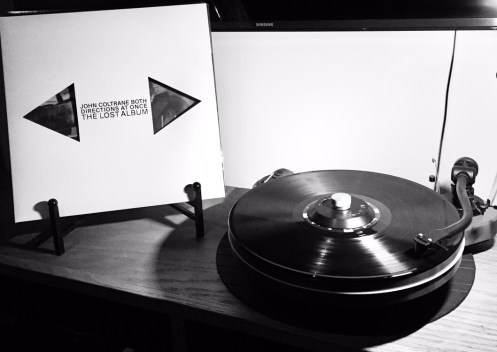
I am accompanying the whiskeys with John Coltrane’s Both Directions At Once The Lost Album.
When I first tasted Triple Smoke at the Distillery a few years ago, I remarked to the bartender that it reminded me of Scotch, and Islay in particular. He smiled and said that was pretty much the point of this spirit. From that point on I have described Triple Smoke as an American Islay to anyone who would listen.
Per Corsair:
The whiskey that put us on the map. We use three smoked malts (cherrywood, beechwood, and peat) to craft this deep and complex whiskey. Smoke and notes of cherry pervade the palate, finished by a slight brininess of mossy peat. Pot distilled then barreled in new charred oak, Triple Smoke has the sweetness of an American whiskey with a single malt’s rich smoke.
The first thing I notice between batch 215 and 244 is the color – batch 215 is paler.
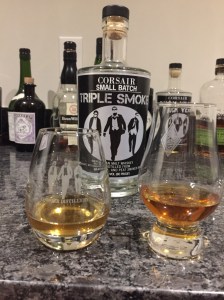
Batch 215 is on the left and 244 is on the right.
Batch 215 and 244 have similar odors, but 215 is much stronger.
Batch 244 has a noticeably thicker viscosity.
Most importantly the taste:
- Both taste great
- Both mix the sweetness of Bourbon with the peaty smoke of Scotch.
- 215 is milder and sweeter than 244.
- 244 is more complex: a thicker viscosity, smokier, a bit more heat, a subtler sweetness and a more lasting after taste.
I can’t say that I prefer one vs. the other. They are clearly similar enough to go by the same name. I appreciate that they are not exactly the same.
If you like Bourbon and you like Scotch you will likely enjoy this clever mashup. The two flavors mix remarkably well together. If you lean toward Bourbon vs. Scotch or vice versa, this may open your palate towards your least preferred brown juice. Triple Smoke is more of a Bourbon than a Scotch. If there is any doubt about that, I finished my tasting session with a wee dram of Ardbeg 10 (a true Islay) and the Triple Smoke is clearly a Bourbon. However, it is the most unusual Bourbon I have ever tasted and one that has earned a regular place in my home bar.
Corsair has several other spirits and I have liked all that I have tasted. None of their spirits are conventional. They appear to have good distribution in the USA. A bottle of Triple Smoke is about $45. A special shout out to Top Ten Liquor in St. Louis Park – my regular liquor store – they always have a great selection and helpful staff.
PS – Coltrane mixes well with Triple Smoke. Both are complex, but accessible.

I am still digesting Kamasi Washington’s recent double XL 5-LP set and this gift from the past arrives. Both Directions at Once: The Lost Album was recorded by Coltrane’s classic quartet March 6, 1963. This material was not released at the time and the master tapes were subsequently destroyed by Coltrane’s label (Impulse!) as a cost saving measure. But it turns out that the session’s producer, the great Rudy Van Gelder, had made a reference copy for Trane. Trane’s first wife Juanita (Naima) maintained possession of the tapes and they were discovered in her estate when she died. Coltrane’s label sat on the tapes a couple more decades. They were finally released in June of 2018. In the liner notes Sonny Rollins, a true peer of Coltrane, says the LP is “Like finding a new room in the Great Pyramid.”
My introduction to Coltrane was Miles’ Kind Of Blue – one of my favorite LPs. I then ignorantly picked up Trane’s Meditations. At the time, Meditations was way to “out there” for even my adventurous taste. I next bumped into Trane in Spike Lee’s movie Mo’ Better Blues. That movie has a montage scene that uses Trane’s Love Supreme, that caught my attention. Off and on for the next twenty-five years I have explored Love Supreme and Trane’s classic quartet on Impulse! McCoy Tyner on piano, Jimmy Garrison on bass and Elvin Jones on drums.
I consider myself a Trane fan, but I have to admit I am more of a Miles fan. I recently got reacquainted with Trane via Miles’ The Final Tour. On that album, Coltrane dominates the proceedings. The Final Tour reminded me of Trane’s greatness and I began re-exploring his catalog. That coupled with my infatuation with Kamasi Washington (a self-admitted Trane disciple), has me in a Coltrane state of mind as I approach Both Direction at Once: The Lost Album.
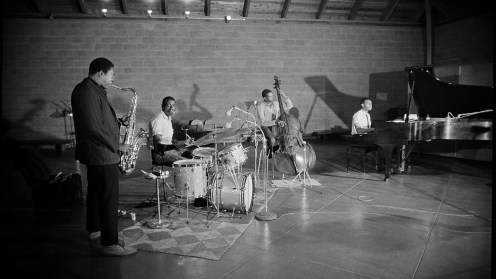
At the time this album was recorded (1963), Trane’s label had convinced him (and by all accounts Trane was complicit) into releasing accessible mainstream jazz. But on tour, Coltrane was flying his freak flag and foreshadowing the brilliance that would become Love Supreme.
The Lost Album is caught between what Coltrane was doing live and his official releases. Thus he was going “both directions at once.”
The Lost Album is primarily a Coltrane solo workout. The band is there to support him. Ravi Coltrane, Trane’s son, states that on this album “the guys are kind of stretching out and getting loose and blowing, having a good time in the studio.
The Lost Album is a high quality recording; this is not a demo. Although the original masters that were destroyed were stereo, the reference tapes that Van Gelder gave Trane were mono. I am kind of a fan of a good mono mix of acoustic jazz.
One of the great songs of Trane’s catalog is “Impressions.” I don’t believe that Coltrane ever released a studio version of the song, just live versions. On The Lost Album there are four studio versions. Two with a trio (McCoy Tyner’s piano sitting out) and two with the full quartet. For Coltrane aficionados these four versions will be worth the price of admission.
My favorite cut is “Slow Blues” which is a geared down “Chasin’ the Slow Trane.” This is an eleven and half minute jam.
This is not necessarily an essential album for the casual Coltrane fan, but it is a very solid album. It is essential for the hardcore Coltrane fan.

 Axl's Catch Groove