
Chris Stapleton is an anomaly in country music, having more in common with Americana than Nashville, yet he is beloved by the country music establishment. Chris plays stadiums, despite his humble style and barely sounds country, he sounds like a ’70s rocker. He isn’t pretty, but he does have a cool outlaw country look.
I am not a big fan, but every time I hear his music I like it. I saw him live at Lollapalooza when he was promoting 2015’s Traveler – he was awesome and he rocked. I saw him perform “Tennessee Whiskey” live with Justin Timberlake on the Jimmy Fallon post-Super Bowl show in Minneapolis (2018) and he completely upstaged JT. Traveler resonated with me, but his subsequent albums fell flat.
He has a new album, Higher, and so I gave it a listen and I like it. It sounds like a well crafted singer-songwriter album from the late 70s. He has soulful vocals that reminds me of a country Al Green. The arrangements and mix are gorgeous (of course they are, Dave Cobb is producing). The guitar solos are short and tasteful (Stapleton plays most of the licks and rhythm). Lyrically, he is an adult – the usual Nashville bro tropes (pickup trucks, getting drunk, hookups, etc.) are absent. In summary, he creates tasty grooves on Higher. Maybe all his albums are this good and I was just not in the right place to appreciate them. If you have not listened to Chris Stapleton, this is a great place to start. If you are a long-time fan you can argue if this is his best yet. This would be a great reference album to test drive a stereo.
If you only have the patience to listen to one song, make it “South Dakota.”
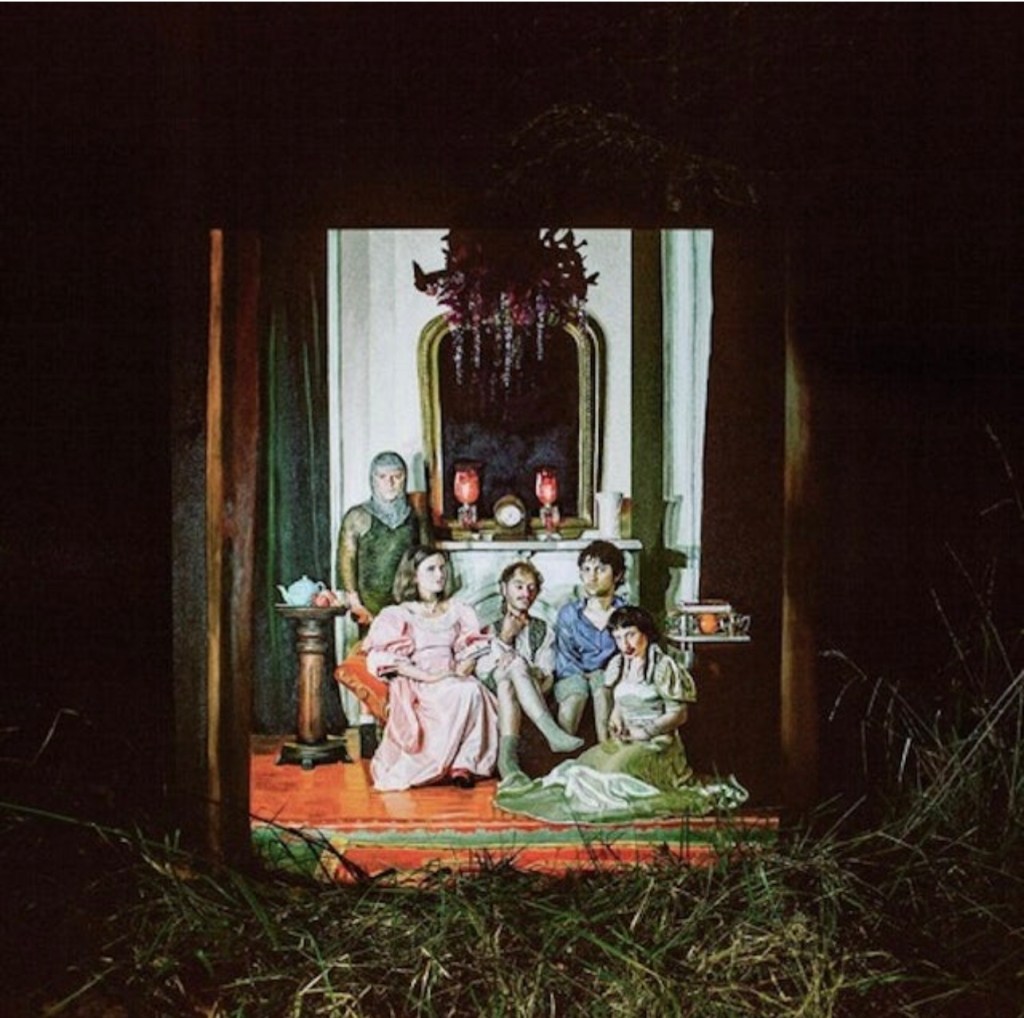
Rat Saw God
(2023)
Dead Oceans
In the late 90s, the Drive-By Truckers (DBT) reinvented southern rock, specifically Lynyrd Skynyrd, with an alternative/indie rock aesthetic – achieving perfection in the early 00s with Southern Rock Opera (2001), Decoration Day (2003) and The Dirty South (2004). The DBT had an insightful take on the modern American South that can be summarized in this lyric:
“Proud of the glory, stare down the shame
From the song “The Southern Thing” from 2001’s Southern Rock Opera
Duality of the southern thing”
Asheville, North Carolina’s Wednesday is updating southern rock for the current decade. Wednesday openly acknowledges their appreciation of the DBT and name-checks the band on Rat Saw Dog’s song “Bath County:.”
“Hittem with a dose of Narcan
Sat right up in the leaned back seat of his
Two door sedan
On the way home, play Drive-By Truckеrs songs real loud
You’ll be my baby ’til my body’s in the ground”
They bring indie rock, grunge, alt-country, and shoegaze to their brand of southern rock. They have also mastered the fine art of melodic-buzz-saw-guitars. I have always been a sucker for melodic-buzz-saw-guitars, for example, Bob Mould (with Hüsker Dü, solo, and Sugar), Smashing Pumpkins, Nirvana, Foo Fighters, The Pixies, etc.

Karly Hartzman, the band’s primary songwriter, also brings a Southern Jewish perspective. She understands the challenges of being Jewish in the South and illustrates it with a novelist detail:
“The kid from the Jewish family got the preacher’s kid pregnant
From “Quarry”
They sent her off and we never heard too much more about it”
At first, I was put off by the squall of guitars, but by song five, I found alt-country comfort in “Chosen to Deserve.” That opened my mind to what the band was doing, and now after listening to the album about ten times, “I get it” and enjoy their point of view. I am intrigued by the stories of dirtbag southern teenagers in the same way as I have enjoyed Springsteen’s blue-collar New Jersey and the Hold Steady’s upper Midwest hood rats. As Steven Hyden’s review points out, the band has a great sense of place.
I thank IndieCast for tipping me off to this album and persuading me to give it a serious try. On my own, I would have never made an effort.
It is great to find a young rock band who, although not shy about their influences, have found their own voice.

In my opinion, the Stones’ golden age (the 70s) ended in 1981 with Tattoo You. I have measured each studio album released over the last four decades (AKA late-period Stones) against their golden age and they have all fallen short. My reaction to each new album, over the last four decades is:
- Likable – I can’t think of a late-period Stones album that I have hated, I have liked them all
- Grateful – just happy they are still alive and capable of producing new material
- Disappointed – although I like the new material, it never lives up to their best work
- Forgettable – after a few weeks of listening it gets put on the shelf and rarely (if ever) listened to again
- Surprising – on the rare occasion I have gone back to a post Tattoo You album, I have been surprised that it is much better than I remember
I like Hackney Diamonds. It is a grower: each rotation sounds a little better and I hear something new. It is as good, if not better than anything in their late period. I took the effort to listen to the six studio albums of new material released between Tattoo You and Hackney Diamonds to verify this was not recency bias – I confirmed it is better than some and about even with others. The late-period is better than I remembered, but not golden, it isn’t fair to compare late-period albums to the 70s masterpieces.
The Stones are giving their all to promote Hackney Diamonds. That being said, I bet only about 1% of the people who attended a Stones stadium show will give a shit about this album. This is a gift to hardcore fans.
The most remarkable thing is that Mick’s voice still sounds excellent and Keef and Ronnie still have some tasty riffs in their fingers. This is a respectable Stones album. Although, it lacks their classic danger (that has been the case for a long time), it is fun, and at least one song, “Sweet Sounds of Heaven,” belongs on my list of 50 best Stones songs (that is an aspirational list – I have yet to make it). This album sounds contemporary without pandering.
Mick Jagger and Keith Richards are is 80. Despite their age, as recently as 2021, when I last saw them live, they remained the greatest live rock band I have ever witnessed. Can the band pull off a late-career recording masterpiece the same way Dylan did at the age of 79 with Rough And Rowdy Ways? Hackney Diamonds is not a masterpiece and won’t overshadow the best in their catalog, but it is a solid Stones album.
My first listen to Hackney Diamonds didn’t hit me. It sounded like an AI version of the Stones with the “make it sound current” dial turned up to 10. But with each subsequent listen it sounds less contrived and is an excellent late-career artistic statement. There are a handful of songs that really resonate with me. It may not be their best since Tatoo You, but it is very satisfying to this old fan. Here is some track-by-track commentary:
“Angry” on the first listen evoked that AI-Stones reaction in me, but with each listen it sounds more naturally Stones to me. Plus it has an epic video.
“Get Close” has a nice contemporary Stones riff. Lots of guitars here. Wonderful sax solo from James King of Fitz and the Tantrums. Elton John is on piano, but he is really buried in the mix – I had to listen very carefully to hear him.
“Depending On You” is a gorgeous acoustic(ish) ballad – a little country. This is an amazing soulful rock vocal from Jagger – his pipes sound amazing (freakish for an 80-year-old rock star). Someone from Nashville needs to cover this.
“Bite My Head Off” is raunchy rock and roll riffs – almost punk rock. Sir Paul McCartney lays down the bass line throughout and has a wonderfully distorted bass solo during the bridge. Again, Jagger’s vocals are amazing. Keef and Ronnie are in a raucous guitar conversation, old dudes proving they still got it. The Replacements would be proud of the old coots.
“Whole Wide World” WTF Mick? What is this? At first, it sounded like a pop song, but the more I listen to it, it is a very clever rock song – damn Gaga should cover this. Lyrically, it has proletariat frustration, but it is also kind of a party anthem. This song that I first dismissed is pretty good.
“Dreamy Skies” is classic country Stones. Just a rock star who needs a break: “I just need some peace from the storm/I got to break away from it all.”
“Mess It Up” the song starts with what I assume is the Charlie Watts (drums) demo tracks – then it kicks into gear as the remaining members flesh it out. When you hear Charlie’s drums for the first time on this album with this song you realize how important he was to Stones’ sound. Interestingly, this is not a rock song but more of an R&B number.
“Live By the Sword” is graced by Bill Wyman (bass), Elton John (piano), and Charlie Watts (drums). You can hear Elton on this track and he sounds badass. But overall this is the least interesting track on the album.
“Driving Me Too Hard” is kind of country. This is a great example of the band sounding contemporary without embarrassing themselves.
“Tell Me Straight” is a gorgeous Keef ballad. He sounds beautifully vulnerable.
“Sweet Sounds of Heaven” is my favorite song on the album. It is classic gospel Stones and includes Lady Gaga on vocals and Stevie Wonder on piano. Below is an epic live performance promoting the album. Hot take: this is a top 50 Stones song. Magnificent.
“Rolling Stone Blues” – The Stones are the original Black Keys/White Stripes. It is easy to forget what a unique and genius interpretation of the blues the Stones are capable of. We are officially reminded of their special gift on this track.
If this is the band’s last studio album, it will be a beautiful goodbye.
Postscript: About 2 months after the release of Hackney Diamonds, the Stones have reissued the album on streaming services with bonus live tracks from their release day promo gig (10/20/23) at the celebrity-studded Racket NYC (e.g.: Christie Brinkley, Elvis Costello and Trevor Noah). It is a short show, seven songs: 3 classic and 4 from Hackney Diamonds. The band sounds fantastic: Keith and Ronnie have epic snarling guitar duels and Jagger sounds as good as ever. I have seen the Stones live several times, for me, Jagger is the greatest rock frontman of all time (sorry Prince and Bruce, you have your virtues too). The fact that he still has it at 80 is freakish. The voice has actually gotten sweeter. The live Hackney Diamonds songs rival the studio cuts. This is an energetic band – the Stones are the best.

This settles it for me, Hackney Diamonds is a very good album, that just got better with these bonus cuts. Top 10 album for 2023 for me.


Bob Dylan At Budokan (1979) is a seminal album in my Dylan fandom. When it came out in early 1979 I was a newly minted Dylan fan (a 20-year-old college sophomore). I had just a few Dylan albums under my belt and was drawn to this album as it looked like the greatest hits live. As a venue, Budokan was known to me from Cheap Trick’s ubiquitous radio hits from their live at Budokan LP.
Bob Dylan At Budokan was love at first sight. I was familiar with about half the songs and I was fascinated by the radical rearrangements. For the songs I was not familiar with, this was my introduction. It served a similar role as Joni Mitchell’s Miles Of Aisles (also a live greatest hits). This was my primary early Dylan education, I played it incessantly.
I was too ignorant to have the conventional critical opinion of the time: this album sucked and Dylan must have lost his mind. The main criticism was the arrangements: it sounded like Bob fronting a Vegas show band (it didn’t help that Dylan was dressed in white like a Vegas Elvis). The performance undermined his legacy – he was washed up and lost in the wilderness. I was too dumb to be scandalized, so I dug the arrangements.
But time has mellowed the hate of Budokon. The revisionist history is that, this is the foundation for the second half of Dylan’s career. From this point forward, Dylan’s live performances would mean radical reinterpretations of his songs – a feature and not a bug. The specific arrangements here foreshadow his Christian born-again gospel chapter. Dylan would make major stylistic changes with each subsequent album. Today, we expect Dylan to trick us. It would be unimaginable in 1979 that Budokan would warrant a box set of the two complete concerts at Nippon Budokan Hall, Tokyo, Japan, February 28 and March 1, 1978 – but like most of Dylan’s left-hand turns into oncoming traffic, time as cured.
Given, how important this album was to my development as a Dylan fan, I am overjoyed to have this set and grateful that it is available on streaming (including in high resolution – I am using Tidal which is streaming MQA 24/96). Yet, as big of a fan as I am of this album, and due to my existential crisis regarding collecting physical music (CDs and LPs), I am not up for shelling out $160 for a 4-CD version (plus I have stopped buying CDs in favor of vinyl and the vinyl version which is nearly $500). A reasonable $40 compromise, assuming you have the original Budokon, is the 16-song vinyl double LP: Another Budokon 1978. It includes the eleven additional songs above plus a few of the songs from the original album, but from the alternate night.
The Complete Budokan is 58 songs (the original was 22 songs). Most of the 36 new songs are repeats as this set documents two back-to-back concerts. However several songs are unique to this set. The audio is remixed from the original 24-channel analog tapes – it sounds great on my high-resolution stream. Since I am streaming, I can’t speak to the packaging, but it looks great (see below) – as is typically the case with Dylan box sets.


I think the most important question is how are the 36 additional songs? The original album pulled songs from both nights. Most of the songs on the original album are repeated on both nights but are not significant in their differences. Eleven songs did not appear on the original album, but some of those are repeated on both nights. The songs that never appeared on the original album are:
- REPOSSESSION BLUES – blues cover
- I THREW IT ALL AWAY (both nights)
- GIRL FROM THE NORTH COUNTRY (both nights)
- TO RAMONA
- ONE OF US MUST KNOW (SOONER OR LATER) (both nights)
- YOU’RE A BIG GIRL NOW (both nights)
- TOMORROW IS A LONG TIME
- A HARD RAIN’S A-GONNA FALL (both nights – instrumental)
- LOVE HER WITH A FEELING – blues cover
- DON’T BELIEVE YOU (SHE ACTS LIKE WE NEVER HAVE MET)
- THE MAN IN ME
The additions of these songs are great. Plus the sequencing of The Complete Budokan 1978 feels more like an actual concert. The songs that are repeated each night are not significantly different, but it is nice to have two complete concerts. The Complete Budokan 1978 is not essential for the casual fan – the original Budokon is good enough. But if the original Budokon is important to you, then The Complete is a wonderful addition to your obsession.

Joni Mitchell’s Court and Spark is an important milestone in my development as a musichead. It is the first album that opened my ears to how artistic pop music can be.
This Record Store Day (RSD) release is a collection of demo recordings of eight of the eleven Court and Spark songs. The recordings are not “never heard before” rarities, but rather come from Joni Mitchell Archives – Vol. 3: The Asylum Years (1972–1975) 5 CD box set that was released in October 2023. This LP is a sampler from that box focused on a section of CD 3.
I have not purchased any of the Joni reissues/archives. My experience with similar Dylan reissues is I spend a lot of money, listen once or twice, and then they gather dust on the shelf. With streaming, I can access the collection for “free.” Don’t worry, Joni has collected plenty of my money over the years. I gave the box a superficial listen on streaming (Tidal) when it first came out. I never really sunk my teeth into it. This RSD release, from this past Black Friday (2023), is the perfect sampler for me, especially its focus on Court and Spark.
Side one of the LP opens with “Piano Suite” which is a medley of “Down To You,” “Court and Spark,” and “Car On A Hill.” It is just Joni’s vocals accompanying herself on piano. It gives me the sense that Joni knew exactly what she sonically wanted Court and Spark (the album) to sound like. The suite was the sonic blueprint for the producer and musicians to work their magic to flesh out Joni’s vision. Not only is it a template of the songs, but it shows how they should weave together to create an album. It is a wonderful glimpse at her creative process. This is the gem of the compilation.
Side one is completed by “People’s Parties.” Here it is just Joni accompanying herself on guitar (including some Joni overdubbed harmonies). Again, it is a pretty clear blueprint for her collaborators.
Side two opens with one of Joni’s greatest hits: “Help Me.” Most of this version is a barebones template of the final product with a solo Joni vocal and guitar. There are some slight lyric differences from the final version. The coolest variation is the song ends with a desperate-sounding cry for help which is absent in the final album version.
“Just Like This Train,” “Raised On Robbery,” and “Trouble Child” are all clear blueprints of the final version (except for “Robbery’s” wonderful overdubbed banshee harmonies).
The Court and Spark Demos are a beautiful gift to Joni fans. I am repeating myself, but I am amazed at how clear a vision Joni had of the final product in these demos. The LP is a fun peek behind Joni’s creative curtain.
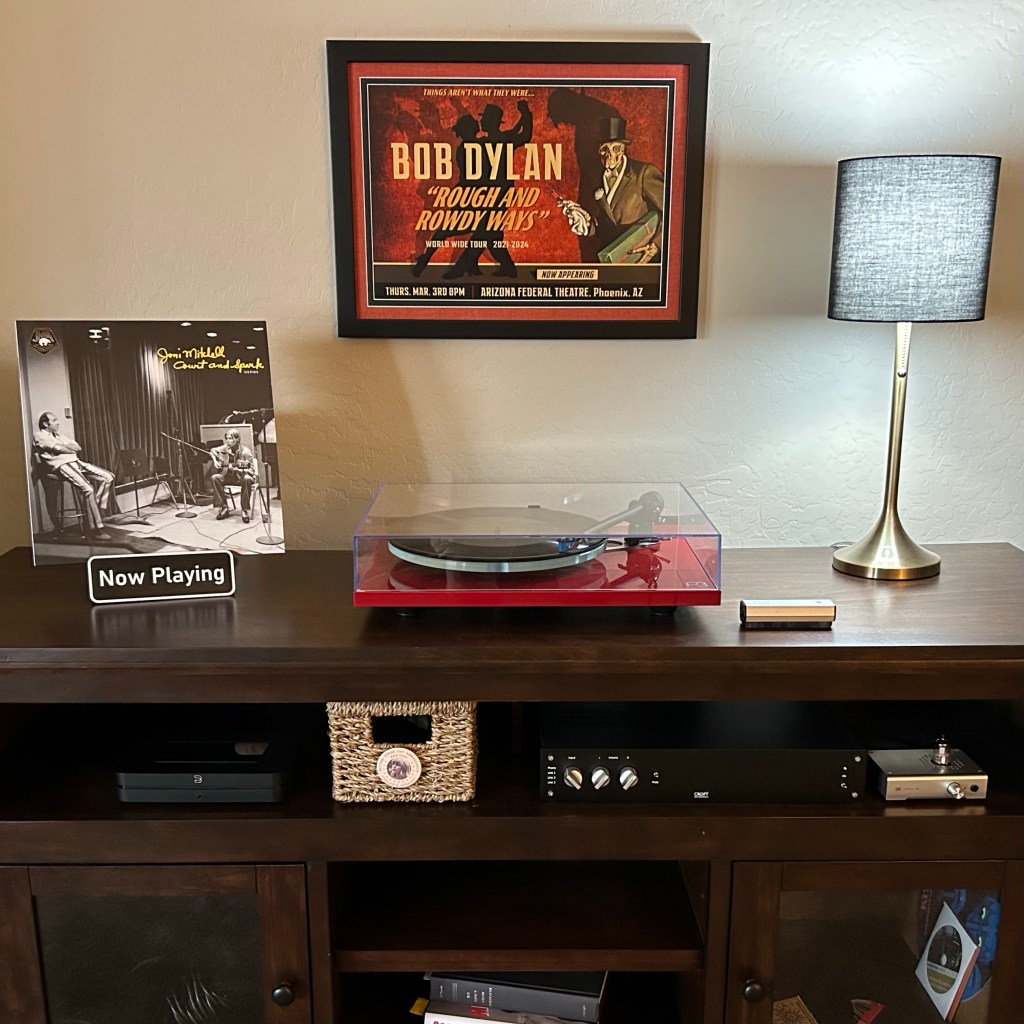
Below is a Tidal playlist (24/44.1 MQA) of this RSD LP taken from Joni Mitchell Archives – Vol. 3. Joni is not on Spotify given her disgust of Spotify accommodating material she objects to (similar to the Neil Young boycott of Spotify).
Listen to playlist in TIDAL: JONI MITCHELL Court and Spark Demos RSD BF 2023
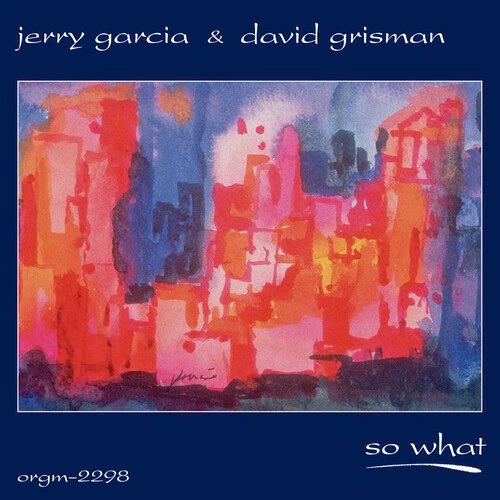
I “discovered” David Grisman on his classic jazz bluegrass fusion (which he calls Dawg music) album: Hot Dawg (1979). I “discovered” Jerry Garcia via the Jerry Garcia Band on their 1991 eponymous live album.
This album was originally released as a CD on Grisman’s Acoustic Disc label in August 1998. I have had that CD version for about twenty years – “discovering” the album about five years after it was released. I have been a fan of mandolinist David Grisman and the inspiration for this album, Miles Davis, since the late ‘70s. I became a Jerry Garcia fan in the 90s. I was never much of a Grateful Dead fan, but man am I a fan of all of Jerry’s outside of The Dead music adventures. It is so diverse: country, bluegrass, jazz, soul, rock, multiple configurations, etc.
I am a longtime fan of this album. When I saw that a vinyl edition (2400 copies were pressed) for Record Store Day 2023 Black Friday (RSD) it was immediately prioritized as my number one for RSD.
I got up at 5:30 on Black Friday to increase my odds of acquiring my RSD list from Stinkweeds, my go-to Phoenix indie record store. I was disappointed that Stinkweeds did not even get any – this occasionally happens on RSD due to production or shipping delays. Store owner Kimber Lanning said they would take my name and number and they would text me if it came in. I was hopeful it would show up. Sure enough, I got a text five days later that they had a copy with my name on it. Sadly, predators on Discogs are selling this for double the price.
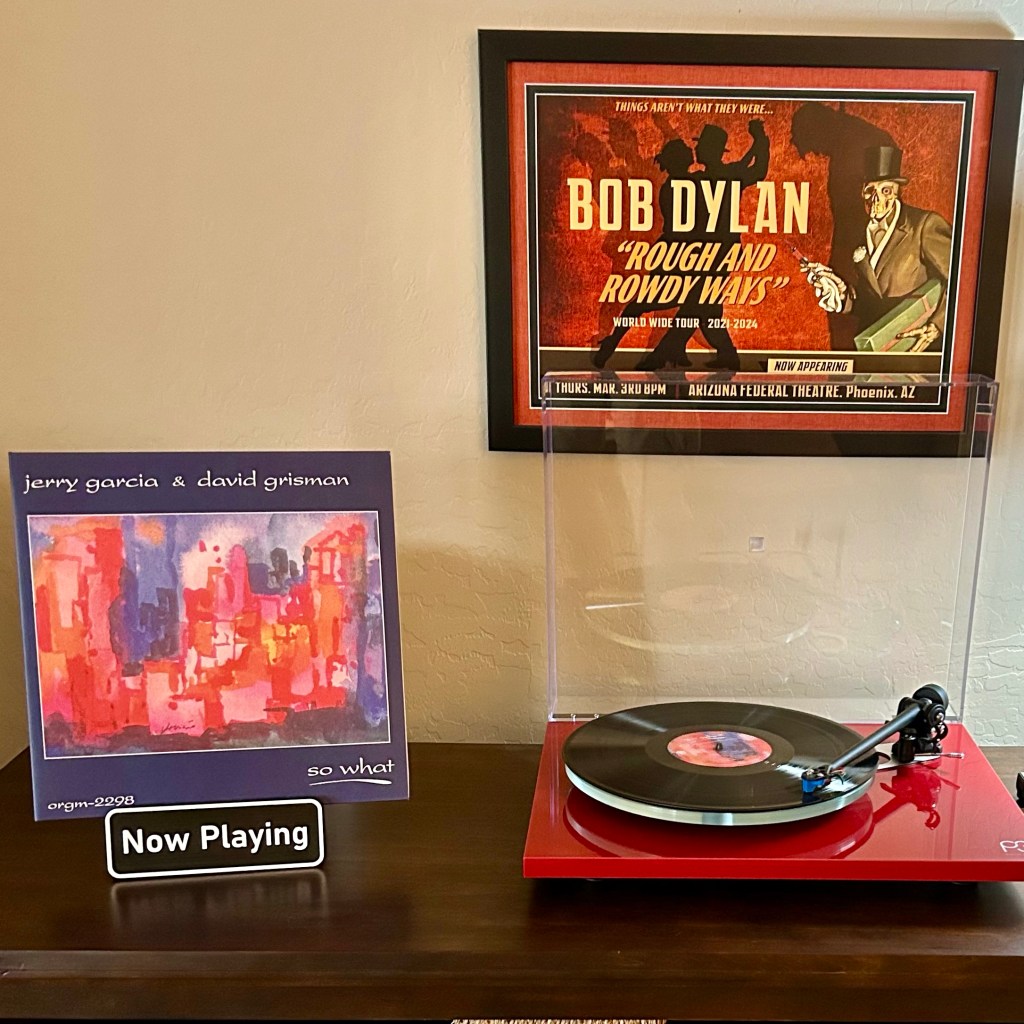
David Grisman’s contribution to society was creating a jazz/bluegrass/folk fusion that he calls “Dawg music.” He also is a buddy of Jerry Garcia and they have collaborated on several musical projects. On this project David and Jerry are joined by sidemen from David’s regular band (bassist Jim Kerwin, Joe Craven on percussion, and, on two numbers, flutist Matt Eakle), the co-leaders perform three versions of Miles Davis’ “So What,” two of apiece of Milt Jackson’s “Bag’s Groove” and Davis’ “Milestones,” and one of Grisman’s “16/16.”
So What is a rare opportunity to hear Jerry playing jazz (Dawg style) music, a genre which he loved but rarely performed. I am very familiar with the source material as Miles Davis’ Kind Of Blue (and most of his catalog) is an important album to me.
Although songs are repeated across the two discs, the improvisation is significant enough to not be bored by the repetition, but enlightened by David and Jerry’s creativity. This kind of music is gentle enough to play as background music and sophisticated enough to listen with full attention. Although Jerry is the big name here, David is the star of this release. He is to mandolin what Béla Fleck is to banjo. This is a great introduction to Dawg music and to yet another side of Jerry Garcia.
This is a “RSD First” which means the title is found first at indie record stores as part of a Record Store Day but may be released to other retailers or websites at some point in the future. So I would not pay current Discogs prices as this should eventually be available via vinyl at reasonable retail prices.
This is a new feature on the blog: a memoir focused on music that shaped me. Here is the first installment of Catchgroove’s Musical Memoir.
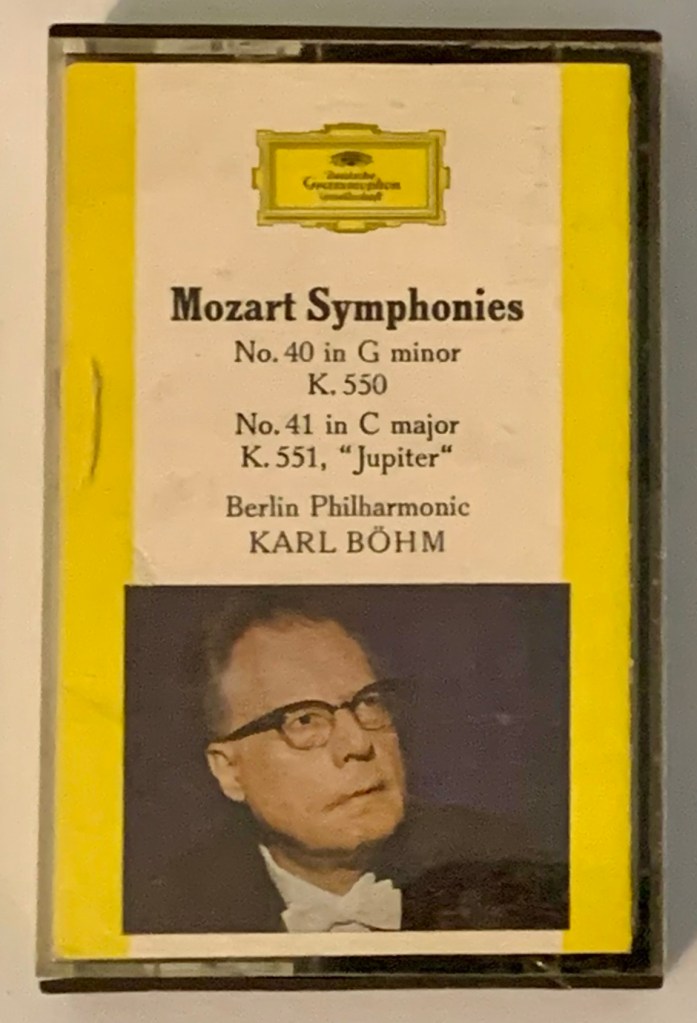
The first piece of recorded music I ever owned was a cassette of Mozart’s 40th and 41st symphonies. I am not sure how I came to be aware of No. 40 (40 was the goal of the acquisition and 41 was merely a bonus B-side for me). I assume I discovered it on local public radio’s classical programming which I listened to regularly as a kid. My parents were not into classical music, this was my own discovery (I will get into my parents’ musical influence on me in a future post).
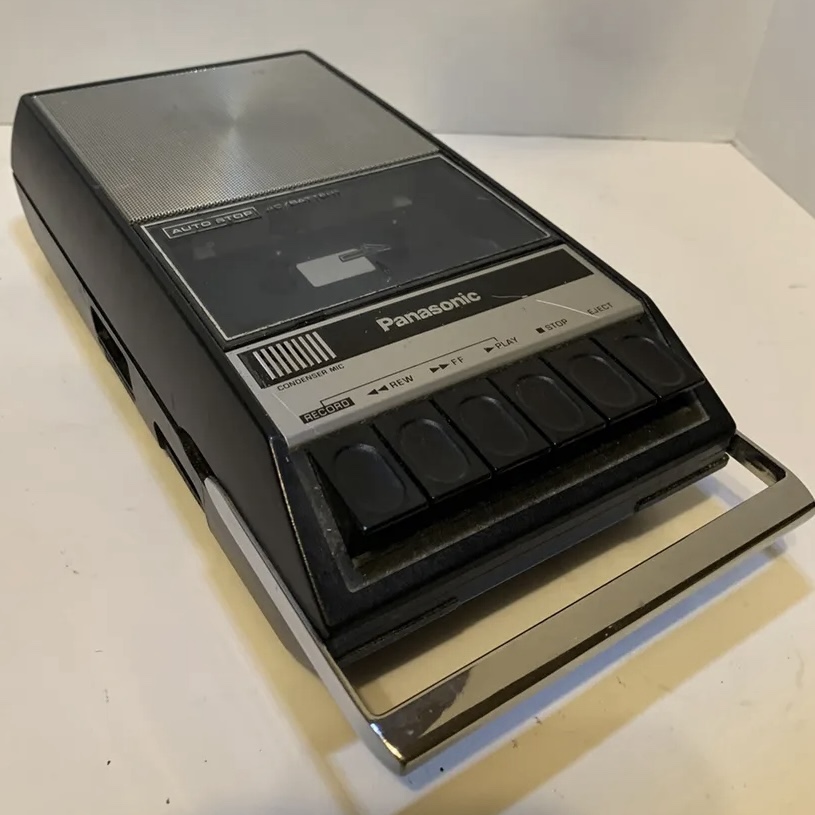
I am unsure when I acquired the cassette, but I would guess around 1968. I had recently received the ubiquitous Panasonic portable cassette player/recorder of the day that looked something like this:
I didn’t have any tapes for this new “toy” so I bought the Mozart tape at Schmidt Music in downtown Minneapolis with my mom (who worked around the corner at the Young Quinlan department store). I was learning to play the flute at the time, and Schmidt was the go-to Minneapolis music store for instruments, sheet music, and classical recordings.
I was not particularly musically sophisticated as a kid, No. 40 just struck a chord in my young mind. I dug the big dynamics (the swells from quiet to loud). I can’t imagine there was great audio quality coming from that small portable device, but I didn’t know any better. The melodies were memorable and hummable. I liked big bands and this was a very big band – an orchestra! Listening to it now it sounds like a stern conversation between an adult and a playful child. It shifted between dark and light. It was moody. It was a long “song” (about a half hour) made up of four parts (movements). It was like a movie. The only other symphony I was aware of was Beethoven’s 5th (which was the symphony most people were aware of). I found the No. 40 way cooler and relished that Beethoven was influenced by No. 40 – Beethoven’s 5th third movement begins with a pitch sequence similar to that of Mozart’s 40th finale.
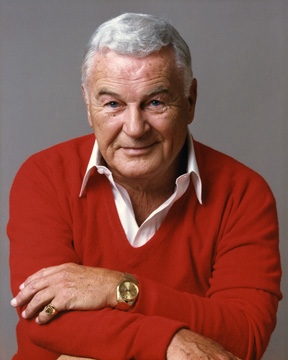
I played that tape over and over and stared at the mysterious man on the cover: Karl Böhm. What was he gazing at? I loved the Deutsche Grammophon logo – it demanded: “Take this music seriously!” I don’t recall owning any additional prerecorded music at the time (I did record stuff off the radio) and so I played this tape to death.
The original acquisition was for No. 40, but what a bonus it was that No. 41 (nicknamed Jupiter) was the B-side. It is the longest and last symphony that Mozart composed. It is regarded by many critics as one of the greatest symphonies in classical music. I fell in love with it too.
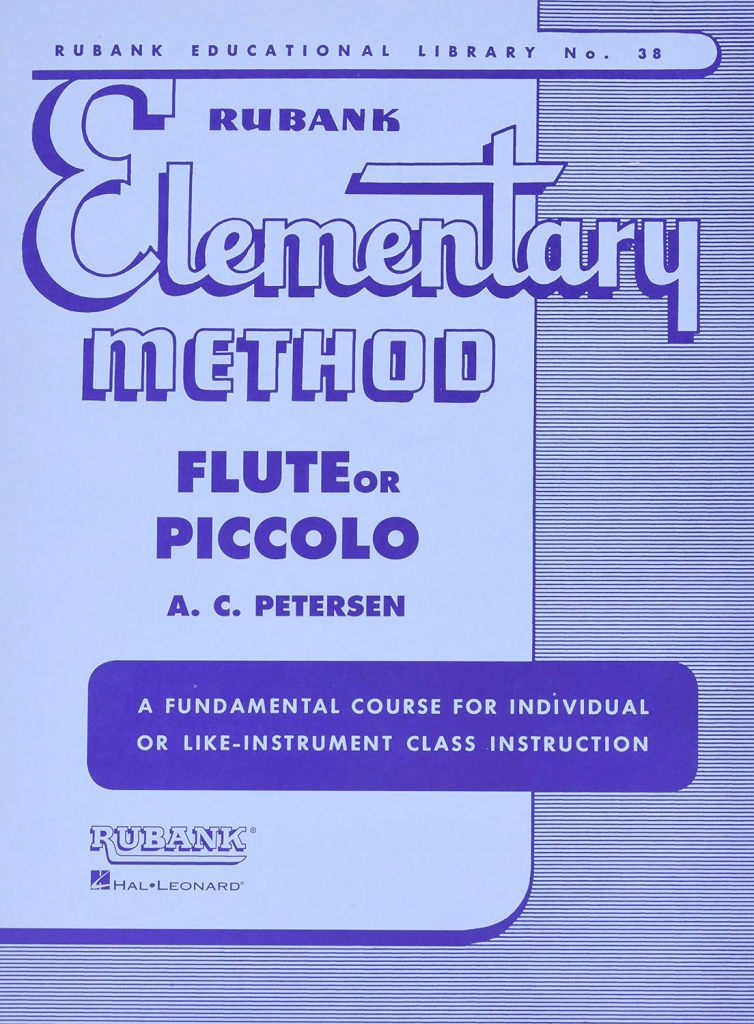
As a kid, I was ambivalent about popular music. I wasn’t a snob, I was genuinely uninterested. I didn’t listen to top-40 radio. However, in the monoculture of the ’60s and ’70s, it was impossible to not know pop tunes. I enjoyed playing popular tunes of the day on the flute (the flute will be another chapter in the memoir). I had a popular music flute songbook and I preferred that to my A.C. Petersen method book (see below) as I could cheat on sight reading with pop songs as I could play them by ear and the sheet music was merely a rough guide. I was mediocre at sight reading, but I had a hell of an ear.
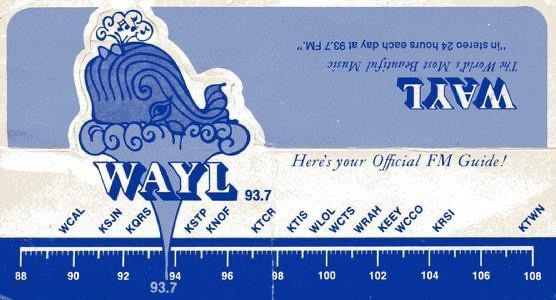
I didn’t think of myself as particularly different from other kids when it came to music even though they were into 7-inch singles of pop hits of the day. I was just attracted to the classical music played on public radio, the elevator music on WAYL (the Twin Cities easy listening radio station), and the big band music played on Hobbs’ House late at night on WCCO (the most powerful and successful radio station in the upper Midwest). It wasn’t until I entered Junior High (1971) that I realized that listening to classical music and playing the flute (as a male) was weird (I also did gymnastics and figure skating).
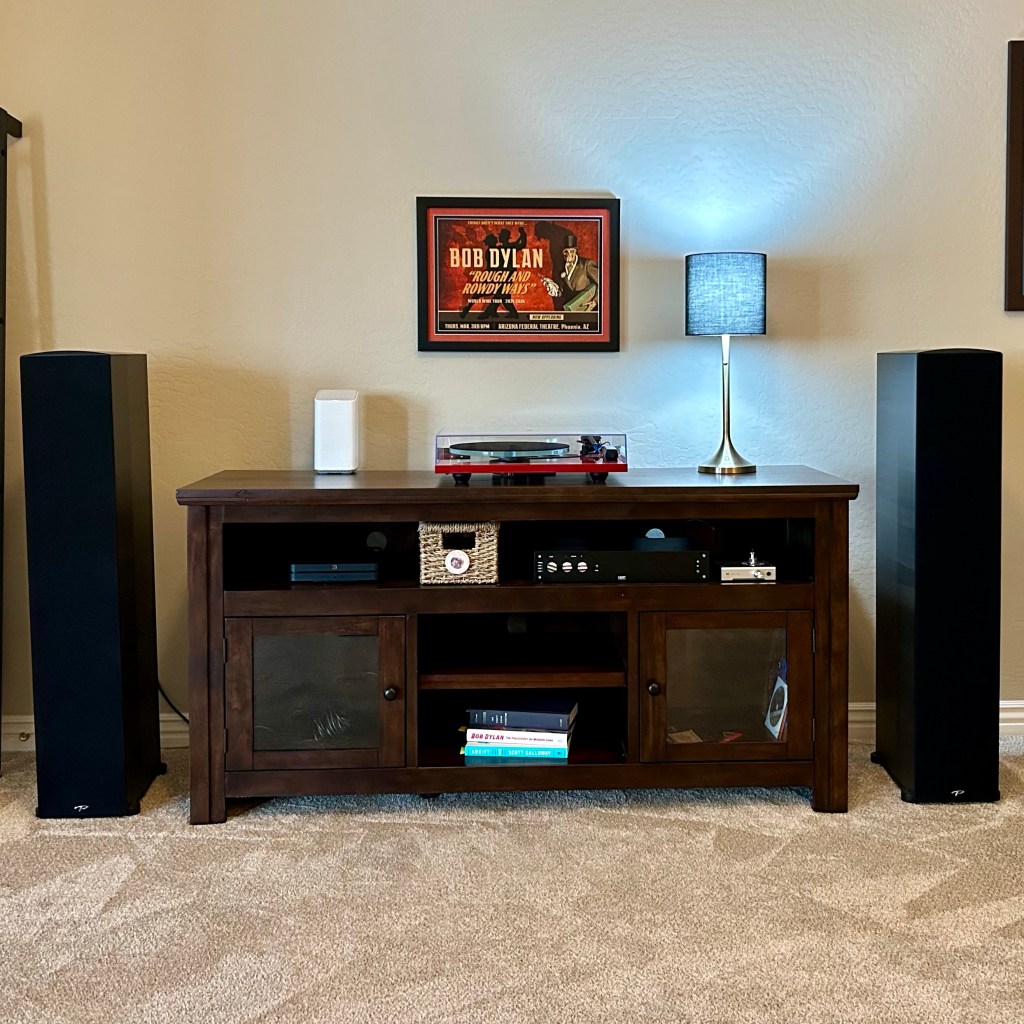
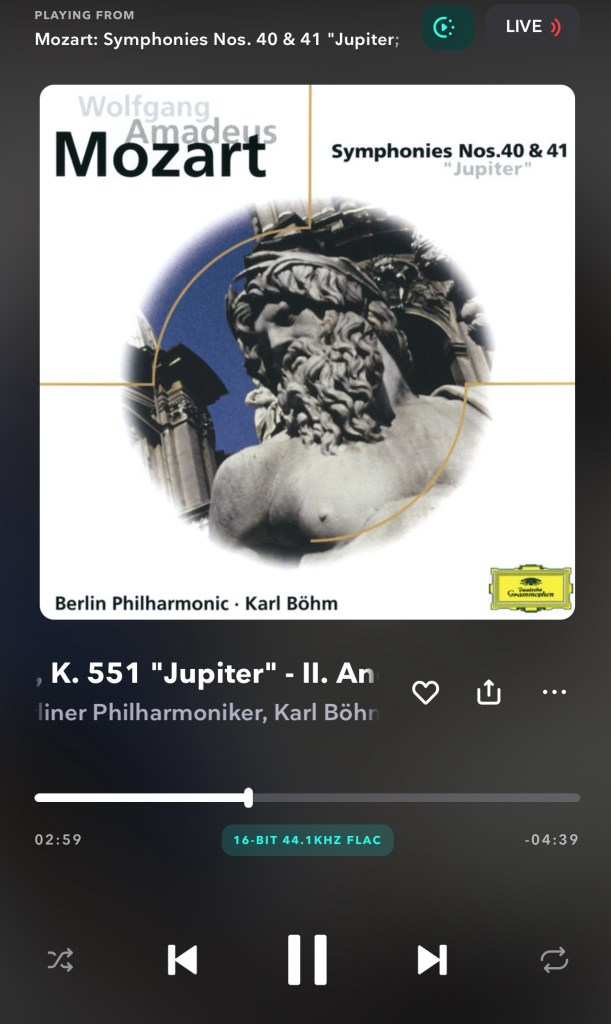
I haven’t listened to the Mozart cassette in probably 50 years, but I found that same recording on streaming services (it is buried in the compilation below on Spotify). Listening to it now via steaming brings back great memories! It still moves me. Playing it LOUD on the big boy stereo (see Desert Sessions rig below) helps too!
If you are interested in hearing my cassette, the same recording is buried in this compilation on Spotify.
My preferred streaming version is on Tidal (CD quality – 16 bit 44.1 kHz FLAC): https://tidal.com/album/4454146
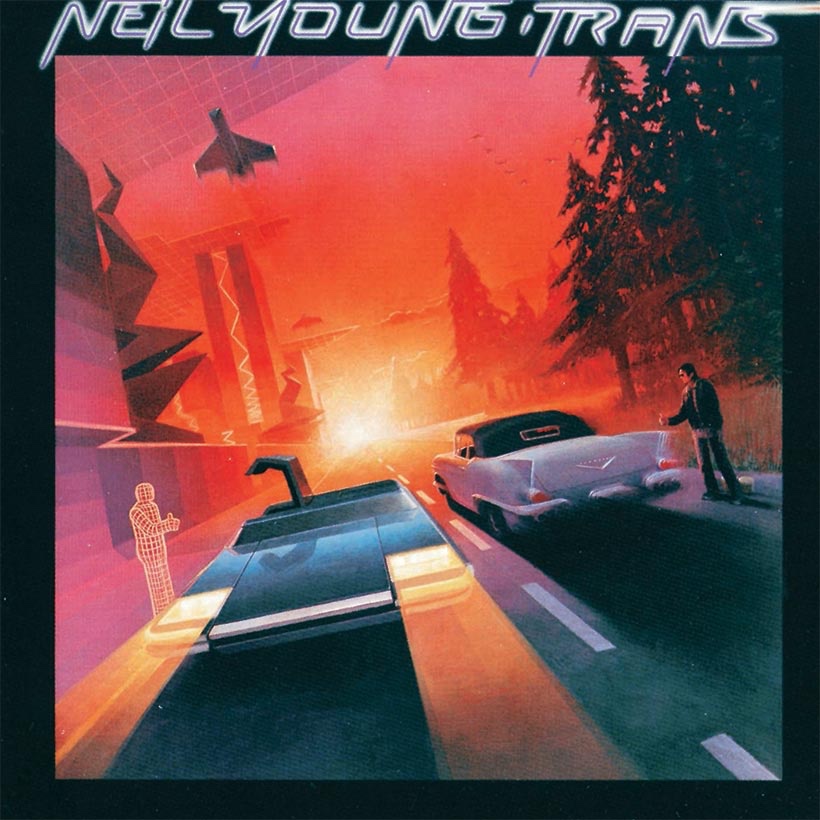
My introduction to Neil Young was 1979’s Rust Never Sleeps. I was a late bloomer to rock and pop and became “experienced” in the fall of 1977 when I entered college. By the time Trans came out in early 1983 I was a serious musichead.
Most of Neil’s fans were baffled by Trans given its electronica stylings. His fans were used to major stylistic shifts in Neil’s career, but going “Kraftwerk” was absolutely baffling to most of his fans. It was greeted with similar negativity as Bob Dylan’s Christian period. I was too Neil Young ignorant to be scandalized by Trans. I liked it from the get-go. It was more fun than Neil’s previous records: Re·ac·tor (1981) and Hawks & Doves (1980) – although with four additional decades of experience with Neil, both of those albums sound better than I remember.
Despite its reputation as an electronica album, it is really not. 3 of 9 songs are typical of Neil (“Like An Inca” is a classic). Even the songs dominated by synths and vocoder would not be mistaken as Kraftwerk songs – Neil’s musical personality shines through even though this is a major stylistic left turn for him. I see it as more of a brilliant experiment. For example, Neil does an imaginative cover of his Buffalo Springfield song “Mr. Soul” that is equal part electronica and Crazy Horse proto-grunge. The album also has my most quoted Neil lyric – due to the sheer silliness of it – “I need a unit to sample and hold.”
The album has a fascinating context. Per Wikipedia:
From late 1980 to mid-1982, Young spent much of his waking hours carrying out a therapy program for his young son, Ben, who was born with cerebral palsy and unable to speak. Neil disclosed to almost no one at the time that he was doing so, or that the repetitive nature of the songs on both the previous album, Re·ac·tor, and this one related to the exercises he was performing with Ben. Work on Trans began in late 1981 as a continuation of Re·ac·tor, with the usual Crazy Horse lineup. But then Young started playing with two new machines he had acquired, a Synclavier and a vocoder. Crazy Horse guitarist Poncho Sampedro recalled, “Next thing we knew, Neil stripped all our music off, overdubbed all this stuff, the vocoder, weird sequencing, and put the synth shit on it.”
I saw the tour that supported Trans, which was billed as a solo show. Neil played solo both acoustic and electric. He played a cross-section of his catalog and some of Trans. The real surprise was the encore – an unannounced appearance by the Shocking Pinks – a novelty rockabilly band complete with gaudy outfits. It was one of the most memorable concerts I have witnessed. The Shocking Pinks gimmick was captured on Everybody’s Rockin’ (also released in 1983).
Trans and Everybody’s Rockin’ resulted in Young’s new label (Geffen) suing him for not being commercial and being “musically uncharacteristic of [his] previous recordings.” The lawsuit backfired and David Geffen personally apologized to Young for the lawsuit and for interference with his work.
Overall I loved the album and it endeared me to Young. It is a gem if you open your mind to the experiment.
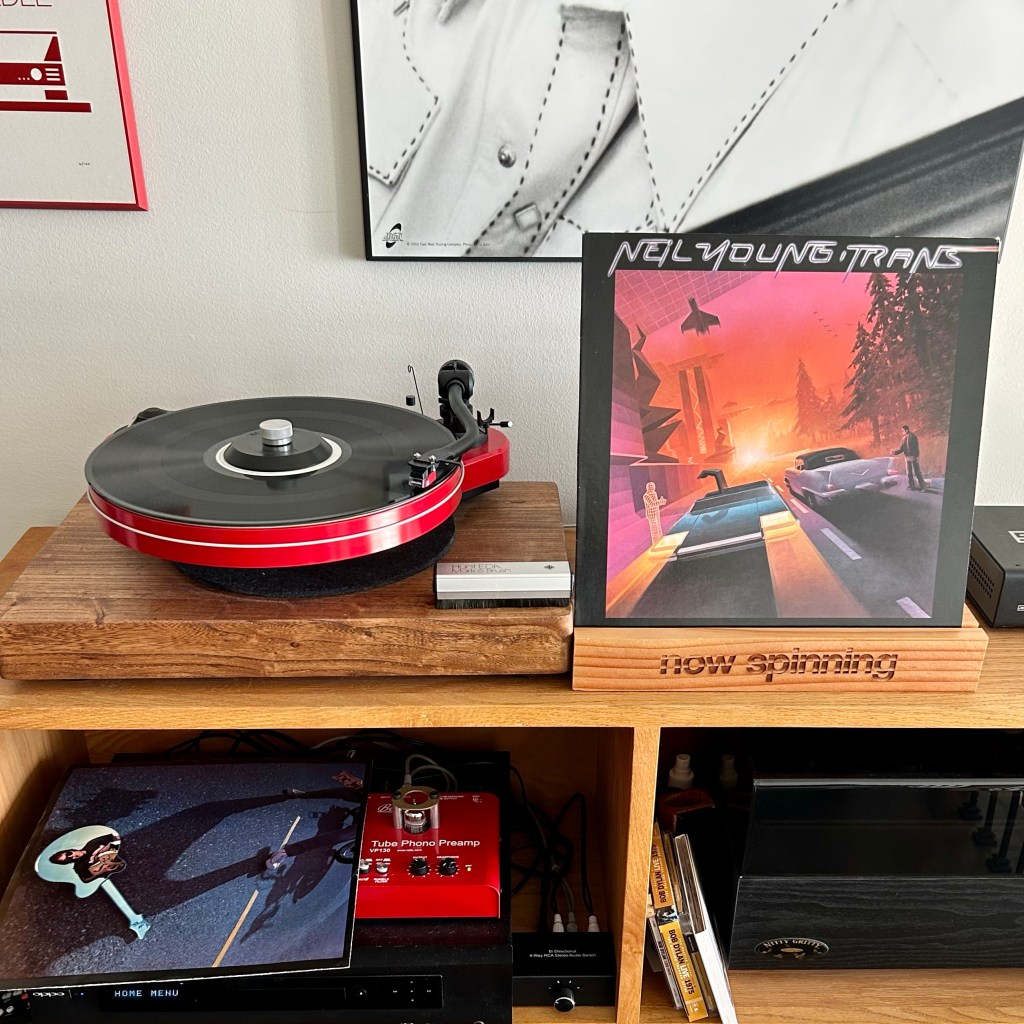
Neil Young is not on Spotify due to his outrage over the podcast The Joe Rogan Experience, which Neil felt was responsible for spreading misinformation about the COVID-19 vaccination. Young’s recordings, including Trans, are available on other streaming platforms.

I was scrolling through Tidal when I came to the “Suggested new albums” section and for some reason, this album caught my attention. I had not heard of Jason Eady. I played it and I was instantly engaged. It reminded me of Tony Joe White, Bonnie Raitt, and J. J. Cale: swampy, funky country, and a bit of the blues.
Eady has a pleasant baritone voice with a little bit of Willie Nelson’s drawl. There are gorgeous slithering guitar riffs, gospelish backup vocals, funky keys, and a wicked groove from the rhythm section. This is a well-executed album. It sounds like a band and not just a singer-songwriter.
Mississippi was produced by Band of Heathens‘ Gordy Quist. I am unfamiliar with Band of Heathens, but this album has piqued my interest. The band is Jason Eady on vocals and acoustic guitar; Dave Jimenez on electric, acoustic, and slide guitars; Trevor Nealon on keyboards and piano; Nick Jay on bass; Clint Simmons on drums; Branden Lewis on trumpet; Courtney Patton and Kelley Mickwee on harmony vocals.
Per Jason’s website:
“Mississippi is an album I’ve been wanting to make for a long time. I’ve always been a lyrics first kind of writer, but this time around it’s all about the sound. Growing up in Mississippi, I was raised around that groove centered music and it’s always been a very big part of what I do. I’ve usually had at least one song on each album that touched on this sound, but this time I went all in. This was a fun album to write because I completely shifted gears and let the music decide what the words were going to be. The words had to fit the music, which is the opposite of my usual process.“
This album is totally about the groove. But that does mean it is lyrically dumb. I haven’t listened to Eady’s music before so I have no idea if this album is representative of his catalog. This is going to be on my favorites of 2023.
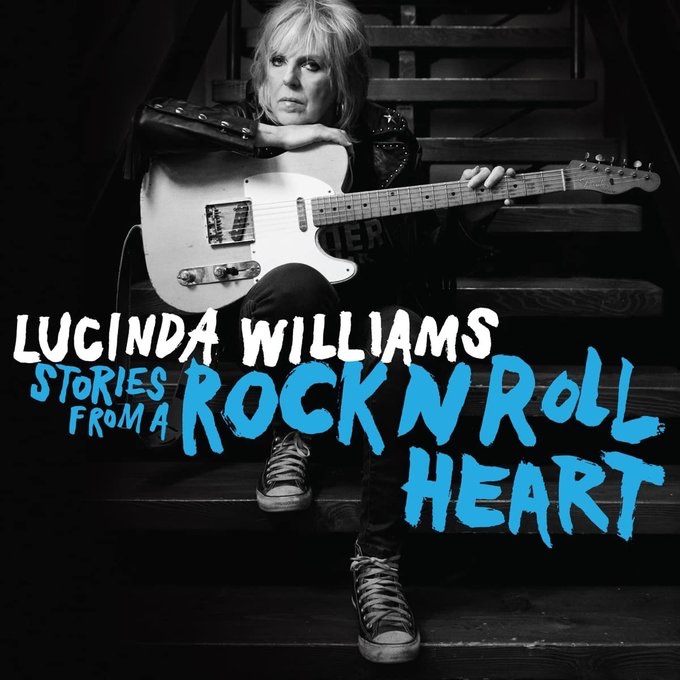
I am a long-time fan of Lucinda Williams. My first taste was her 1988 album on Rough Trade – the self-titled Lucinda Williams. I saw her at 7th Street Entry (Minneapolis) on the tour in support of that album. I have kept up with her recordings over the years and have seen her live several times.
This is Lucinda’s first album since her stroke in 2020. Although the stroke affected her guitar playing, her voice is as strong as ever. She wanted to make a rock & roll album. Lucinda told Rolling Stone magazine:
“I wanted to write more rock & roll songs, à la Tom Petty,” says Williams, who opened for Petty at his final show before his death in 2017. “That’s been a desire of mine, but they’re harder to write. When I sit down with my guitar, I go into ballad mode. That’s from my folk days, I guess.”
Sometimes, as Williams herself says, you just need to rock: “We got through the pandemic. Let’s get back together, have some drinks and stay up all night.”
Rolling Stone
It definitely has a rock & roll vibe, but it still maintains Lucinda’s folk rock/Americana roots.
“Let’s Get The Band Back Together” has a nice loose bar band vibe. Sloppy like the Stones, that is, sloppy in a good way (this sets the tone for the whole album). The guitars and the B3 are so tasty. And my gal Margo Price is on background vocals and tambourine!
On “New York Comeback” in addition to Lucinda’s drawl, you get tight harmonies and call and response from Bruce Springsteen. I love mic drop rhythms like this:
“Before they cut the house lights
Before you walk into the night
Before you head out to last call
For that last stiff highball”
“Last Call For Truth” takes a drinking song and makes it poetic:
“GIVE ME ONE MORE SONG TO SING ALONG TO
GIVE ME ONE MORE DANCE TO HOLD YOU THROUGH
GIVE ME ONE MORE TASTE OF MY LOST YOUTH
AND IT'S LAST CALL FOR THE TRUTH
IT'S LAST CALL FOR THE TRUTH”
“Jukebox” is a tribute to the original streaming device. There used to be really cool curated jukeboxes – they could define an establishment.
“Stolen Moments” is a nice song about a lost lover remembered in those rare quiet moments in a busy life.
Side two opens with “Rock N Roll Heart” with Bruce Springsteen and Patti Scialfa on backup vocals. The song is a tribute to the simple fact that rock n roll can be spiritual and aid in survival. Lucinda sings: “As long as you’ve got a rock n roll heart / It can’t be broken or torn apart.”
On “This Is Not My Town” Lucinda is channeling Patti Smith channeling The Doors. Another great Margo Price background vocal here.
“Hum’s Liquor” is about The Replacements’ Bob Stinson. Stinson is a tragic figure in rock n roll. Hum’s is a liquor store I grew up near in Minneapolis and has its own tragic history. Bob’s little brother and fellow Replacement Tommy sings background.
“Where The Song Will Find Me” is a gorgeous ballad that suggests songs find you vs. you finding the songs. I believe this.
Closing an album is an art form. “Never Gonna Fade Away” is a great way to end an album. It is a triumphant and defiant proclamation, that despite life’s difficulties, the song’s protagonist will survive.
In Stories From A Rock N Roll Heart Lucinda’s lyrics are simple and the music is only rock n roll (but I like it). This might be the strongest vocal performance of her career – she is not fading away.
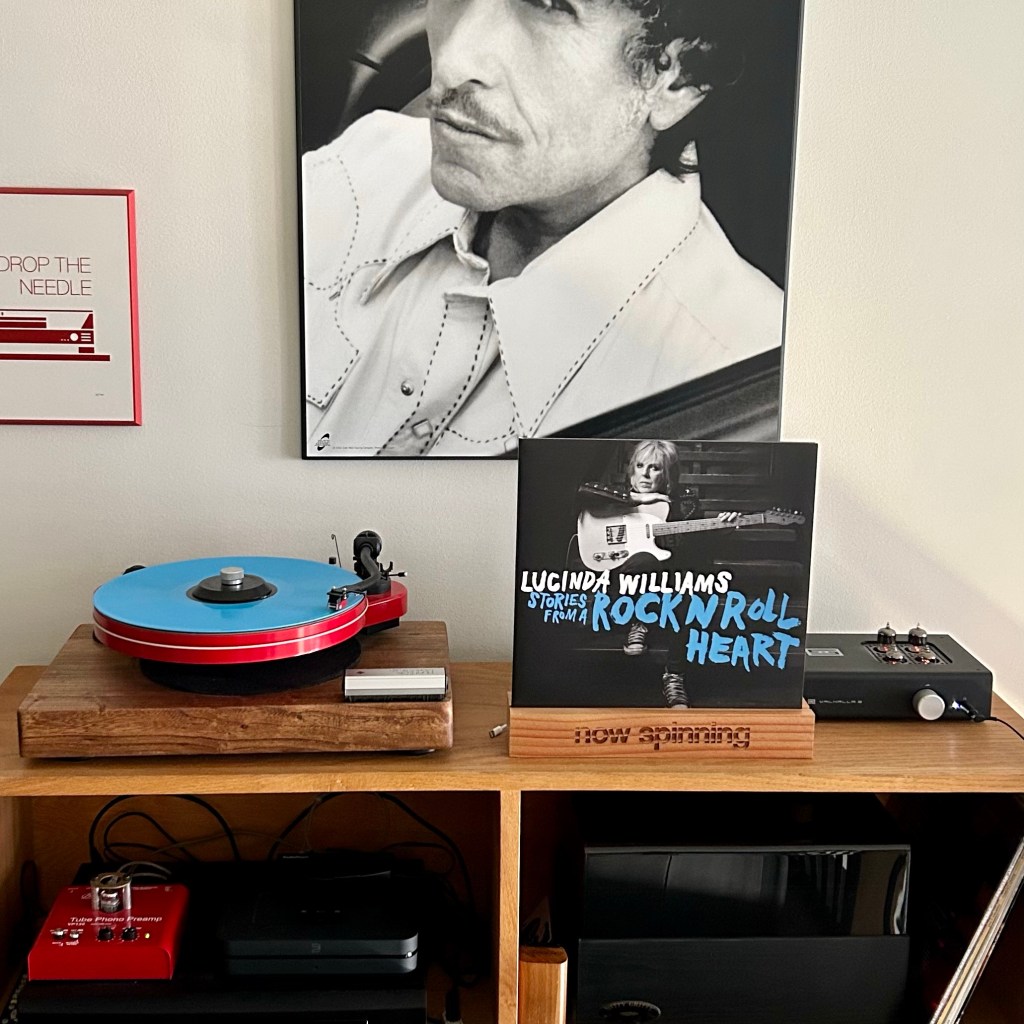
The album is currently not available on streaming services (however four singles are on streaming services). Unclear what her strategy is with this approach when most fans listen via streaming.

 Axl's Catch Groove