
I am a 65-year-old white cisgender male—not precisely in the Beyoncé demographic. But I am also a musichead who likes a broad range of genres (with Americana and singer-songwriters dominating). Of course, I know Beyoncé, and I have listened to many of her songs and liked some of them. I have heard several of her albums (album guy vs. a singles guy), but none has resonated with me; therefore, I have not been a Beyoncé fan (spoiler alert: I am now). I appreciate her as an artist, but she hasn’t clicked with me. The pre-release hype for this album was that it would be her Country album. I listened to the two singles “TEXAS HOLD ‘EM” and “16 CARRIAGES,” and they are Country (ish), and I liked them – enough so that I was motivated to listen to COWBOY CARTER the moment it was released (9:00 MST on March 28, 2024 – one of the benefits of living in Phoenix is I get to hear new releases “early”). On first listen, a Beyoncé album resonated with me for the first time. COWBOY CARTER has been in constant rotation since, and with each listen, I like it even more and have become obsessed with trying to figure it out. In his review, New York Times music critic Jon Pareles points out that Beyoncé albums are “meant to be discussed and footnoted, not just listened to.” That is precisely what I find myself doing.
As much as I love the album, I also recognize it as a hodgepodge. It feels like Bey is showing off: “Look at all the genres I can do and how profound I can be!” Then it hits me, Bey is pissed at the music industry. Despite all her success, she is underrated. Consider Jay-Z’s recent speech at the Grammys, where he calls them out for slighting his wife: “I don’t want to embarrass this young lady, but she has more Grammys than anyone and has never won album of the year. So even by your own metrics, that doesn’t work.” So Bey has made an album for guys like me and the old white guys who vote for the Grammys (and anyone else who has not accepted her genius): “Here you go, assholes, try to dismiss this.” COWBOY CARTER is like how Taylor Swift’s folklore opened my ears to her music by working in a style in my comfort zone (in TSwift’s case, Americana). Beyoncé is playing in a place closer to my neighborhood (Country, rock, folk, Americana, old school R&B, etc.), something an old white musichead can understand. I can’t dismiss COWBOY CARTER; it is brilliant; it is the gateway drug for people like me. This is just what I needed to become a Beyoncé fan.
So, on to the music, let’s start with the teaser singles and then move on to the rest of the album.
“TEXAS HOLD ‘EM” is what I would expect in a Beyoncé Country song: sassy, danceable, twangy guitar and banjo (courtesy of Rhiannon Giddens), and most importantly, a banger. It is Queen Bey’s version of a hoedown: “Furs, spurs, boots.” This is a great first single and could be the song we remember from this album a decade from now (but there are several other candidates, too). “16 CARRIAGES” is a different beast; it is a serious song where Bey contemplates the sacrifices of being a mega pop star for a quarter of a century. I assume the 16 carriages refers to the semis associated with an arena concert. I wonder if she chose 16 to reference the Junior Parker/Elvis song “Mystery Train” (“Train I ride, sixteen coaches long”). Sonically, it is adventurous and a more challenging listen than the pure fun of “TEXAS HOLD ‘EM.” It suggests the new album is not a novelty but a big statement. It sounds better in the context of the album. The two singles accurately foreshadow COWBOY CARTER: it is fun but also a huge artistic statement. Bey has met me at a place where I can more than intellectually appreciate her; I can now enter the BeyHive as a fan.
After signaling that COWBOY CARTER would be a Country album (including the two teaser singles), she does a bait-and-switch and says, “This isn’t a country album. This is a ‘Beyoncé’ album.” It has Country elements, but it is more in the tradition of a singer-songwriter album (ironic given that Bey creates more like a movie director, that is, collaboratively, vs. the typical solitary methods of singer-songwriters). It is also genre-diverse, and Beyoncé puts on a clinic of her magnificent voice performed in several styles (Country, pop, hip-hop, rock, folk-rock, and even opera) – it is like there are ten different vocalists on the album.
“AMERICAN REQUIEM” opens as a solemn hymn with a riff that reminds me of Buffalo Springfield’s “For What It’s Worth.” Lyrically, Bey is claiming her right to the Country genre by alluding to her controversial performance of “Daddy Lessons” with the Dixie Chicks at the 2016 Country Music Awards. She was criticized by Country fans who found issues with her liberal politics and lack of Country cred.
“It’s a lot of talkin’ goin’ on
While I sing my song
Can you hear me?
I said, ‘Do you hear me?'”
“BACKBIIRD” A great example of Beyoncé’s genius on COUNTRY CARTER is covering the Beatles’ (more specifically, McCartney’s) “Blackbird.” In the past, McCartney has said that the lyrics were inspired by hearing the call of a blackbird in India and racial tension in the Southern United States. The lyric: “you were only waiting for this moment to arise” is about black people’s struggle in the US. In 2018, McCartney elaborated on the song’s meaning, explaining that “Blackbird” should be interpreted as “black girl” (“bird” is a British term, similar to the American term “chick” for girls/women) in the context of the civil rights troubles in southern 1960s US, specifically the Little Rock Nine. Beyoncé uses the song to point out the struggle of black women (blackbirds) in Country music – a genre black people helped invent. To emphasize her point, she is joined on the track by four contemporary “blackbirds” of Nashville: Tanner Adell, Brittney Spencer, Reyna Roberts, and Tiera Kennedy. It is a relatively straight cover of the Beatles classic, but the fact that Bey and black Nashville artists are performing it is Bey’s demand for women of color to get their “moment to arise” in Country music.
“PROTECTOR” opens up with Carter’s daughter, Rumi, asking her mom to play the lullaby, and Mom obliges. The song is a gorgeous Country ballad. The arrangement is acoustic guitar-focused with a dash of Gary Clark Jr.’s slide guitar. Lyrically, it is a mom’s pledge to protect their child.
“MY ROSE” is a Beyoncé choir (Bey overdubbing herself – an old Joni trick). It is a short song about accepting your and others’ beauty.
“SMOKE HOUR ★ WILLIE NELSON” is a hip-hop skit featuring Willie introducing “TEXAS HOLD ‘EM.” But first, there is the spinning of an imaginary radio dial where we hear snippets of Son House’s “Grinnin’ in Your Face,” Sister Rosetta Tharpe’s “Down by the Riverside,” Chuck Berry’s “Maybelline”, and Roy Hamilton’s “Don’t Let Go.” Then Willie instructs us to spark one up and enjoy “TEXAS HOLD ‘EM.”
“BODYGUARD” is one of my favorite tracks on the album. It has a sexy lilt and is neither Country nor R&B, but closer to Stealy Dan with better vocals, that is pop jazz. This is the Raphael Saadiq show – he rocks the house with his funky bass, guitar, and production. I love Lemar Carter’s Motownish drums – man, can he create a groove.
“DOLLY P/JOLENE” – Dolly throws Bey a soft pitch that Bey hits out of the park. This is not a reverent cover; Bey changes the album’s mood from Dolly’s resignation to defiance. There are even some lyric changes like: “Jolene, I know I’m a queen, Jolene/I’m still a Creole banshe bitch from Louisiane (Don’t try me).” Yup, don’t mess with QueenBey!
“DAUGHTER” is not about the narrator’s daughter but the narrator as the daughter of her father. Bey’s vocals and arrangement reminded me of Joan Baez. At the bridge, she becomes an opera singer and performs the famous opera aria “Caro Mio Ben,” a song about loneliness due to the absence of a loved one. The aria’s message is in stark contrast to the narrator’s violent mood toward their lover’s infidelity.
“SPAGHETTII” Bey presents a witness, Linda Martell, the first Black female artist to join the Grand Ole Opry, who says in the spoken word section of “SPAGHETTII”: “Genres are a funny little concept, aren’t they? In theory, they have a simple definition that’s easy to understand, but in practice, well, some may feel confined.” Bey doesn’t feel confined and proceeds to rap, contrasting with the rest of the album’s predominantly Country, pop, and R&B styles. I assume “spaghetti” refers to “Spaghetti Westerns,” genre busters like Bey.
“ALIIGATOR TEAR” sonically has a singer-songwriter vibe, a cross between Laura Marling and Sheryl Crow. The song suggests that some of her accolades, for example, her many Grammys, are unctuousness (alligator tears). I love The-Dream’s (Terius Adamu Ya Gesteelde-Diamant) production.
“SMOKE HOUR II” is another Willie Nelson spoken word interlude. This time Willie is giving his full endorsement of Beyoncé genre jumping “…if there’s one thing you can take away from my set today, let it be this: sometimes you don’t know what you like until someone you trust turns you on to some real good shit. And that, ladies and gentlemen, is why I’m here.”
“JUST FOR FUN” (with Willie Jones) is a lovely modern country rock tune with a heavy dose of gospel produced by Dave Hamelin (The Stills). I have never heard of Willie Jones – he kills it with his sweet country voice. It turns out that Willie is an X Factor kid. Pretty low on the totem pole – this is one hell of a bump. It is refreshing that Bey ultimately does this music thing for fun:
“I’m goin’ all out just for fun, I am the man, I know it
And everywhere I go, they know my name
So I laugh and I lie and the coyotes cry
And, uh, time moves quickly and so do I, so do I
So I’ll say my goodbye”
“II MOST WANTED” (with Miley Cyrus) is a jam! These two are perfect duet partners. They are both distinctively different singers, but they are both divas. The song sounds like an interpolation of Fleetwood Mac’s “Landslide.” Googling this song, it appears it is a tribute to Beyoncé’s mother-in-law, Gloria Carter, and her wife, Roxanne Wiltshire. Love these lyrics:
“I’ll be your shotgun rider
‘Til the day I, ’til the day I die”
This should be a massive hit on Country Radio, or the world is wrong. I would love for Lady Gaga and someone like Annie Lenox to cover this.
“LEVII’S JEANS” (with Post Malone) is a trashy Country song with modern R&B production values. I love it!
“Boy, I’ll let you be my Levi’s jeans
So you can hug that ass all day long”
Tacky but damn clever. Post Malone is a perfect cameo with his rap-singing. Tip of the hat to Nile Rogers for the funky folk guitar riff.
“FLAMENCO” is a short song that has a Joni Mitchell vibe: vocally, the arrangement, and lyrically (“Realize that you don’t know what you got until it’s gone”).
“THE LINDA MARTELL SHOW” is a spoken word interlude where Martell introduces the wildest song on the album. “YA YA” has a lot going on – this is the most over-the-top track on the album – lyrically and in the arrangement. It is a brilliant pop cocktail of 60s pop (“These Boots Are Made for Walkin’” and “Good Vibrations”), Tina Turner, James Brown, Little Richard, and Elvis. Bey is resurrecting the Chitlin Circuit and reminding us of the genius of that juxtapositioned with the whitest of pop music from the 60s, which coexisted with Motown and Stax. It is, without exaggeration, a tour de force. I hope it is a huge hit.
“OH LOUISIANA” is a cover/sample of a Chuck Berry song. It is a brief tribute to Bey’s Louisiana Creole heritage. It is also the second time she invokes Berry, who supercharged Country music to help create Rock ‘n Roll.
“DESERT EAGLE” is a short funk jam with a prominent bass riff. The song is sexual (desert eagle is a sex position).
“RIIVERDANCE” is an Irish dance tune performed over a rhythm of Dolly-inspired nail percussion. The dance feels like an analogy of the excitement of love.
“II HANDS II HEAVEN” is the kind of pop and hip hop I equate with Beyoncé. Lyrically, I am not sure what is going on here, but Bey’s vocals are outstanding.
“TYRANT” (with Dolly Parton)—beyond the intro, this is barely Dolly. Again, she is working in the pop/hip-hop genre. She uses the term “tyrant” to describe her power, especially her sexual power.
“SWEET ★ HONEY ★ BUCKIIN’ (with Shaboozey)” is three songs. The “SWEET” section opens with a hip-hop Patsy Cline interpolation, then goes into a Shaboozey rap. This first section focuses on how far black folks have come: “We’ve come a long way from the rough ride from the railroads to the rodeos, sweet country home.” In the “HONEY” section, Bey is joined by Pharrell Williams. It has a 60’s girl group feel and is about making love. The “BUCKIIN” section also includes Pharrell and has a hip-hop feel. This section means she is “bucking” trends and will do what Bey will do.
“AMEN” ends the album with a song that echoes the opening track. It is a hymn that brilliantly concludes the album:
“This house was built with blood and bone
And it crumbled, yes, it crumbled
The statues they made were beautiful
But they were lies of stone, they werе lies of stone
Trumpets blarе with silent sound
I need to make you proud
Tell me, can you hear me now?”
Beyoncé has delivered an impressive piece of art. It is a history lesson on how the black (and female) experience has been significant in developing Country music and other “white” pop forms. Despite demanding to be taken seriously, the album is fun. I am embarrassed as a musichead that I did not understand what a significant talent Beyoncé is. Her vocals are insane – it is like several vocalists are on the album. The juxtapositions are a bit messy, but I am okay with that, I like the variety. This is the most sophisticated pop I have heard in a long time.

I have been a Norah Jones fan since February 26, 2002. I know that specific date because I had read the pre-release promo back in the day, and based on what I read, I was confident enough to buy her debut album on CD on release day without hearing it first. It was love at first sight (actually, at first listen). I was not alone: Come Away with Me sold over 27 million copies.
Over the next 22 years, Norah did not release a bad album, however, there have been some albums that didn’t grip me. Good news: Visions grips me. Anytime Norah wants to get a little weird, I am all in – Visions is a little weird (adventurous) in the retro funky soul grooves it explores.
The collaboration of Norah and Leon Michels is inspired. Michels is the album’s producer, cowriter, and backup musician (he is a multi-instrumentalist). His claim to fame is he played saxophone in Sharon Jones & The Dap-Kings and has performed with Lee Fields & The Expressions, Dan Auerbach’s band The Arcs, Menahan Street Band, and his own project El Michels Affair. Michels and Jones first collaborated on the single “Can You Believe” and later worked together on Jones’ 2021 holiday album I Dream of Christmas (which I have never listened to – I will now based on Visions).

Per the Visions pre-release promo, Norah said: “The reason I called the album Visions is because a lot of the ideas came in the middle of the night or in that moment right before sleep, and ‘Running’ was one of them where you’re half asleep and kind of jolted awake. We did most of the songs in the same way where I was at the piano or on guitar and Leon was playing drums and we were just jamming on stuff. I like the rawness between me and Leon, the way it sounds kind of garage-y but also kind of soulful, because that’s where he’s coming from, but also not overly perfected.”
Here are some track-by-track comments:
“All This Time” (Jones/Michels) opens the album and wow what a sexy song! I could imagine a 70s soul/R&B male vocal group doing this, for example, the O’Jays or The Stylistics. Love these lyrics:
“All this time, I think of you
I think of you
Stay with me, I’ll make it easy”
“Staring at the Wall” (Jones/Michels) sounds like an indie version of Bonnie Raitt and I can imagine Bonnie covering it in a blues-rock style. Norah’s guitar playing has advanced to the point that it rivals her piano playing. It is nice to have this guitar edge as part of her palate.
“Paradise” (Jones/Michels) was the teaser single released a couple of months before the album. It is girl-group splendor – like The Supremes. Norah has developed amazing self-backup vocals (what Joni used to do). Lyrically it is a complex romance – exes back together, it’s hot, but it can’t continue:
“I watch you fall
I try to stop
Waiting for the pain to drop
I know I’ve got to let you go again
Although I never wanted this to end
I know it’s time to let you go”
“Queen Of The Sea” (Jones) – Norah has really developed as a songwriter and singer and this song showcases that. This is a guitar-based arrangement with more amazing self-backup vocals and wonderful horns. The song has a country music vibe. Again her fretwork is so cool – it is minimalistic but groovy AF. This could be a Lucinda Williams’ song.
“Oh, you made a mess out of me
But I’m finally free, ooh
Oh, you made a mess out of me
But I’m finally free
Ooh, oh, ooh”The “Ooh, oh, ooh” almost sounds like “boo-hoo” which is lyrically appropriate.
“Visions” (Jones) is a mournful deconstructed Mariachi/country song with a gorgeous rich vocal.
“Running” (Jones/Michels) sounds like Roxy Music, but with female vocals and point of view. I like the bass (wow Norah you have come a long way from just tinkling keys on a piano) and baritone sax courtesy of Michels.
“I Just Wanna Dance” (Jones/Michels/Steinweiss) sounds late at night. The song has a nice retro soul feel with outstanding horns (assume that is the Steinweiss influence). Norah’s keyboards have a Billy Preston vibe.
“I’m Awake” (Jones) has an empowering lyric. It has a funky keyboard, like something Stevie might do. A little bit of an Al Green (arrangement) and Diana Ross (vocals) vibe too.
“Swept Up in the Night” (Jones/Michels) has some Joni in the arrangements. Again some nice horns.
“On My Way” (Jones/Remm) Pete Remm is Norah’s husband and father of their children, so not surprisingly this is a lullaby.
“Alone with My Thoughts” (Jones/Michels) starts as a mournful piano ballad. The arrangement gets fuller as the song progresses – again great use of horns.
“That’s Life”(Jones/Michels) is jazzy, but schmaltzy, in a good way. It is a nice long goodbye to end the album.
Overall Norah has advanced on several fronts. I assume the pandemic gave her a chance to really woodshed. Her vocals are the most adventurous and satisfying in her catalog. As mentioned earlier her guitar playing now rivals her piano. Her songwriting is strong. The arrangements are loose but serve the songs (however I am not feeling the birds in some of the arrangements). Michels is a strong musician-producer presence – which I like because Norah is a musician’s musician and consummate collaborator. This is my favorite Norah Jones record since Little Broken Hearts (2012) – also an album with a strong producer presence (Danger Mouse). This will clearly be my “best of 2024” list.
I am a little disappointed in the quality of the vinyl, it does not live up to the usual Blue Note standards in that is a little noisy. I did go with the indie record store Orange Blend version – I may need to skip these pretty vinyl records in favor of the old reliable: black. The 24-bit/96 kHz FLAC on streaming sounds fantastic.

I am a long-time fan of The Black Crowes and the Robinson brothers’ various side projects. I was disappointed that Chris and Rich could not find a way to get along to keep their rock ‘n roll train rolling. Right before the pandemic, the brothers mended fences to cash in on the 20th anniversary of their brilliant debut Shake Your Money Maker (1989). That tour, like everything, got paused due to Covid. The tour got going once the world opened up and in 2022 they released an EP of covers inspired by the year 1972. Hopefully, new music was on the way. The brothers have continued to get along: there is more touring and now a new album: Happiness Bastards.
The new album sounds great. They have taken a deep inhale of the Stones, Faces, AC/DC, and Aerosmith and exhaled a cloud of their unique brand of country-fried jam band boogie swagger. It is great to have them back. Nothing new here, but that is ok with me – just finely crafted rock ’n roll (although the collaboration with Lainey Wilson is a nice new spice).
They have taken a deep inhale of the Stones, Faces, AC/DC, and Aerosmith and exhaled a cloud of their unique brand of country-fried jam band boogie swagger.
Here are some track-by-track thoughts:
“Bedside Manners” – Blasts off with classic Crowes’ swagger.
“Rats and Clowns” – Has an AC/DC groove that makes you want to wiggle.
“Cross Your Fingers” – opens with a gorgeous acoustic intro. Chris’ vocals are tender. Then it blasts off with a Led Zepplin-like swagger.
“Wanting and Waiting” was the teaser single back in January and it signaled the boys were back. A bit of an AC/DC groove but clearly with a Crowes’ twist. It rocks! The organ is insane.
“Wilted Rose” (featuring Lainey Wilson)- Happiness Bastards is produced by Jay Joyce who also produces Wilson. I listened to a Chris Robinison podcast and the collaboration with Wilson seemed pretty organic and not clickbait. Wilson’s contribution is perfect – a nice spice to the meal, without overshadowing it.
“Bleed It Dry” has an opening riff that would make Keef proud and Chris’ vocal move like Jagger’s.
“Dirty Cold Sun” is some more Stonesy greaze – tightly sloppy.
“Flesh Wound” – has a fun pop-punk vibe that shows early influences were as much indie rock as classic rock.
“Follow the Moon” has a wonderful classic rock intro – look out riff-master Joe Walsh!
“Kindred Friend” closes the album on a gentle note. This is a gorgeous acoustic-based ballad with a Joe Walsh inflection to Chris’ voice
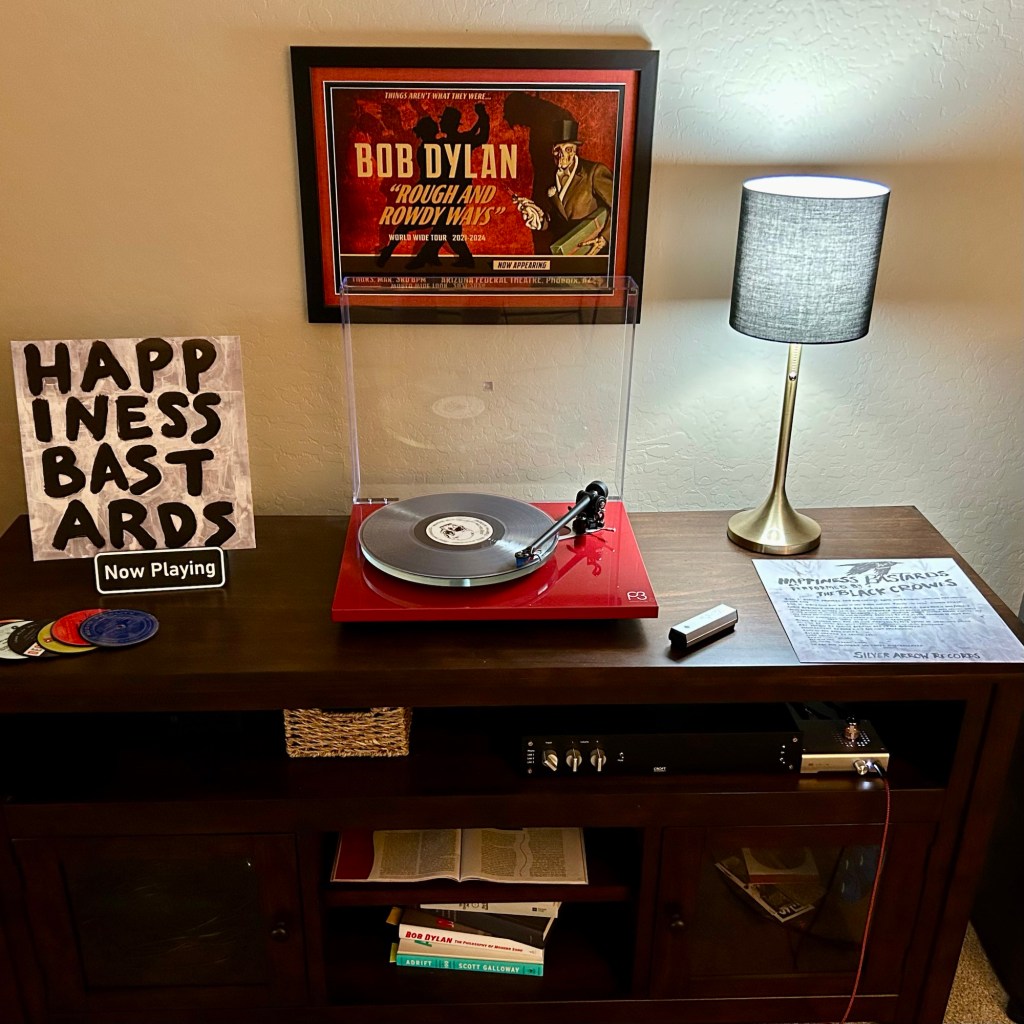
Overall – Happiness Bastards is not a pivot or reinvention – just more of the Crowes’ brilliant craftsmanship. Maybe that is why the cover art is a semi-transparent whitewashing of The Southern Harmony and Musical Companion (my vote for the best in their catalog) album with the album title sloppily scrawled on it (the black cover is a similar concept to Shake Your Money Maker).
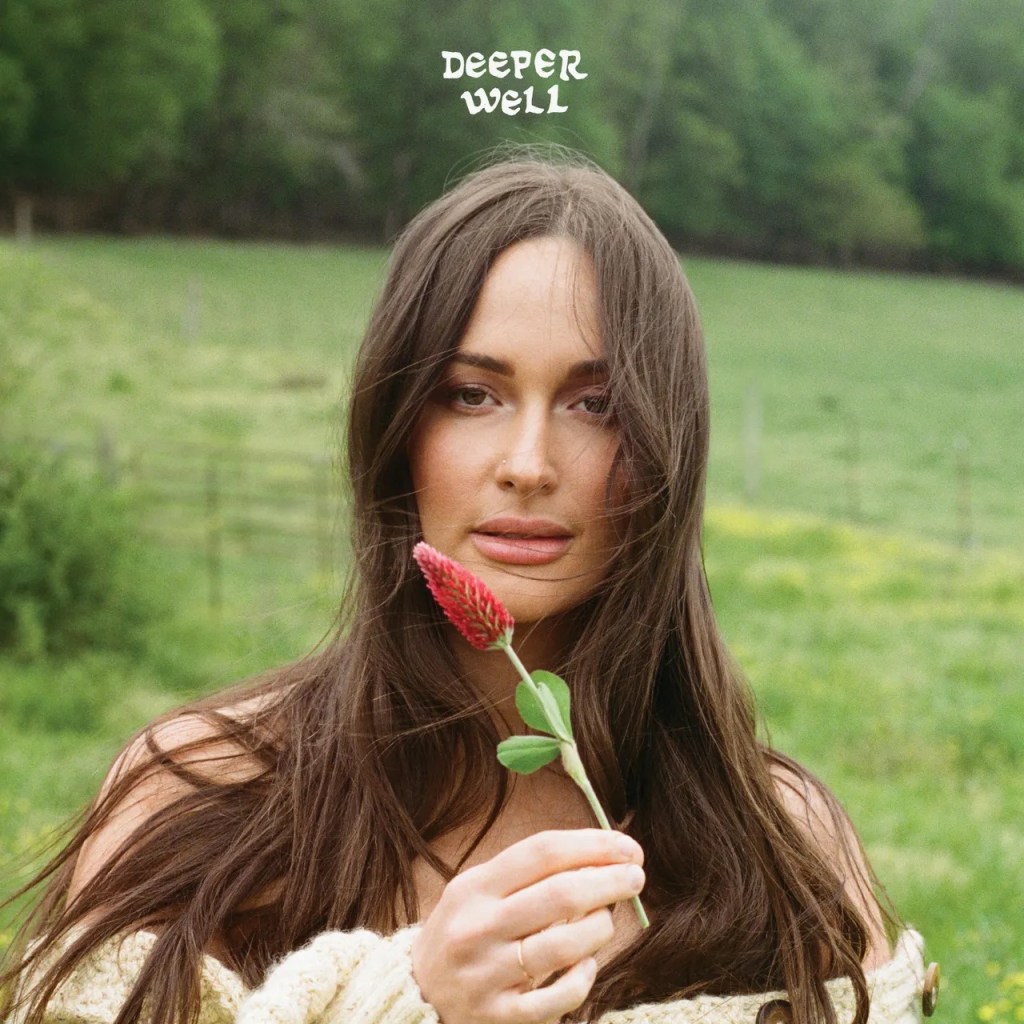
I have been looking forward to the new Kacey Musgraves album since the lead single “Deeper Well” was released in early February – it signaled Kacey was back. 2021’s star-crossed never resonated with me, and I was hungry for a return to Golden Hour (2018) form. The One Lo ve movie-inspired Bob Marley cover “Three Little Birds,” released in January, caught my attention too. Unfortunately, Kacey and her team wasted money on a teaser commercial at the Grammys. It got totally lost when Taylor Swift mic dropped that her new album, The Tortured Poet’s Department, is coming on April 19. But now that it is here, I happily declare that Deeper Well is an excellent album.
Like Golden Hour, Deeper Well has a luscious production. However, this is not Golden Hour Vol. 2, as Deeper Well has its own aesthetics. Kacey sings slightly differently: more pop but still with a singer-songwriter vibe (and, when appropriate, a little twang). The lyrics are direct and have a world-weary, smart-ass attitude, but somehow optimistic.
…lyrics are direct with a world-weary smart-ass attitude
“Cardinal” opens the album with a baroque folk-rock intro—like a Byrds’ song. The music has a sad and wistful sound. Lyrically, Musgraves explores the old trope that a cardinal (bird) is a messenger from someone who has died. The narrator tries to decipher the message from the bird. No conclusions are made, just guesses. It is a beautiful start to the album.
“Deeper Well” is a gorgeous single, and if this was the only bright star on this album, this album cycle would be a success. Fortunately, this is just one of several great songs on the album. Again, Kacey is exploring a Bryds-like sound. Lyrically, the narrator is doing some weighty introspection: failed relationships, drugs have become too important, sycophants, etc. All these things need to be left behind and instead focus on a “deeper well.” In an interview, Kacey explains the deeper well metaphor:
“”Deeper Well’ cuts to the core of the human experience for those that are wanting to experience a deep relationship with themselves and also other humans that are existing. The older I get, the more I realize that if you don’t know yourself and you don’t have a deep relationship with yourself, you’re not going to have that with anybody else.”
“Too Good to Be True” – I love good songwriting that puts a twist on a cliche. Kacey delivers a brilliant twist on the “too good to be true” cliche:
“Be good to me and I’ll be good to you
But please don’t be too good to be true”
“Moving Out” is a song that remembers a house that two ex-lovers shared.
“Giver / Taker” is the most conventionally country song on the album, yet it reminds me of a combination of Dylan and Beck.
“Sway” has a country vibe with a Bon Iver(ish) ending. It has a simple message: don’t get uptight, and learn to go with the flow:
“I’ll sway (Yeah, oh yeah)
Like a palm tree in the wind”
“Dinner With Friends” is a ditty that examines romance.
“Heart of the Woods” has an indie rock/Americana feel to the music. Lyrically, this song is more opaque than the rest of the album.
“Jade Green” has Nick Drake vibes, but it also, musically, evokes Chris Isaak’s 1989 hit “Wicked Game.”
“The Architect” is a clever musing on the existence of god via a gorgeous jangling folk arrangement.
“Lonely Millionaire” is a pretty pop ballad with Kacey’s take on “money can’t buy you love.”
“Heaven Is” has a Celtic folk song feel. Lyrically, it points out the simple things that make it great.
“Anime Eyes” is the album’s most elaborate and experimental arrangement. It has a superb crescendo.
“Nothing to Be Scared Of” is a plea to a lover to open their heart and lose their life’s baggage:
“Come to me, and drop your bags
And I’ll help you unpack them
You’re the only one I want to give my love
There’s nothing to be scared of”
This album will burnish Kacey’s reputation as a singer-songwriter and recording artist. The songwriting is simple and direct, and the music/arrangements perfectly augment the lyrics. One odd feature is that many of the songs just end. Kacey could have done a better job sticking the landing on some of these songs. Golden Hour was a huge step forward, moving Kacey from an up-and-coming country star to a brilliant pop singer-songwriter. Deeper Well is evidence that Golden Hour was not a fluke and Kacey is for real.
My introduction to the album was the 24-bit/44.1 kHz FLAC stream on Tidal, and the sonics are like butter.
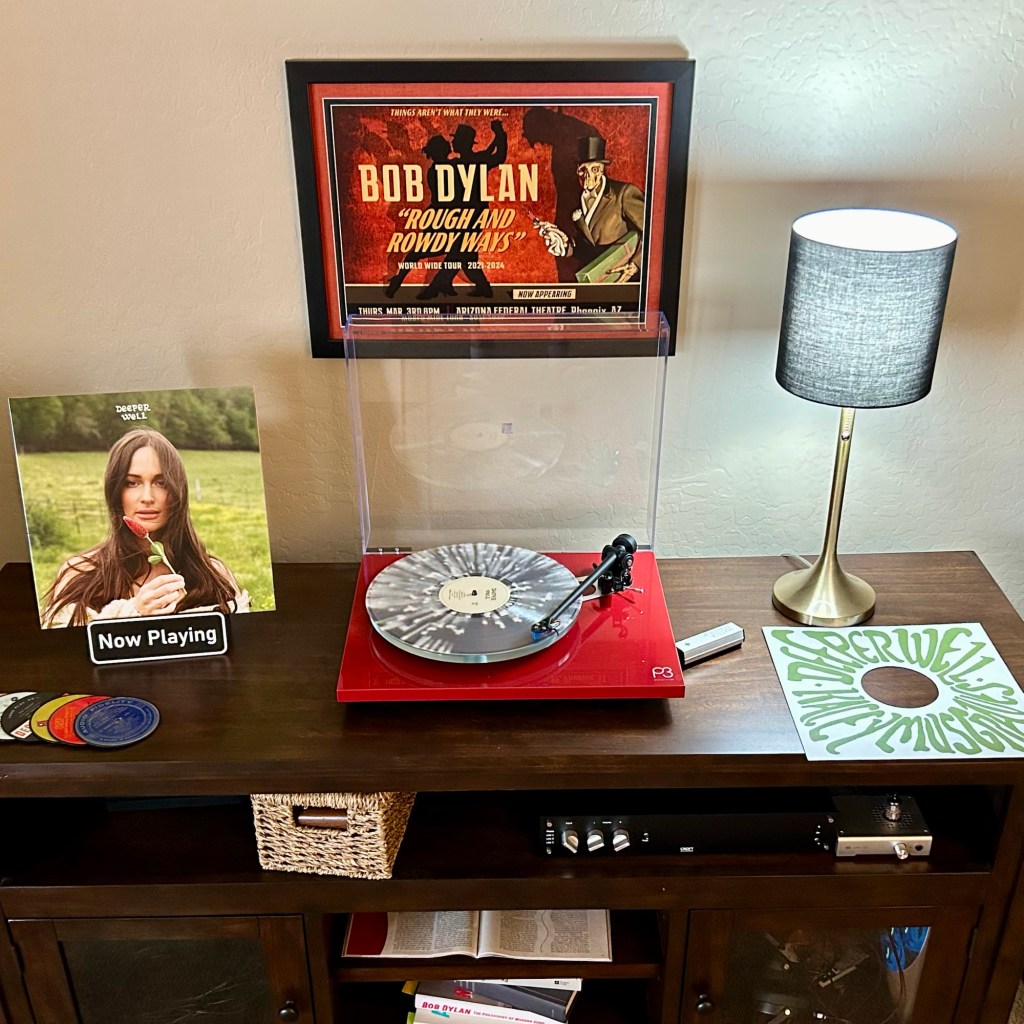
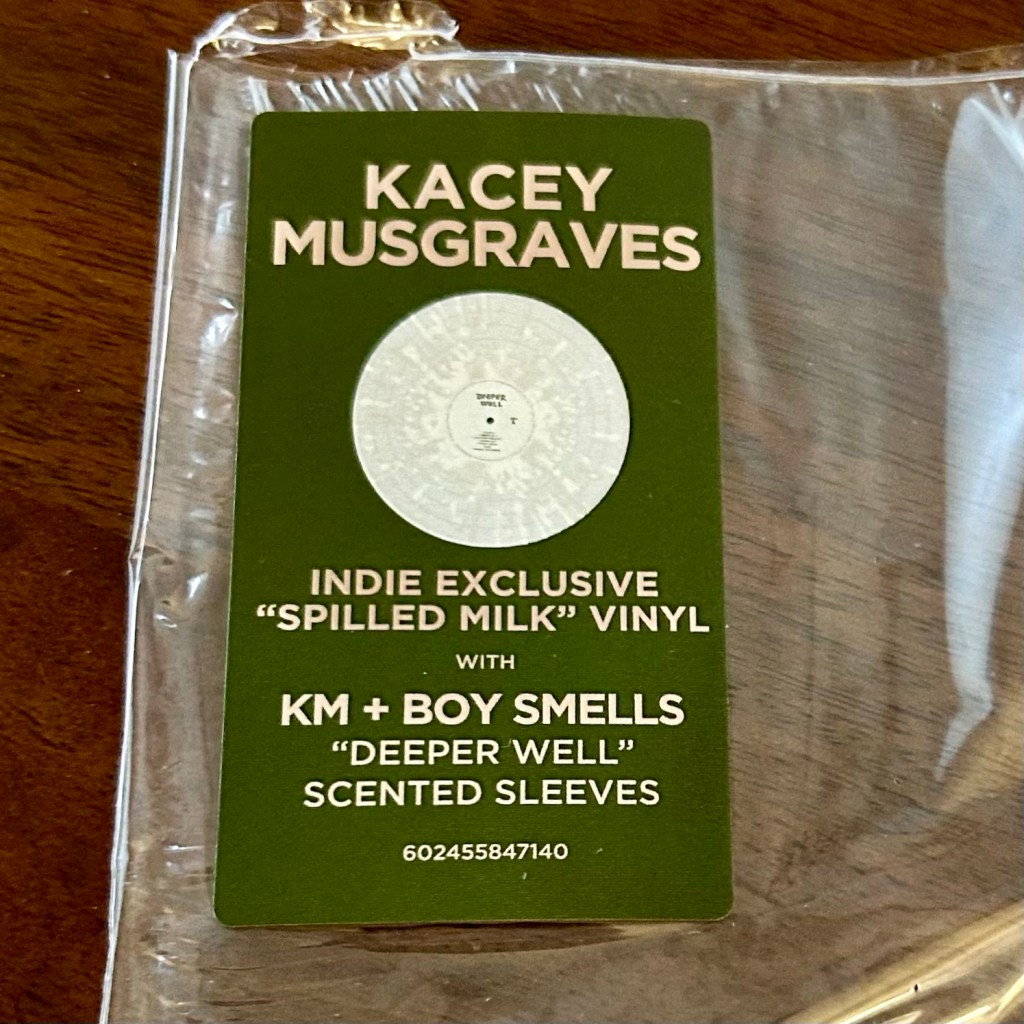
The vinyl version has an excellent master and pressing, and the packaging is well done. I chose the indie record store version and pressed it on “spilled milk” vinyl. The leaves are scented with “KM + Boy Smells” – a nice gimmick.
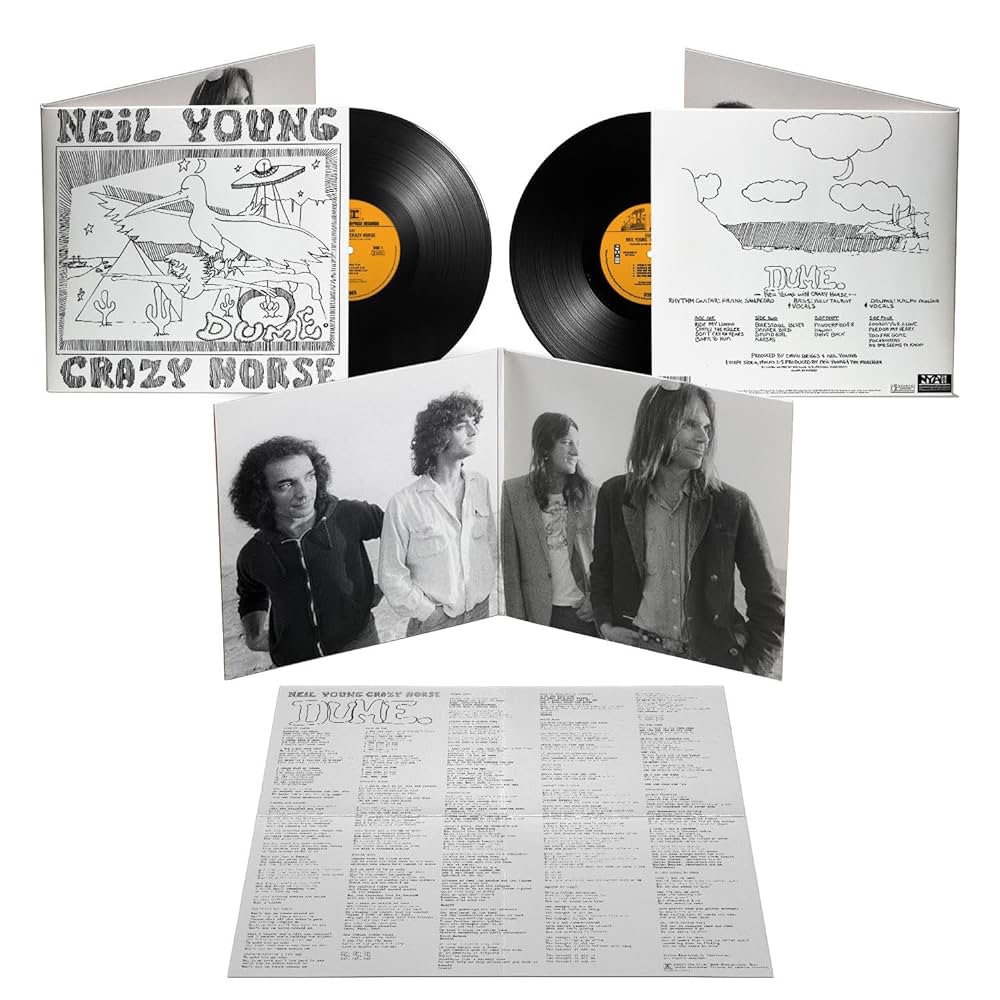
Dume is yet another “lost” Neil Young album. In the mid-’70s, Neil Young, Crazy Horse, and producer David Briggs lived in the Point Dume area of Malibu. Zuma, named after the beach they lived near, was recorded during that period. When Young was assembling his 2020 Archives Vol II box set he created Dume to combine songs from Zuma with unreleased tracks and mixes from that same period. Of the 16 tracks on Dume, half were not on Zuma. Most of the non-Zuma songs eventually found their way onto other releases (in different arrangements) including three on Rust Never Sleeps. All the Zuma tracks are represented except the CSNY song “Through My Sails.”

Zuma is one of my favorite Neil Young albums so it is a delight to have this new compilation from the Neil Young Archives series. “Cortez The Killer” is my favorite cut on the original Zuma and one of my favorite Neil Young songs. Its groove and the slow grinding lugubrious jam are the sounds that hooked me on Neil Young and Crazy Horse in the first place: heavy metal on Red Wine and Quaaludes. I absolutely love when Neil does this kind of shit. Well, Dume has plenty more. I am going to focus this review on the Dume songs that were not on Zuma. The songs marked with a # were unreleased versions of songs that appeared in other places in the Neil catalog until the Archives Vol II CD/digital box and are new to vinyl. The songs marked * were unreleased songs until the Archives Vol II box and are also new to vinyl. Here is the annotated track list focused on the non-Zuma songs:
“Ride My Llama” # is a Rust Never Sleeps track. The Dume version is full-on Crazy Horse electric grunge compared to the acoustic version on Rust. Both are great and each deserves a place in the catalog.
“Born To Run” * This is not the Bruce song. This is a song I had not heard before. It is a typical vibe of Neil and The Horse.
“Kansas” * Is another song that I have never heard before, but it fits like a glove on this album. It is classic wonderful sloppy proto-grunge from The Horse.
“Powderfinger” # is a highlight of 1979’s Rust Never Sleeps. This version is stunning: it is a pure country rock (or as we call it today Americana) song. I think I prefer it to the Rust Never Sleeps version. Rust and Live Rust were pivotal in my becoming a Neil Young fan and so this is a new essential track for me.
“Hawaii” # is another song that is new to me and represents a unique guitar sound for Neil and The Horse. It foreshadows the New Wave – by five-plus years. It has a really cool groove and sticks the landing with a great ending.
“Too Far Gone” # This song eventually appeared on Freedom (1989). The Dume version is acoustic and is begging for Mick Jagger to cover it in his ironic country voice. The Freedom version is similar, but not identical to the version on Freedom. I prefer the Dume version.
“Pocahontas” # is a folk electric version that is different enough from the Rust Never Sleeps version to be a delightful addition to the catalog.
“No One Seems To Know” # finally made its appearance on the 2018 live album Songs For Judy (as an acoustic piano version). The version on Dume is a similar acoustic piano version.
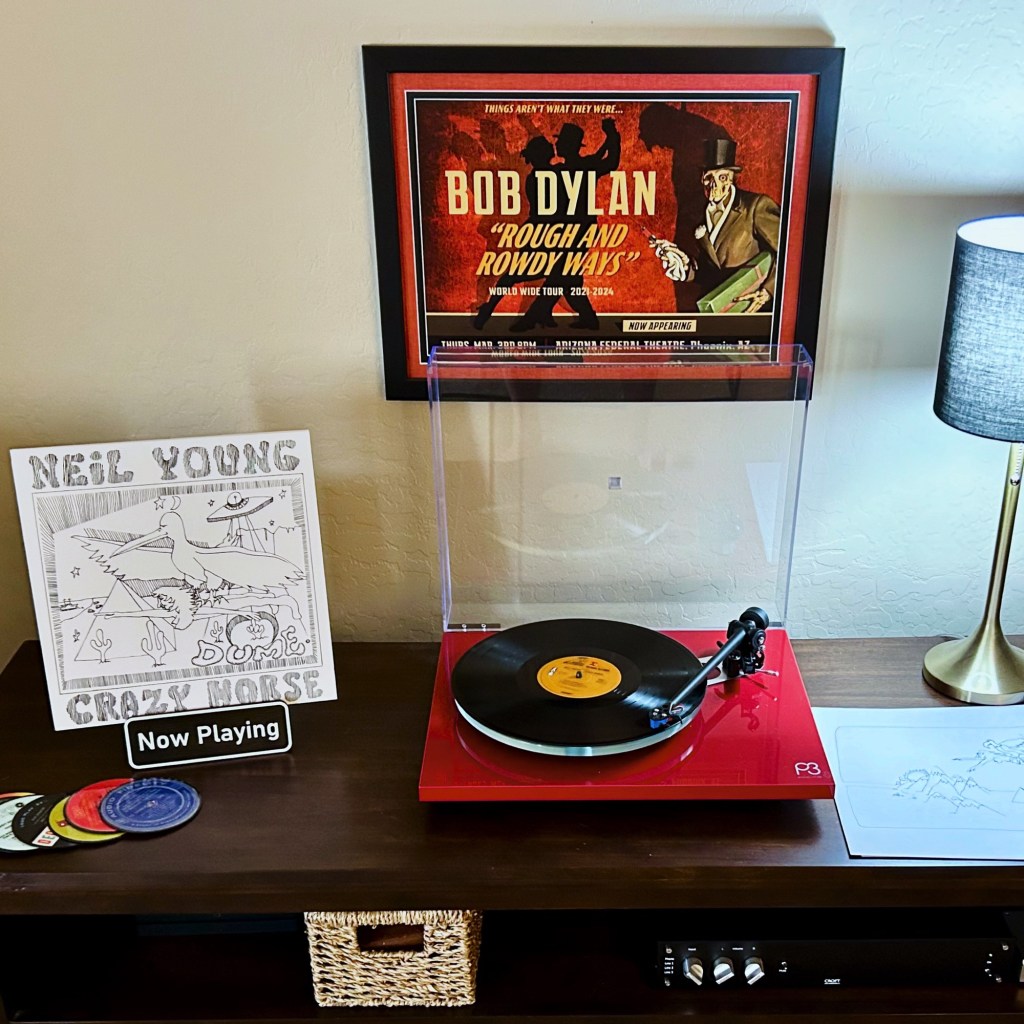
The vinyl is well mastered and pressed and this album is analog heaven. The wax sounds great on my system – it is tube extasy on the guitar solos. The packaging is nicely done – an enhanced version of the original Zuma LP. The album can be streamed on all services, including Spotify. I use Tidal and Dume is buried in the Archives Vol II compilation (tracks 99-114) in. 24 bit/192 kHz FLAC.
I get overwhelmed by the volume of the Neil Young archival releases, but Dume has muscled its way through the mess and will be a great pre-game to the Neil Young & Crazy Horse show (and new album Fu##In’ Up – which is a redo of 1990’s Ragged Glory when Neil was in his godfather of grunge era) that I will be seeing in Phoenix this spring. I am amazed at how coherent this album is and further amazed that Young was able to use these songs on other albums – especially Rust – they seemed like they belonged on Rust, but Rust and Zume are very much companions and this is even more evident after listening to Dume.

I am unsure when the notion of a tube (or valve as they call it across the pond) amp entered my audiophile lust zone. I had an old Ampeg guitar amp that was tube-based, so I was well aware of the warmth of that sound vs. solid state. In early 2011, I started researching tube amp options as a few years earlier I fell back in love with my vinyl record collection after flirting with MP3.
Here is some of the back story on my transition back to vinyl after a long affair with digital. I got my first CD player around 1985 and was absolutely blown away. What appealed to me about CDs is that they were quiet – no surface noise. For many years I felt that CDs sonically sounded better than vinyl records. Another huge benefit was that 70 minutes of music fit onto a CD – no getting up to flip a record. Many double LPs could fit on a single CD. I liked CDs so much that I began buying CDs of vinyl LPs I already owned. For the next 25 years, I bought and played CDs. But as time went on I began to be fatigued by the harshness of the CD format. I could listen to vinyl LPs for hours on end, but my CD limit was about 90 minutes and then my head began to hurt.
When MP3 came into my awareness in the early 00s I was initially smitten – the music was free, files were small enough to fit on a portable player (e.g., an iPod), files could be downloaded in a reasonable time, and not overwhelm your computer’s hard drive. I had a twinge of guilt that I was stealing the music, but that was not a new thing as I had been borrowing LPs from friends for years and copying them to cassette tape and more recently borrowing CDs to rip and burn. The MP3 “market” was just a more convenient way to borrow music, albeit from strangers. It did have the risk of viruses and malware, but I was fearless and fortunately never got burned. But it did not take long for me to realize that MP3s did not sound as good as CDs so I used MP3s to sample an album and if I liked it I bought the CD.
Around 2005, the combination of the terrible sound of MP3s and my ear fatigue from CDs got me playing my vinyl records again. Despite the surface noise, the extra effort to listen, and the lack of portability, I fell in love with vinyl LPs all over again. Fortunately, I had never considered liquidating my vinyl LPs (I probably had 1000 vinyl LPs at that point). As I was rediscovering vinyl there was a glut of used vinyl. Most people had liquidated their vinyl when they transitioned to CDs and now were even liquidating their CDs in favor of digital files on their computers. I began to acquire cheap used vinyl records and over the next few years – I doubled my vinyl collection. Simultaneously and coincidental with my personal vinyl revival, a small vinyl revival was appearing in the recording industry. By 2010 the revival was gaining full traction and artists were starting to release new music on vinyl. For the first time in my life I was organically part of a musical trend (I am a notorious late-to-the-party guy when it comes to musical trends).
I was in an analog state of mind. I wanted to try out tube audio as everything I heard about tubes was that they had a warmer sound – similar to what I was experiencing with my transition from digital (CDs and MP3s) to analog (vinyl).
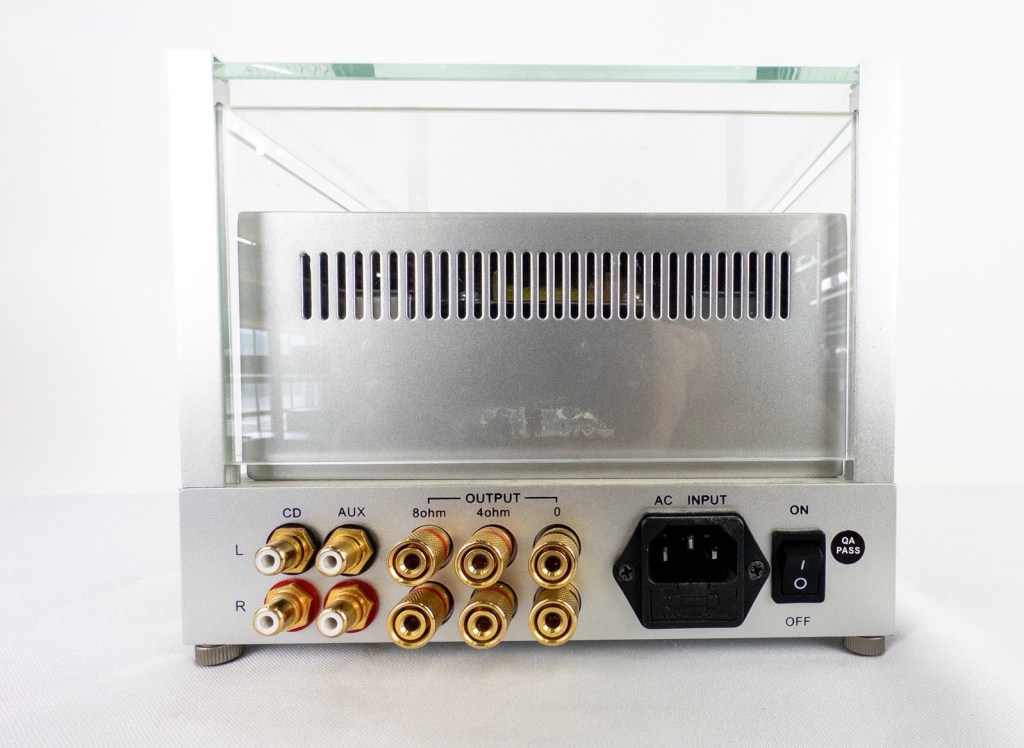
Given that I am a budget audio, I aimed to find a quality tube amplifier at a reasonable price. In researching I determined that the best solution for me was a JoLida Glass FX 10 integrated amplifier. The amp was new to the market and it checked a lot of boxes for me:
- It was affordable – $450
- It looked adorable (I realize that is not a legitimate audiophile reason, but hey I am shallow)
- It was getting great reviews

Although it was low-powered at 10 watts, I had learned early in my audiophile journey that power was overrated. Quality power was more important than the amount of power, I had efficient speakers, and I rarely listened to music loud.
In early 2011, I ordered the FX10 from The Needle Doctor (an amazing, but now defunct, store that will get its own blog post in the music memoir series). When the amp arrived at the store I drove over to Dinkytown (Minneapolis) to pick it up. My first reaction was how small the box was. I also ordered an inexpensive phone preamp as I knew the FX10 did not have a built-in phono preamp. In 2011 (and over the preceding couple of decades) it had become rare that a new amp had a phono input given the general music economy was digital.
I unboxed the amp, set it up, placed Joni Mitchell’s For the Roses on the turntable, dropped the needle, and experienced rapture. Even my wife, who supports my music and audio passion despite little interest herself, was struck by the beauty of the sound coming out of the amp.
What did I hear? I will use the tube cliche: warmth. I had a decent solid-state amp (NAD 7240PE) that did a great job, but the FX10 was a different beast. It sounded like a warm blanket felt on a cold night. Going back to the NAD, it now sounded frigid vs. warm, jagged vs. smooth, and hard vs. soft. The FX10 paired with a vinyl record was magical.
The timing of the arrival of the FX10 in 2011 could not have been more perfect: The kids were off to college so I had more time on my hands. In the fall of 2011, I had major surgery and a 6-week recovery that even gave me more time to focus on listening to new music. I had a little extra money so I did a bunch of upgrades: a new turntable, a tube-based phono preamp, and new speakers. I was in audio heaven.
Since then I have done more upgrades and when it comes to amplification I have stayed in the tube lane. I don’t have a technical understanding of tubes vs. solid state, I just know that tubes are my preference. I realize that tubes are not for everyone, but if you are into great sound I recommend you dip your toe into the tube world. The least expensive way I know is via a Schitt Vali headphone amp ($150).

I am a longtime fan of Cat Power (AKA Charlyn Marie “Chan” Marshall) and her mellow purr since her 2006 album The Greatest. Cat Power, although an excellent singer-songwriter, has a history of doing great covers including three albums of cover songs. The concept here is to cover Bob Dylan’s legendary 1966 British concert where he challenged his fans by going electric as documented by the 1998 album: The Bootleg Series Vol. 4: Bob Dylan Live 1966, The “Royal Albert Hall” Concert.
The original Dylan show was actually recorded at the Manchester Free Trade Hall during Dylan’s 1966 world tour, but early bootlegs attributed the recording to the Royal Albert Hall so it became known as the Royal Albert Hall Concert. The original setlist consisted of two parts, with the first half of the concert being Dylan alone on stage performing an acoustic set of songs, while the second half of the concert is Dylan playing an “electric” set of songs with his band The Hawks (later renamed The Band). The first half of the concert (acoustic) was greeted warmly by the audience, while the second half (electric) was filled with heckling due to some of the audience’s dissatisfaction with Dylan going electric. The show included Dylan’s legendary confrontation with a heckler who yelled “Judas” which can be heard on the recording. After “Judas!” there is clapping, followed by more heckles. Dylan then says “I don’t believe you”, then after a pause, “You’re a liar.” Bob Dylan then said to his band, “Play it fuckin’ loud” as they began “Like a Rolling Stone.” At the end, the audience erupts into applause and Dylan says, “Thank you.”
A pretty amazing concert for Cat Power to cover. She takes the same approach as Dylan: the first half acoustic and the second half electric with her band. She has the same set list (songs and order) as the famous recording. The performance is a live show at Royal Albert Hall recorded on November 5, 2022.
The arrangements are faithful to the Dylan originals, yet Cat Power’s unique vocals make the material her own. Hearing her interpret these songs opens up new meanings and nuances.

LP One: Acoustic Set
These covers are faithful to the original album: voice, guitar, and harmonica. Cat Power’s performance is like a sweet caress – she is clearly in love with the material – it is devotional. Cat Power has a similar but unique phrasing to Dylan. The recording quality is pristine.
LP Two: Electric Set
This is by far my favorite set. It is wonderfully feisty. The arrangements are faithful, but not beholden to the original. It is like the band took the original and readjusted it for Chan’s phrasing and Chan’s phrasing is wonderful – Dylanesque, but still plenty of Cat Power. It is an inspired interpretation. It includes an audience member shouting “Judas!” at Cat Power in the same manner as the original Dylan show.

This is a brilliant concept for an album and Cat Power nails it. She is taking this show on the road too (unfortunately not to a city near me).

As a kid, I became fascinated with the piccolo and wanted to play it. My parents indulged my interest and found a piccolo teacher who told them that if I wanted to play the piccolo, I would first need to learn to play the flute. That sounded fine to me. I started to learn the flute when I was in third grade. I took lessons at the MacPhail Center For Music in downtown Minneapolis. My instructor was Dennis Schulte, AKA Mr. Schulte.
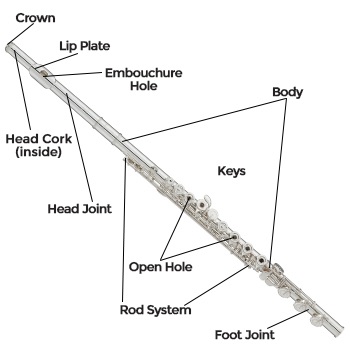
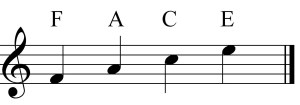
My grade school did not have a band so learning the flute was a solitary effort. My first flute was a “rent to buy” and was a Gemeinhardt student model. The first thing that Mr. Schulte did was teach me to make a sound on the flute head joint. This is not as easy as it sounds: you blow over the embouchure hole and you have to create an embouchure which is the use of the lips, teeth, tongue, and facial muscles to play a wind instrument like the flute. I bet this took a week to figure out. When I returned for my second lesson, I could make an appropriate sound. Also, part of that first lesson was learning the basics of reading music: learning the notes on a staff by the mnemonic device: Every Good Boy Does Fine and FACE.

I took to the flute like a duck to water and after a few months, my folks realized that I was not going to quit it so they actually purchased a flute for me. Mr Schulte insisted that I get an open-hole flute with a silver head joint as that would be a quality flute that would see me through the next several years. An open-hole flute has holes in the keys which are covered by the player’s fingers. The upside is that it allows for a greater range of fingerings, playing techniques, and improved tone. The downside is that it requires greater dexterity to play – AKA, it is harder to play. Mr. Schulte’s theory was to start a player young on an open hole so that you develop dexterity early in your flute playing career. I don’t remember how much the flute cost, but it must have been a lot for my parents – the equivalent of over $1000 today. I remember that McPhail sold ticket books to pay the instructor. I think it was $5 a lesson – which is roughly equivalent to $35 in today’s dollars – so a lot.
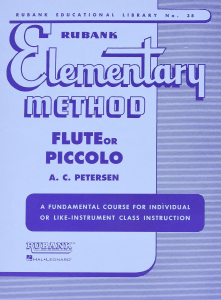
Mr Schulte was impressed with my ear: he used to have me turn my back on him and he would audition (A/B style) state-of-the-art flutes and ask me to judge which sounded better. I consistently picked the most expensive model, e.g. a wood open hole with a silver head joint. The downside of my good ear was that I could cheat and play music by ear at the expense of mastering sight reading. Mr. Schulte would give me an assignment each week from the A.C. Petersen method book by playing it for me. I relied more on remembering that demo than on reading the music. For fun, I had a music book of pop hits of the day that I ended up playing mostly by ear vs. reading the music.
I would even write my own tunes on the flute. The only one I remember was an upbeat instrumental I titled “The Dancing Tabby” – I was cat-obsessed as a kid.
The flute is a relatively easy instrument to play once you figure out how to make a noise blowing across the embouchure hole. After that, it is memorizing fingering (see fingering chart below) and adjusting your embouchure and blow to change octaves and create effects like staccato. Below is a flute-fingering chart:

I continued to improve at the flute for the next few years. When I started junior high I joined the band. I was shocked to learn that the flute was a “girl instrument.” As a seventh-grade male, I didn’t have a lot of gender confidence so I felt uncomfortable in the flute section. However, this is where I first discovered boobs – a couple of junior high girls in the flute section were beginning to blossom and I was stirred by the slightest glimpse of their cleavage.
A few months into my band career I accidentally left my flute on top of my locker at school and once I realized it and returned to my locker it was gone. My dad was furious at my carelessness, but he was also furious at the band instructor as he assumed that he had stolen the flute – a bizarre accusation – but I was fine with his misplaced blame as it took some of the heat off me for my screw-up.
I continued to play the flute in the band with a borrowed flute for a few more months, but I had lost my passion for the instrument: I wasn’t secure enough in my sexuality to play a “girl instrument,” my weak sight-reading was now a liability and the borrowed flute was a piece of crap. I ended up quitting playing the flute before the end of seventh grade.
Many years later I got together with a bunch of guys and we started a band: Whale (that is a topic that will get its own post). I was learning the guitar and it was my primary instrument in Whale. My wife had her old flute from when she was a kid and so I started to mess with it. My embouchure was still functional and my ability to play came back like riding a bike. I brought it to Whale band practice and duct taped a small microphone to the flute’s head joint and I was now Whale’s Ian Anderson.
Since Whale broke up 30 years ago I haven’t touched the flute, but now that I am retired I think about taking it up again as I have great memories of playing the flute.

Here is another special request from one of my daughter’s friends to review something, this time it is Rick Rubin’s book on creativity.
I am a fan of Rick Rubin, first as a record producer and second as a podcaster. His career as a record producer is unusual in that he has produced all kinds of genres (hip hop, rock, country, etc.) and artists (new, established, and legacy). He has some curveballs too – he was the unlikely guy to resurrect the career of Johnny Cash. From everything I have read about him and listening to him on his podcasts, his skill as a record producer is not technical (he is not a musician or engineer), but rather by being the king of the vibe: he helps creative people be the best version of themselves. On his podcast, Tetragrammaton with Rick Rubin, he has long conversations with creative people. You get a sense of how he coaches creatives by witnessing the conversations.
In his book, you learn that he is a student of the creative process. He has developed an understanding of how creativity works and has documented his understanding. The book is meant to show that there are techniques to be creative and it is not magic. At the beginning of the book, Rubin says:
Nothing in this book is known to be true.
It’s a reflection on what I’ve noticed
Not facts so much as thoughts.
I believe that some people are more gifted than others, whether it is intellect, sports, visual arts, music, or whatever. However, I also believe that most gifted people squander their gift and less gifted people could do more if they put their mind to it and had good guidance/coaching. This is why a book like Rubin’s is so important: it is aimed at artistically gifted people to maximize their gifts and at less artistically gifted people to reach their potential. I don’t see myself as an artist, but I do see myself as creative. I found the book useful to me in enhancing my creativity. As an appreciator of artists, it helped me understand them more.
The book is arranged in short chapters and is easy to read and understand. The book can be read from beginning to end, but it also can be read randomly, that is, read a chapter that catches your fancy or meets an immediate need. It is a hipster version of Chicken Soup for the Soul. When Rubin explains things, it sounds obvious. His understanding of creativity is achievable by anyone who puts their mind to it and follows Rubin’s tips.
Here are some example quotes from the book to give you a feel for Rubin’s approach:
How differentiates craft and art: “If you know what you want to do and you do it, that’s the work of a craftsman. If you begin with a question and use it to guide an adventure of discovery, that’s the work of the artist.”
Another quote: “Creativity is something you are, not only something you do. It’s a way of moving through the world, every minute, every day.”
There is one key concept that Rubin talks about that I could not grasp. He calls it The Source. There is a quote early in the book where he says:
We begin with everything: everything seen, everything done, everything thought, everything felt, everything imagined, everything forgotten,
and everything that rests unspoken and unthought within us.This content does not come from inside us. The Source is out there. A wisdom surrounding us, an inexhaustible offering that is always available.
I never got The Source. The important point, one that I struggle with (the same way I struggle with spirituality/faith), is that The Source is not from inside us but from outside us. Rubin is saying that the source of creativity is not internal but external. My gut is it is both inside and outside. Maybe The Source will make sense to true creatives. But other than that, most of Rubin’s words make a lot of sense to me.
If you are artistic, creative, or interested in artists and creatives you will find Rick Rubin’s book worth your time.
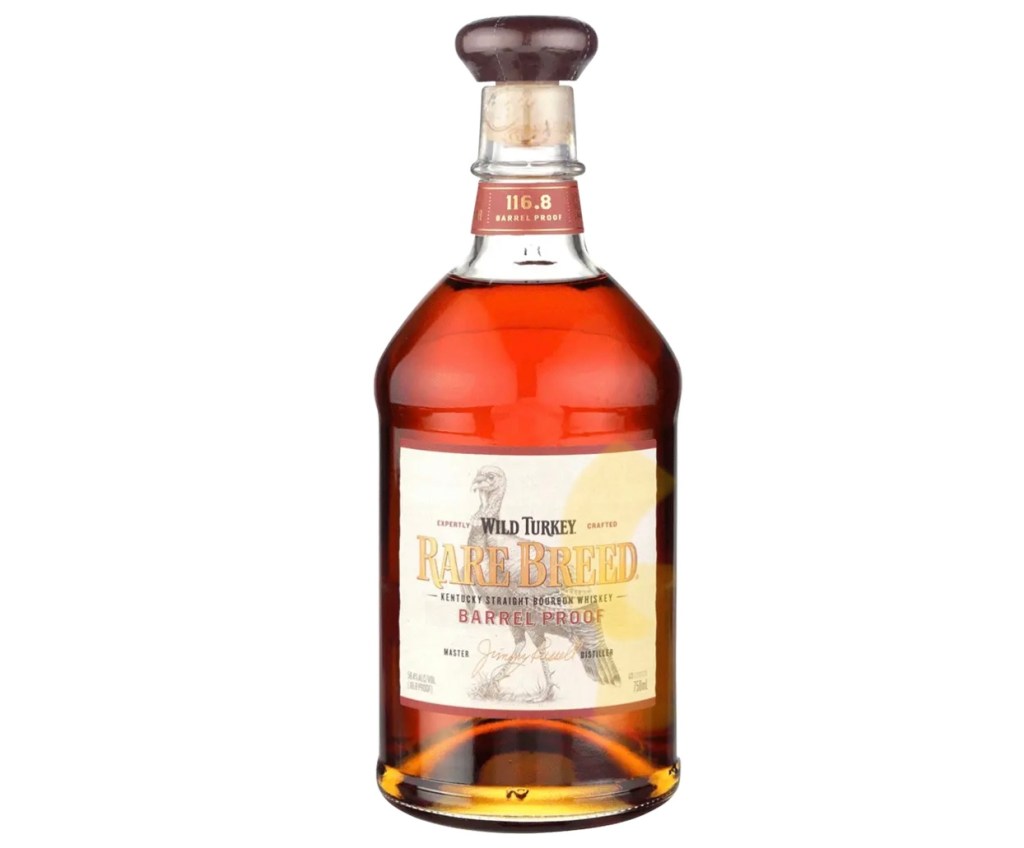
Per the distillery’s website: “The true, bold spirit of Wild Turkey has been captured in this authentic barrel proof whiskey, creating one of the finest bourbons in the world. Uncut with water, Rare Breed is an uncompromised Kentucky bourbon with tones of sweet tobacco and hints of orange and mint, making it a remarkably smooth whiskey legend.”
I am a Bourbon fan and there is not really a Bourbon I don’t like – but I certainly like some more than others. I like the various Buffalo Trace brands, the various forms of Maker’s Mark, Four Roses, and Jefferson’s. Despite it being a classic brand, I have never had Wild Turkey. I don’t like spending big bucks. I like to keep it in the $40 range (and I am more than happy to spend less – especially for a cocktail spirit) but I will spend $75 for something special (that is about my upper limit). I mostly drink whiskey straight, but I do like an Old Fashioned. I bought this at Costco for around $40.
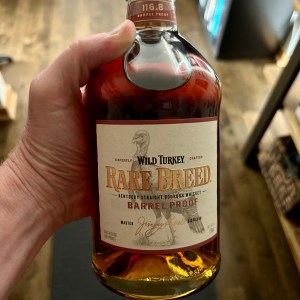
My first taste was neat and it was too hot – it is 116.8 proof (58.4% ABV) after all. But served over ice: perfection. I typically don’t like straight whiskey on ice as the flavor gets diluted. However, with high-ABV whiskies, the dilution is a good thing. So on a hot summer night, it is a delight to sip on a cold whiskey and appreciate the dilution.

Once your palate adjusts from a cold one, a neat pour tastes amazing.
As for the taste:
- Heat – the first thing that hits you as I said before is the heat
- A hint of licorice
- Some orange
- Unquestionably Bourbon – you won’t confuse as any other kind of whiskey
- Despite the heat, it is clean – not a lot of aftertaste
- Sweet, but not too sweet
Now that I have gotten used to it, I don’t feel the need to have it over ice. But ice is a nice option when the time is right.

My biggest endorsement of a spirit is would I buy it again? Absolutely! The next question is, does it need to be in regular rotation in our bar? Not necessarily, this is a special spirit that I will buy on sale (or at Costco). This is a high-quality spirit at a reasonable price ($40-$45).

 Axl's Catch Groove