
Austin Post, AKA Post Malone, is a rapper, singer, songwriter, record producer, and guitarist who has performed in a variety of genres, including hip hop, pop, R&B, trap, rock, and now, with his new album, F-1 Trillion, country.
F-1 Trillion features a bunch of guest appearances, including Tim McGraw, Hank Williams Jr., Morgan Wallen, Blake Shelton, Dolly Parton, Brad Paisley, Luke Combs, Lainey Wilson, Jelly Roll, Ernest, Sierra Ferrell, Chris Stapleton, Hardy, and Billy Strings. There are three solo songs, too. There is a deluxe edition (Long Bed) with nine more solo songs.
Post’s take on country is conventional contemporary pop country. Post takes country seriously, but the dominant vibe is fun – he clearly loves country music. It is not a stretch for Post to “go country,” as he has been evolving in this direction for a while. Post has occasionally performed country covers in concert, so it is not a surprise that he has released a country album and plans to promote it with a country-focused tour this fall. California rapper Lil B wrote on Twitter in October 2017 (when Post was considered a hip-hop artist): “Post Malone is slowly turning into a white dude! Lol he’s pushing it, give it a few years he gonna be full country and hate blacks lol“, with Malone replying in an interview, claiming that his white skin has been “used against him“. Well, country Post has fully arrived.
Post has a pleasant voice, although it is a bit thin and electronically enhanced (this is true for his pop material too – electronically enhanced vocals are common in contemporary pop country). His voice is not particularly country, but the arrangements and lyrical themes are country. His voice mixes well with his collaborators – a little too much – at times it is difficult to differentiate Post from his collaborators. In general, I found that I preferred the Post solo tracks as I was less distracted by identifying the collaborator. I assume this will diminish as I get more familiar with the album. Ultimately, his vocals work in this country context.
Post wrote the songs with a gaggle of co-writers (as is the Nashville way these days). They are catchy toe-tappers. Post and his writing and production team (many seasoned pros in the country genre) have mastered contemporary pop country.
Post’s country album works because of his devotion to the genre. He is clearly a country music fan. F-1 Trillion is neither a novelty nor a vanity project but a labor of love. It is a fun detour in his career. Post is always the king of good vibes – a modern-day Jimmy Buffett. On F-1 Trillion Post continues the good vibes.
Main Album Track list:
“Wrong Ones” feat. Tim McGraw
“Finer Things” feat. Hank Williams Jr.
“I Had Some Help” feat. Morgan Wallen
“Pour Me A Drink” feat. Blake Shelton
“Have The Heart” feat. Dolly Parton
“What Don’t Belong To Me” (solo)
“Goes Without Saying” feat. Brad Paisley
“Guy For That” feat. Luke Combs
“Nosedive” feat. Lainey Wilson
“Losers” feat. Jelly Roll
“Devil I’ve Been” feat. ERNEST
“Never Love You Again” feat. Sierra Ferrell
“Missin’ You Like This” feat. Luke Combs
“California Sober” feat. Chris Stapleton
“Hide My Gun” feat. HARDY
“Right About You” (solo)
“M-E-X-I-C-O” feat. Billy Strings
“Yours” (solo)
Deluxe edition (AKA F-1 Trillion: Long Bed) additional tracks:
“Fallin’ In Love”
“Dead At The Honky Tonk”
“Killed A Man”
“Ain’t How It Ends”
“Hey Mercedes”
“Go To Hell”
“Two Hearts”
“Who Needs You”
“Back To Texas”
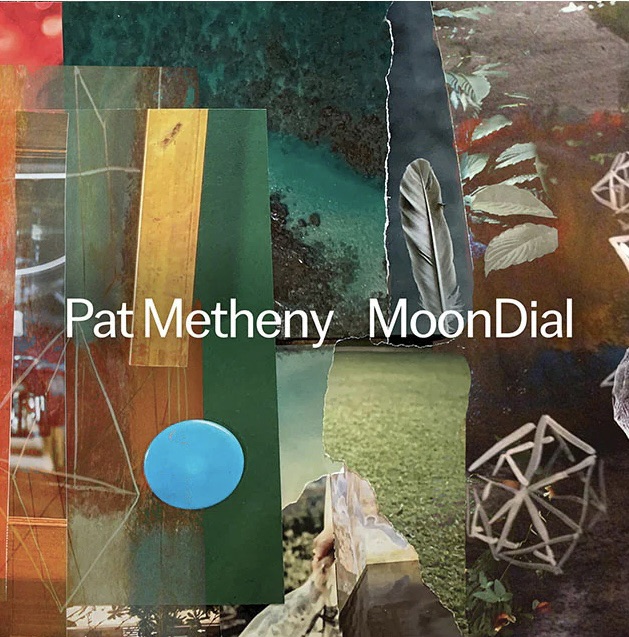
MoonDial is a companion to Metheny’s last album, Dream Box. Per Meheny’s website:
“With the release of Dream Box in the spring of 2023, I took off on a long solo tour around the world, sitting alone onstage for two and a half hours for the very first time. I had played a few tunes here and there by myself each night for years but had never built a presentation that focused solely on solo guitar playing for such an extended run of concerts.“
While on tour, Metheny acquired a new baritone guitar from luthier Linda Manzer, but he commissioned it with nylon strings vs steel like his other baritones. There were challenges with the new instrument – again, from Metheny’s website:
“My deep dive into the world of Baritone guitar began when I remembered that as a kid in Missouri, a neighbor had shown me a unique way of stringing where the middle two strings are tuned up an octave while the general tuning of the Baritone instrument remains down a 4th or a 5th. This opened up a dimension of harmony that had been previously unavailable to me on any conventional guitar.
There were never really issues with Linda’s guitar itself, but finding nylon strings that could manage that tuning without a) breaking or b) sounding like a banjo – was difficult.
Just before we hit the road, I ran across a company in Argentina (Magma) that specialized in making a new kind of nylon string with a tension that allowed precisely the sound I needed to make Linda’s Baritone guitar viable in my special tuning.
There was suddenly a whole new palette of sound under my fingers, just like that.”
Metheny began introducing his new instrument on the Dream Box tour, and soon, he had an album’s worth of material. During a tour break in December 2023, he recorded MoonDial.
The songs mix originals and covers (Corea, Lennon & McCartney, Bernstein & Sondheim, Mercerr, jazz standards, and traditional folk music). The music is mellow, quiet, and acoustic, or as Metheny puts it:
“This record might offer something to the insomniacs and all-night folks looking for the same sounds, harmonies, spirits, and melodies that I was in pursuit of during the late nights and early mornings that this music was recorded.”
There were a lot of clear nights during that December, and in my imagination, it seemed like the moon was checking out what I was searching for up on the upstate NY mountain where I was recording.“
I prefer Metheny’s ensemble work, but this music has its place. It is excellent background music without being musical wallpaper. One of the appeals to Metheny’s music, beyond his brilliant sense of melody, is his guitar tone. Nothing is better than Metheny discovering a new toy, like when he found the Roland guitar synth in the late 70s/early 80s. He takes these new instruments and makes them sing in his singular voice. Manzer’s baritone guitar and Magma strings are Metheny’s latest muse, and MoonDial is the beautiful result. The baritone guitar has a unique tone: rich and thick like an electric hollow body guitar, but clearly acoustic. It has a deep bass and lots of overtones. It often sounds like two guitars or overdubs, but it is Methany playing solo. It is a pretty great sound.
I am consuming the album via a high-resolution Tidal stream (24-bit/96 kHz FLAC). The album is also available in Atmos format on Tidal, but I don’t have the proper equipment to listen to that format. Typically, I would buy the vinyl, but given how quiet this album is, I can’t imagine how vinyl surface noise would improve the listening experience.
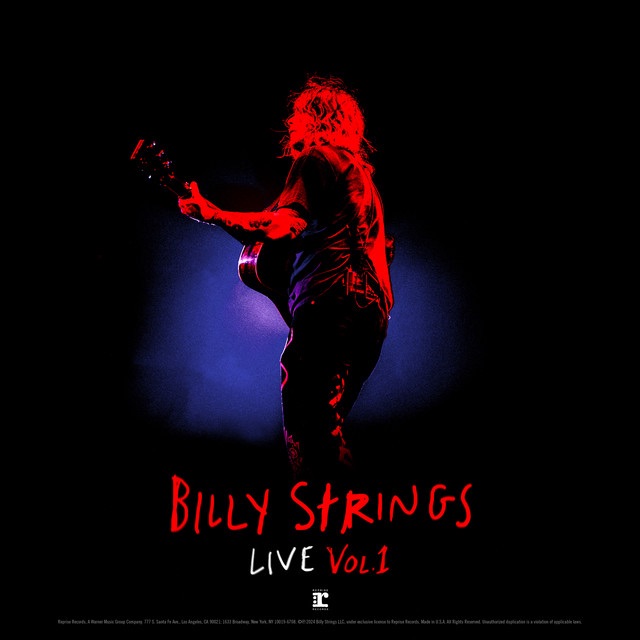
Billy Strings, né William Lee Apostol, is one of my new favorite musicians. Wikipedia describes him as “an American guitarist and bluegrass musician.” Yes, he is that, but he is so much more: he is bluegrass plus metal plus jam band. Bluegrass and metal have always had a “fastest gun in the West” mentality, and Strings and his band are fast. Jam bands are characterized by their psychedelic meandering, Strings and his band do that also. But their secret sauce is their sense of melody, adventurous spirit, and creating rock drama in their live shows.
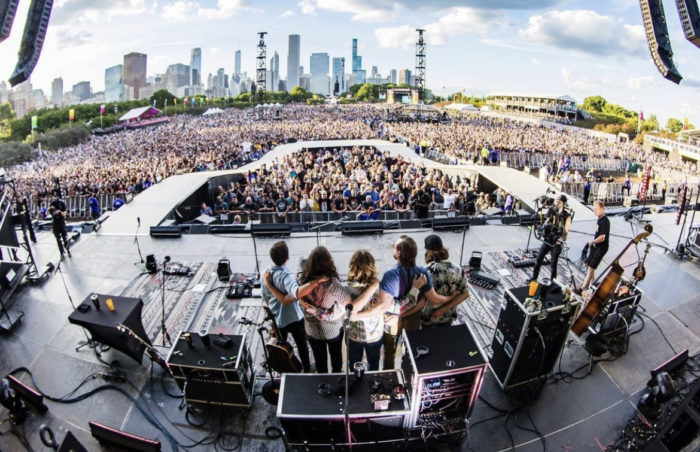
My son was the first to alert me to Strings by raving about Strings’ brilliant set at the 2022 Lollapalooza in Chicago. I have been to Lolla several times, and I was hard-pressed to imagine how a bluegrass band could succeed on the big stage of a pop music festival. So I checked out Billy Strings on streaming, and frankly, I was unimpressed. Strings and band were good, but so are a hundred other bluegrass bands, and they can’t command the attention of fifty thousand fans at a pop festival. So I kept listening, and the band grew on me, but I still didn’t fully get it.
Then I saw Strings live in Phoenix in the spring of 2023, and I got it. It reminded me of when I saw Bruce Springsteen for the first time in 1978. I was barely a fan, but I thought I should check out what all the hype was about. Bruce blew my mind. The next day, I went to a record store, bought Greetings From Asbury Park, brought it back to my dorm room, dropped the needle, and was disappointed – this was nothing like the amazing show I witnessed the night before. My Billy Strings experience was similar – I was underwhelmed by the studio albums, blown away by seeing him live, and still underwhelmed post-live with the studio albums. I saw Strings again this summer; his live performance has improved in a year – I became more impressed, but still, the studio recordings did not resonate with me.

Fans now have a live album that matches up to the live show – a recording that genuinely represents the Billy Strings experience. I am excited to see that the album title includes the phrase “Vol. 1” – I hope this means there is more to come (Googling this, there has so far been no word from Billy’s camp regarding any potential future live albums). Strings has most of his shows available on nugs (legal bootlegs), but Live Vol. 1 is a deliberate live album properly mixed and pressed to vinyl and CD (and available on streaming services with two bonus tracks – and a different track order).
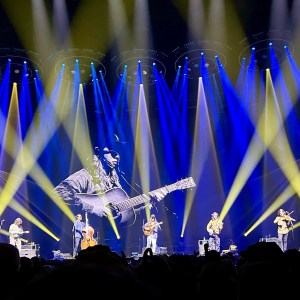
The Billy Strings band consists of Strings on guitar and vocals, Billy Failing on banjo, Royal Masat on bass, Jarrod Walker on mandolin, and Alex Hargreaves on fiddle—and they are all great musicians. Although they are primarily an acoustic band, Strings occasionally runs his acoustic guitar through pedals/effects and a guitar synth to create a rock sound. He also uses effects on his vocals. On studio recordings and live, the band primarily plays original compositions. They also cover traditional folk/bluegrass songs. Still, they also are not afraid to play rock and pop songs (at the Minneapolis show, he played some traditional country covers, and at the Phoenix show, he played a Dylan cover – online, I have seen him cover Cher’s “Believe”). The band’s stage presentation resembles a rock show with fantastic lights and video. Billy Strings is not your daddy’s bluegrass band.
Side 1 opens with “Dust in a Baggie” (recorded December 15, 2023, at Mohegan Sun Arena at Casey Plaza, Wilkes-Barre, PA). The song was initially released on the album Rock of Ages, which Billy did with Don Julin (2013) and again on his self-titled 2016 EP. This song is a regular part of the String’s live repertoire. The music is arranged and performed as a traditional bluegrass number but is not a bluegrass standard. Instead, it was written by Strings and Don Julin. Lyrically, the song is about getting busted and incarcerated for a trace amount of meth possession (mere dust in a baggie per the song title and chorus).
“Away From The Mire” (recorded June 2, 2023 at Moody Center, Austin, TX) first appeared on Home (2019). This song captures the Billy String sound – he updates the bluegrass sound by running his acoustic guitar through pedals to give it an electric guitar sound. Despite the manipulation, the bluegrass prevails. Again this is a Billy Strings original (cowritten with Jon Weisberger). In various interviews Strings has suggested this is about a family argument. I particularly like the use of the term “mire,” which means both (per Merriam-Webster) “wet spongy earth (as of a bog or marsh),” as well as “a troublesome or intractable situation.” This live version extends the studio version from seven and a half minutes to thirteen minutes. It is jam-band heaven. This is one of Strings’ most streamed songs.
“Long Forgotten Dream” (recorded September 22, 2023, at Renewal, Buena Vista, CO) first appeared on Home (2019). It is pure bluegrass and another Strings original. Lyrically, it sounds like the narrator is trying to make sense of a dream that he has just woken from.
Side 2 opens with “Heartbeat of America” (recorded February 25, 2024, at the Ryman Auditorium, Nashville, TN) and first appeared on Renewal (2021). This song has more of a rock song vibe, and at times, Strings’ guitar sounds like Carlos Santana fronting the Allman Brothers. Lyrically, the narrator has smoked some weed and has become very creative:
“Now I’m seeing music that nobody else can see
With all the colors like a symphony surrounding me”
“Dos Banjos” (recorded November 14, 2023, at La Cigale, Paris, FR) first appeared on Fiddle Tune X with Don Julin (2014) – it also appeared on his self-titled 2016 EP. The song is played as a duo with Billy Strings on clawhammer banjo and Billy Failing on banjo (referred to as Dos Billys). Lyrically, the song describes despair:
“The times have changed, the times have changed,
Humanity has lost its way
The people now, the people now,
How they survive, I don’t know how”
Side 3 is a medley of “Fire Line” and “Reuben’s Train” (recorded February 25, 2024, at the Ryman Auditorium, Nashville, TN). “Fire Line” originally appeared on Renewal (2021), and “Reuben’s Train” is a traditional bluegrass song that is not on a studio album (however, it is a frequent song in the live set). This track is just over nineteen minutes and is performed mainly with traditional bluegrass instrumentation – as part of the instrumental section, Billy hits the pedals and gets a bit metal. The studio version is slightly more ornate (piano and harpsichord) and considerably shorter.
Side 4 opens with “Turmoil & Tinfoil” (recorded December 31, 2023, at UNO Lakefront Arena, New Orleans, LA), the titular song from Turmoil & Tinfoil (2017). Per Stings in an interview with American Songwriter, “This song is about missing someone who is standing right in front of you. If you’ve ever had a friend who is addicted to hard drugs, you might know what I’m talking about.” Again, this is a Billy Strings original arranged in a traditional bluegrass format but occasionally Billy hits the guitar pedals to give it an electric guitar sound. The band stretches the six-minute studio versions to twenty-one minutes of jam-band glory.
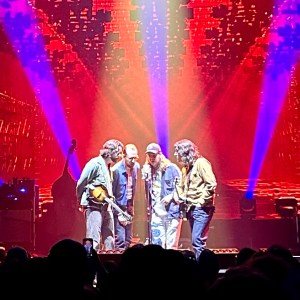
“Richard Petty” (recorded March 1, 2024, at State Farm Arena, Atlanta, GA) is not on a studio album. It must be a newer song, as it has only recently appeared in the live set. It is performed a capella (see photo below from a recent Minneapolis show).
Billy Strings dropped two Live Vol. 1 bonus tracks on his billystrings.live website using a nifty WinAmp player straight out of the 2000s. The two songs are also available on streaming services. The streaming version of the album is in a different track order than the vinyl and CD.
“Hellbender” (recorded April 22, 2023, at St. Augustine Amphitheatre in St. Augustine, FL) originally appeared on Renewal (2021) and is pure bluegrass. It is in regular rotation in the live show. The song describes being on a hell of a drinking bender.
“Highway Hypnosis” (recorded June 16, 2023, at Pine Knob Music Theatre in Clarkston, MI) originally appeared on Home (2019). The band triples the length of the song live from the studio version (although looking online, Billy has doubled the length to nearly thirty minutes at times). The song was written with bluegrass royalty Ronnie McCoury and his son Evan. The song is a driving song where the narrator enters a dream state. There is some amazing solos by Strings and the band. At times, there is almost a funk vibe. Mid-section, sound effects evoke a kind of road chaos that evolves into an audience call and response only to end with some hot picking. This song epitomizes Strings’ adventurous approach to bluegrass.
This album does an excellent job of capturing the excitement of a Billy Strings’ show and is the perfect introduction to Billy Strings. The tracklist is a “greatest hits.” Savoring this collection, I am struck by how seamlessly and tastefully Strings mixes his acoustic and electric guitar textures to create a progressive, uniquely Billy Strings take on bluegrass.
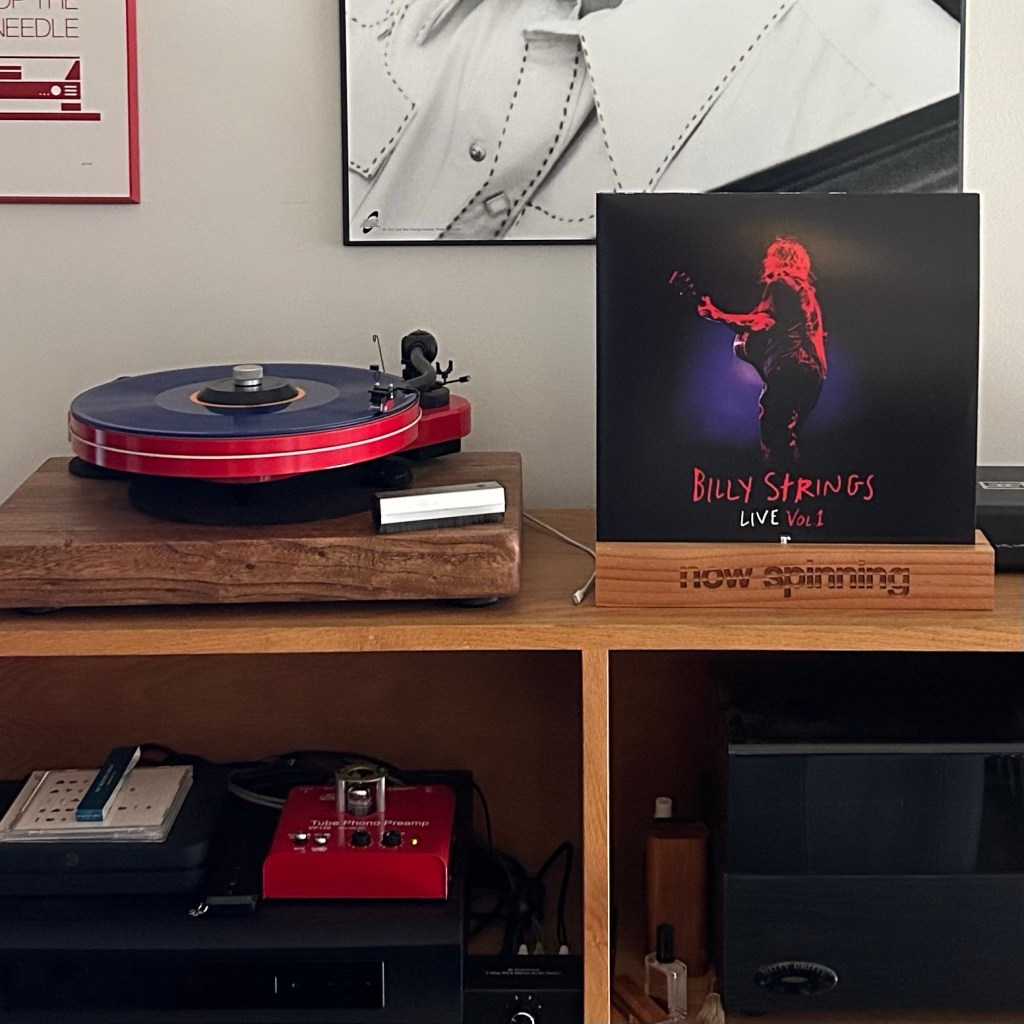
My vinyl edition is the Independent Record Store version, which is two LPs on 180-gram translucent blue vinyl. It is a quality pressing and sounds excellent. The high-resolution stream is 24-bit/96-kHz FLAC (I use Tidal), and it sounds fabulous.
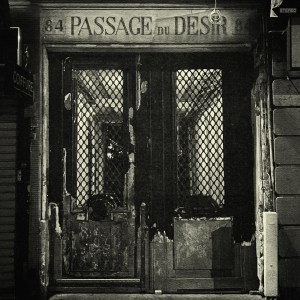
It is great to have a new Sturgill album under the Johnny Blues Skies (JBS) pseudonym; it is a return to his psychedelic outlaw country form of A Sailor’s Guide to Earth (2016). Sturgill Simpson famously said he would only make five studio albums early in his career. He must consider The Ballad of Dood and Juanita, released in 2021, his fifth studio album—even though it was his seventh (he must not count the two Cuttin’ Grass bluegrass remake albums). This claim is significant because his latest album is being released under the stage name Johnny Blues Skies (JBS) – the loophole Simpson has developed to continue to release new music. The bluegrass version of Sturgill on The Ballad of Dood and Juanita never resonated with me. I like the Cuttin’ Grass albums, but they sound like a vanity project. I loved Sound & Fury, but that didn’t sound like a Sturgill Simpson album (it was a rock album – that would have the album use a pseudonym). Passage du Desir (French for “Passage of Desire”) sounds like a Yacht Rock/Countrypolitan version of psychedelic outlaw country Sturgill, and it serves him well. Simpson has been critically acclaimed and has a solid following; he has not broken through to the contemporary country or pop audience. Passage du Desir could be his Chris Stapleton moment.
In a profile in GQ promoting this album, Simpson states: “Sturgill served his purpose, but he’s dead, he’s gone, and I’m definitely not that guy anymore.” The album was written in Paris and recorded in Nashville and London’s Abbey Road. Sturgill had been taking a timeout from the music business after damaging his vocal cords. He traveled the world, spending most of his time in Paris. Eventually, the muse came with a vengeance, and he wrote three to four albums worth of material. “I just wanted to make love songs,” Simpson told GQ, citing the Bee Gees, Fleetwood Mac, Procol Harum, and “grown-ass man records” by Van Morrison and JJ Cale as influences. Despite a new stage name, Johnny Blue Skies, Simpson says: “Honestly, I feel like it’s the most ‘me’ record I’ve ever done because it’s sort of a little bit of everything else, finally realized together.” One of my favorite music critics, Steven Hyden, came to a similar conclusion on Passage du Desir in his review:
“Sturgill Simpson’s first music under a different name is the closest he’s come to making a ‘classic’ sounding Sturgill Simpson LP in quite some time. In true paradoxical Sturgill Simpson fashion, being someone else has given him permission to be more like himself.“
Simpson is backed on the album by many of the musicians he has been playing with for a decade. His long-time engineer/producer/collaborator, David R. “Fergie” Ferguson (Johnny Cash, John Prine, Tyler Childers, etc.), helped Simpson produce the album.
“Swamp of Sadness” opens the album with an intro that combines violin, accordion, and mandolin. After that intro, JBS and the band join, and we have classic Sturgill sonically and lyrically. The song’s narrator is a drunken sailor wandering around Paris, struggling to find his purpose: “Trying to break the cycle of solitude and sin.”
“If the Sun Never Rises Again” has a classic soft-rock vibe – it would not be out of place on a soft-rock radio station in rotation with James Taylor. This is my favorite song on the album. It is sonically beautiful. Lyrically, it is the tale of two broken lovers who have miraculously found each other with the ultimate dream:
“Why can’t the dream go on forever?
Why can’t the night never end?
All we need is starlight in our eyes however
What if the sun never rises again?“
“Scooter Blues” takes a T-Rex riff and country fries it. The narrator is saying “screw it” to the rat race and heads to paradise and goof off:
“When people say, “Are you him?” I’ll say, “Not anymore”
With the wind in my hair, I’m gonna scooter my blues away”
The song also has one of the most ridiculous (in a good way) rhymes (and one of the most wholesome forms of decadence – chocolate milk and Eggos for breakfast):
“Spend my mornings making chocolate milk and Eggos
My days at the beach, my nights stepping on Legos
Wave to the world, screaming, ‘Hasta luego’
Everybody back home will say, ‘Where the hell did he go?’“
“Jupiter’s Faerie” is a melancholy ode to an estranged friend lost to suicide. The song manages to make sadness transcendent:
“I hear there’s faeries out on Jupiter
And there was a time that I knew one
But today I’m feeling way down here on Earth
Crying tears of love in the light of mourning dawn”
“Who I Am” is a crucial track on the album, given Sturgill’s decision to assume the new name Johnny Blue Skies: “I lost everything I am, even my name.” JBS is channeling Waylon on this classic outlaw country tune. The song explores the loss of self and the meaning of life—heavy stuff.
“Right Kind of Dream” musically reminds me of the stuff on 2019’s Sound & Fury, except that the arrangement has been dropped into low gear to match the vibe of the Passage du Desir. Lyrically, the narrator dreams of a better relationship than the one that currently exists: “How I wish that happiness left scars too / Just like you do.”
“Mint Tea” reminds me of the country version of the Allman Brothers (the Dickey Betts songs). The narrator sounds like a dangerous dude trying to convince his lover that he is not so scary: have some tea, sit down next to me, etc.: “Tell me why you’re so afraid of little ol’ me.”
“One for the Road” is a gorgeous ending to a great album. Sonically, it is like a country Pink Floyd song. It is jam band glory. JBS repurposes the one-for-the-road cliche from a last drink to a final confession of a failed lover: “Knowing I’m the one that let us down and I broke your heart.” The song is overflowing with remorse and regret.
Unless you have seen Sturgill live, you don’t realize what a great guitarist he is, but on this album, his beautiful honey-dripping riffs are on full display. As always, The voice is classic country, but he has modified it to a soft-rock Waylon. The lyrics are his typical psychedelic longing. It is great to hear Johnny Blue Skies’ Sturgill Simpson impression: high and lonesome country music with a dash of the blues. This is one for the ages.

The vinyl is nicely packaged, and the LP looks like gold leaf. My copy sounds excellent, but on the internet, several have complained of it being noisy (a common problem with today’s pressings) – so it is a crap shoot. The high-resolution steam is 24-bit 96 kHz FLAC (Tidal) and sounds excellent. The album’s mix is pristine and perfectly represents the arrangements.
So far this year, I have been underwhelmed by this year’s releases and have spent more time listening to old rather than new music. That being said, there are still some excellent 2024 releases to tout. The following list is in no particular order.
Billie Eilish – HIT ME HARD AND SOFT – Billie is 22 years old and can no longer be considered a wunderkind. On her third album, she has released her best. After saying that this list is in no particular order, I will contradict myself and say I have placed the album first as I think it is the best on this list. In my original blog post, I was excited enough to say: “I will stake my measly music-head reputation on the line and say that the new Billie Eilish album is a pop masterpiece and one of the year’s best new albums. I am not saying that it will have any significant cultural impact or that anyone other than her hardcore fans will care about this album in a month; just that it is excellent, and I want everyone my age to hear it.” Some time has passed, and I stand by my original statement.
Cat Power – Cat Power Sings Dylan: The 1966 Royal Albert Hall Concert – In my original blog post, I said: “The arrangements are faithful to the Dylan originals, yet Cat Power’s unique vocals make the material her own. Hearing her interpret these songs opens up new meanings and nuances.”
Kacey Musgraves – Deeper Well – In my original blog post, I wrote: “This album will burnish Kacey’s reputation as a singer-songwriter and recording artist. The songwriting is simple and direct, and the music/arrangements perfectly augment the lyrics. Golden Hour was a huge step forward, moving Kacey from an up-and-coming country star to a brilliant pop singer-songwriter. Deeper Well is evidence that Golden Hour was not a fluke and Kacey is for real.”
The Black Crowes, Happiness Bastards – The Brothers Robinson got back together to celebrate and financially exploit their debut album. That went well enough that they were inspired to record an album of quality new material. I also saw them on tour, and the new material mixes well with their greatest hits. Here is my full review.
Maggie Rogers – Don’t Forget Me – When this came out, I wrote: “On Don’t Forget Me, Rogers has found the Maggie Rogers sound: a soft rock guitar-forward production and an updated version of a 70s singer-songwriter vibe. There is a quiet confidence in Rogers; she sounds comfortable as a pop star.”
Kamasi Washington – Fearless Movement – In my blog post about this album and the tour supporting it, I wrote: “Fearless Movement is my new favorite Kamasi Washington album. At 86 minutes, it is a relatively short Kamasi album, which helps – it is more digestible. I like how it more deliberately incorporates Kamasi and the WCGD’s hip-hop influences. Witnessing this material live has only enhanced my appreciation of the album.“
Kenny Garett & Savoy—Who Killed AI—Earlier this year, I wrote: “The ghost of Miles Davis hangs over this album both in the sound (late-period Miles) and in the experimentation (combining electronics and jazz). Garrett and Svoy’s concept of a Miles-inspired combination of jazz sax with electronica works is inspired—it sounds fresh but also honors the past.”
Vampire Weekend – Only God Was Above Us – I like this album, but it did not pass the “if I like it, I will buy it on vinyl” test. Maybe that will change later this summer when I see them live. In my review, I said: “Overall, this is an excellent album. It is not significantly different from the rest of their catalog, but it distills what they do best. This would be a great introduction to the band.”
Pearl Jam – Dark Matter – The band continues with a nice late-career renaissance (they have been around for nearly 35 years). 2020’s Gigaton was excellent, and Dark Matter is even better. It might be too pop for hardcore fans, but I think it sounds great. It also did not pass my “if I like it, I will buy it on vinyl” test.
Maggie Rose—No One Gets Out Alive—If you like Linda Ronstadt from the 1970s, you will like this album.
Norah Jones – Visions – In my review, I wrote: “Norah has advanced on several fronts. I assume the pandemic gave her a chance to really woodshed. Her vocals are the most adventurous and satisfying in her catalog, and her guitar playing now rivals her piano. Her songwriting is strong. The arrangements are loose but serve the songs.”
Wilco – Hot Sun Cool Shroud EP – This is a last-minute entry as it was released on 6/28/24. This six-track EP (18 minutes) is a collection of leftovers from Wilco’s last album, 2023’s Cousin. They were demos finished by Jeff Tweedy and engineer Tom Schick. I loved Cousin, and these are quality leftovers.
Some albums I initially liked but have not stood the test of time:
- Beyonce—COWBOY CARTER—I was blown away when I first listened to this album. I had not critically listened to a Beyonce album until this one. I wrote a long blog post about it, but I have not returned to it.
- Taylor Swift – The Tortured Poets Department – Simple problem here – it is just too much volume. I recently made a playlist of the TTPD songs she added to her latest leg of The Eras Tour, which was much more digestible. It reminded me that there are some excellent songs on this album. My review is here.
- The Smile – Wall Of Eyes – I completely forgot about this album until I reviewed my blog and Instagram posts. It did not blow me away like the debut did. I originally wrote: “My assumption is that Radiohead is on indefinite hiatus, and so The Smile is likely the closest we will get to fresh Radiohead. The Smile is a satisfying substitute. As for the lyrical content, I have rarely paid attention to Radiohead’s lyrical content, and I am not about to start now with The Smile. Enjoying the soundscape roll over me is all I need.“
And one more thing—I just finished Ann Powers’s outstanding new book on Joni Mitchell (Traveling: On the Path of Joni Mitchell. Rather than writing a typical biography, Powers takes a music critic’s approach. She also takes an autobiographical approach by sharing her relationship with Joni’s music. After five decades of listening to Joni, I gained new insights reading this book.

I have been a fan of Joni Mitchell for over 50 years, and she is on my musician Mt. Rushmore. I am familiar with her biography, so it is perfect that Ann Powers’s book on Joni is not a straightforward biography. The history of Joni’s life is here, but the book is more of an exploration of her music — it is like an elaborate album review—only of her whole catalog. At times, Powers is autobiographical, but in a relevant way – she describes her relationship with the artist as a fan (but a critical fan). Powers is not a biographer but a music critic, and the value she provides here is a critical appraisal of Mitchell’s career. In Powers words:
“I’m not a biographer, in the usual definition of that term; something in me instinctively opposes the idea that one person can sort through all the facts of another’s life and come up with anything close to that stranger’s true story. Instead, I’m a critic. A kind of mapmaker, as I see it, setting down lines meant to guide others along the trajectories of artists who are always one step ahead of me. In Mitchell I found an inexhaustible subject, one who never let me put down my pen and declare my maps complete.”
Ann Powers is an excellent guide on the Joni path. She has a feminine point of view, which I appreciate as I don’t have that perspective. It provides deep insights into Joni, the person, and the music. As much as Joni wants to be considered a singer-songwriter vs. a woman singer-songwriter, it is impossible not to consider the feminine context of Joni’s art — especially because she was a creator in a male-dominated world.
In order to tell Joni’s story, Powers goes on some wonderful tangents, like when she compares Joni’s Blue to Miles Davis’ Kind Of Blue and when she explains jazz fusion (and argues that Joni is ultimately a jazz fusion musician).
Powers is not afraid to consider Joni’s questionable decisions; for example, she takes a deep dive into Mitchell’s alter ego, Art Nouveau – an African American man, more specifically, a pimp-like character Joni would occasionally impersonate (most famously on the cover of her 1977 album Don Jaun’s Restless Daugther).
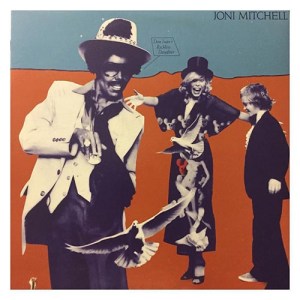
Powers does a great job of reconsidering Joni’s underrated 80s albums. She is unafraid to share her reverse schadenfreude—it bugs her that prickly Joni has turned into cuddly Joni in Mitchell’s final chapter of life.
One of the major takeaways from the book is that it has prompted me to explore my Joni fandom. As I read the book, I jotted down what I love about Joni:
- The mood her music creates, especially the melancholy but also the humor
- The lyrics and stories
- Her voice and how it ages
- Her guitar playing
- The arrangements (Joni has been her own producer for most of her career)
- Her command of multiple genres: folk, folk-rock, pop, rock, and jazz-fusion
- Her look
- Her attitude
- Recently, from the most recent iteration of Joni, her giggle
I love how Powers puts it at the end of the book in her acknowledgment section:
“Joni Mitchell, I thank you for your endless complexity. It gave me so much to explore, and I’ll never regret my time following you.”
If you are a fan of Joni Mitchell, Ann Powers’s Traveling: On the Path of Joni Mitchell is a must-read!

My introduction to Chappell Roan was a recent headline that she “slayed it” at New York’s Governors Ball Music Festival on June 9, 2024. I had no idea who she was. Then, my daughter texted me to ask if I was familiar with Roan. My daughter’s interest in Roan was that she was being elevated to a bigger stage at Bonnaroo (which she was attending). It became clear that Roan was a rising star. It was also clear that her small-town girl queer coming-of-age perspective really resonated with audiences. That motivated me to listen to The Rise and Fall of a Midwest Princess to witness the hype.

Upon first listening to the album, I heard Lady Gaga, Billie Eilish, TSwift, and Olivia Rodrigo in the production and performance. My knowledge of contemporary pop divas is limited, so I don’t know how original Roan is, but sonically, it sounds pretty derivative of those pop divas. That being said, this is a fun album, and based on what I have seen online, Roan is outstanding live. On repeated listening, what came out was how great it was lyrically and from a storytelling perspective. As a male cishet senior citizen, I am pretty clueless about LGBTQ+ coming-of-age. The more I listened, the more impressed I was by Roan’s stories, and I felt like I was getting an education. She wrapped her stories in a fun pop sheen, which made it even better – she is a legit pop star with a vision.
So, who is Chappell Roan? I am summarizing from Wikipedia: She is 26-year-old Kayleigh Rose Amstutz from a small town near Springfield, Missouri. Roan is not an overnight sensation. She signed a contract with Atlantic in 2015 and released some singles and an EP, but there was not enough traction, and she was dropped by Atlantic in 2020. She secured the faith of producer Dan Nigro – who is a big deal. He has produced and co-written songs for Sky Ferreira, Kylie Minogue, Caroline Polachek, Olivia Rodrigo, and Conan Gray. He won a Grammy Award for Best Pop Vocal Album for producing Sour (Olivia Rodrigo breakout) in 2021. He signed Roan to his Island Records imprint Amusement. He co-wrote and produced this album. Over the last few years, Roan returned to the game with independent singles (that appear on this album). So, the point is she is not a rookie. The Rise and Fall of a Midwest Princess is her moment. Her post-album single, “Good Luck, Babe!” is her first big hit and is raising the profile of The Rise and Fall of a Midwest Princess (more about that new hit in the postscript below).
The album is a concept album of sorts, even though nine of the fourteen songs were released as singles between April 2020 and the September 2023 release of this album. At the very least, the album has a narrative arc. In an interview with Teen Vogue, she said:
“It is the storyline of a girl who moved from a small conservative town to a city and had an awakening of this world she never knew existed… Which includes queerness, which includes heartbreak, which includes falling in love, which includes the city and clubs, and it’s the world of Chappell Roan.”
The album opens with “Femininomenon,” a song about an online relationship gone sour and the female narrator’s frustration with men as lovers. Roam addressed the made-up word “femininomenon” in a Reddit thread:
“ummm no man could literally get me off (stilll the case ^e^) and my cowriter and i were just messing around and made up the word haha! it’s so weird“
Sonically, “Femininomenon” is a little too “High School Musical” for me. It is the weakest track on the album; it only goes up from here. Looking online, this song plays better live than on the recording.
“Red Wine Supernova” – I assume the title is a reference to the 1996 Oasis hit “Champagne Supernova” (which is one of those meaningless phrases that sound cool – per Noel Gallagher, the song’s writer, “It means different things when I’m in different moods”). After the frustration described in the last song, the narrator is having fun and more fulfillment in a lesbian relationship.
“After Midnight” is a goody-two-shoes having fun being a freak in the club. It has a wonderful disco groove.
“Coffee” is Billie Eilish-esque sonically. The song is about the wrong idea of getting together with an ex—even if it is just for coffee.
“Casual” is my favorite song on the album. It is a power ballad that perfectly describes two people in a relationship who are not on the same page: the man thinks it is “casual,” and the woman believes it is love. In the end, the woman figures it out:
“I hate to tell the truth, but I’m sorry dude you didn’t
I hate that I let this drag on so long, now I hate myself
I hate that I let this drag on so long, you can go to hell”
“Super Graphic Ultra Modern Girl” is sonically pure Lady Gaga. After the last song, our heroine will not make the same mistake on the next dude (or a dude at all).
“HOT TO GO!” was the final single released about a month before the album’s release. It sounds like Olivia Rodrigo’s pop punk. It is Roan’s cheerleader fantasy.
“My Kink Is Karma” is a kiss-off to an ex and sounds like a Taylor Swift song.
“Picture You” – The melody reminds me of Radiohead’s “Creep.” Lyrically, the song’s narrator is masturbating in front of a mirror while fantasizing about a female love interest.
“Kaleidoscope” is another song with a Billie Eilish vibe. The song describes the complications of “just friends” becoming more (even without “crossing the line”). Roman uses a kaleidoscope as an analogy for this situation:
And love is a kaleidoscope
How it works, I’ll never know
And even all the change
It’s somehow all the same
Turn it to the left and right
Colors shinin’ in your eye
And even upside down
It’s beautiful somehow
It’s never just a shape alone
Love is a kaleidoscope
“Pink Pony Club” sounds like a Lady Gaga anthem. The song is inspired by West Hollywood’s iconic gay bar, The Abbey, which features male and female go-go dancers and regular drag shows. It is Roan’s queer anthem about a safe place to wave your freak flag. This was the first single in this album cycle and got her much attention – her biggest hit before the new album and “Good Luck, Babe!“
“Naked in Manhattan” captures the first moments of a new crush and, more specifically, the transition from heterosexual to homosexual relationships. The small-town girl is in the big city:
In New York, you can try things
An inch away from more than just friends
Per Genius.com, “California” was composed during the pandemic lockdown while Roan was quarantined in her hometown. She had returned to Missouri from California after her career had tanked (sacked by Atlantic and her indie single “Pink Pony Club” was underperforming). The story is from the perspective of our heroine failing in California and knowing it is time to hightail it home. The song has a sense of resilience vs depression. Spoiler Alert: our gal will make it despite this setback. I don’t fully appreciate the challenge of being queer in Rednecksville (although Roan has taught me a lot with this album), but “California” is the most profound and most revealing track on the album.
“Guilty Pleasure” sounds different from the rest of the album. It starts as a quiet acoustic ballad and then explodes into a disco/rock jam. It is catchy AF, and it shows off Roan’s pipes. Lyrically, this is the story of a hot relationship. I once was young and went to discos—this would have been a banger under the mirrorball.
Although this is a collection of singles, the song sequence is so brilliant that it has become a concept album. I have also buried the lede: Roan can sing! Well done, Chappell Roan!
Postscript: Roan released a new single (not on this album) this past spring, “Good Luck, Babe!” It is her first big hit. It was number 77 on the Billboard Hot 100 upon release and peaked at 16. More significantly, it is in the top 10 on Spotify.

Sonically, Roan sounds like she has found her sound (this was hinted at in “Guilty Pleasure”): epic pop rock. Lyrically, it is an intriguing breakup song: the narrator has been dumped because her lover can’t handle their queer relationship. The narrator is pissed – treating her lover’s abandonment for heterosexuality as infidelity. The song has a clever ending – it slowly deflates like a hot air balloon. Her voice is wonderfully dynamic – Gaga would be proud.
You have to have a hit if you want to be a star—with “Good Luck, Babe!” Chappell has a hit! In addition, she now has three of The Rise and Fall of a Midwest Princess songs on Spotify top 50 thanks to “Good Luck, Babe!” too.
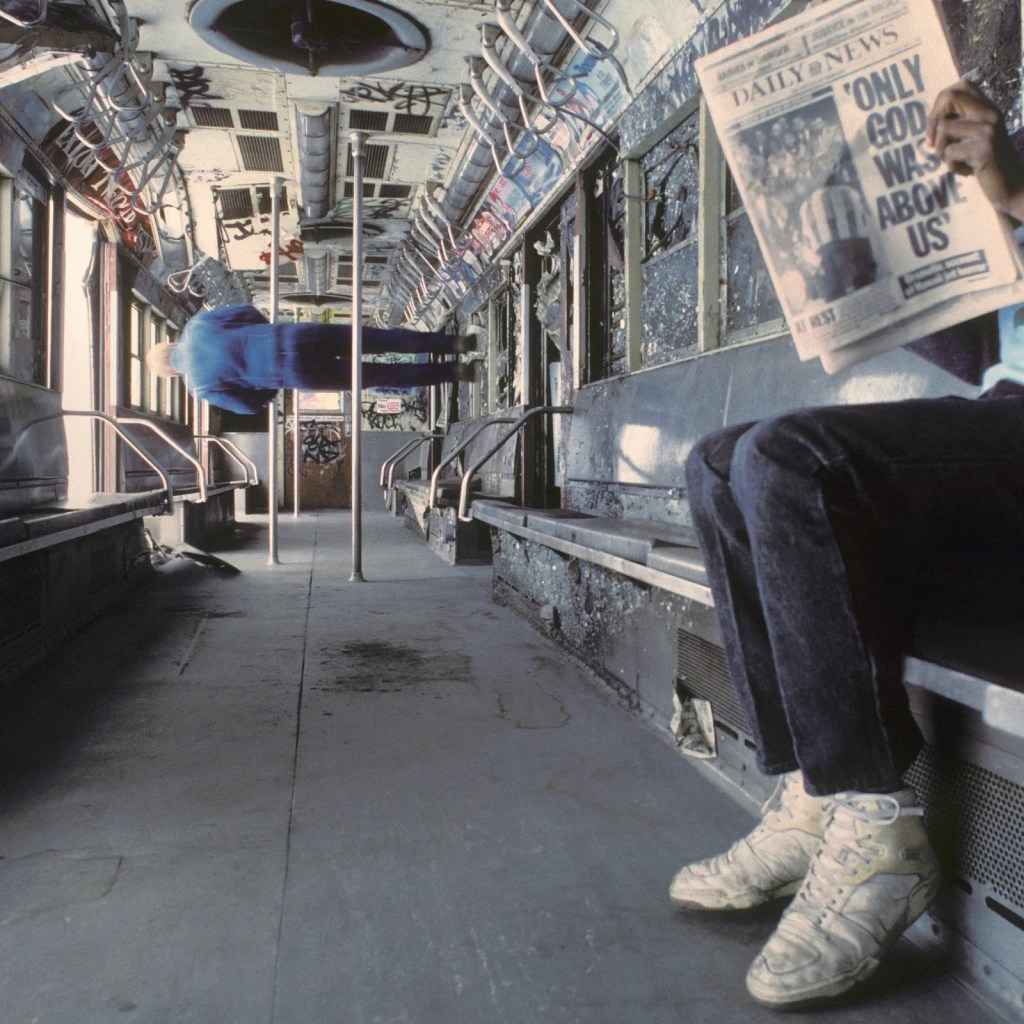
Only God Was Above Us
2024
It has been six years since Vampire Weekend’s last album, Father of the Bride – an eon in pop music. That album is my favorite; it brought a jam band aesthetic to their sound. Only God Was Above Us is a taut but adventurous indie-rock sound that harkens back to their first three albums with a twist: it is noisy (distorted guitars, squawking saxophones, busy arrangements, etc). It is unquestionably a Vampire Weekend album with Ezra Koenig’s distinctive vocals, clever lyrics, and baroque pop sound. It is a grower; the first few listens to the album did not impress, but it revealed itself around the fifth time through the album.
The music critic Steven Hyden has declared that with Only God Was Above Us, Vampire Weekend passes his five-album test: “…you look at their discography, and you judge whether they have put out five consecutive ‘great’ albums.” The five-album test is Hyden’s method of judging if an act is Hall of Fame worthy – although a Hall of Fame act can still get there without the five-album test. I agree that Vampire Weekend is a Hall of Fame act, and Only God Was Above Us cements that status by being both the epitome of the Vampire Weekend catalog and a step forward – it is the perfection of Vampire Weekend.
“Ice Cream Piano” sets the tone for the album’s sonics. The intro is quiet, yet a distorted guitar is boiling in the background, and at about the one-third mark, the song explodes. The lyrics speak to our crazy times. The song’s narrator declares: “You don’t want to win this war ’cause you don’t want the peace.” Our world today is filled with chaos mongers, where disruption is the goal, not a solution. The narrator’s response to this chaos reacts with a clever homophone (not their first use of this device – see “Diane Young” off of Modern Vampires of the City) of the song title:
“In dreams, I scream piano, I softly reach the high note
The world don’t recognize a singer who won’t sing”
I scream piano means “I scream softly” (“piano” being a musical term for playing quietly vs. the instrument). Quietly screaming seems like an appropriate response to our crazy times.
“Classical” is a “classic” example of Vampire Weekend’s ambition. Sonically, it is a combination of indie rock and jazz. Lyrically, it is a meditation on class conflicts and, specifically, how elites prosper at the expense of the lower classes. The narrator begrudgingly accepts that this has become the norm, that is classical. By “classical,” the narrator means “…regarded as representing an exemplary standard; traditional and long-established in form or style” (per New American Oxford Dictionary). It is “classic” Vampire Weekend that they would refer to class issues as classical.
“Capricorn” is a vignette on a “December Capricorn” (someone born in late December, but most of their first year is the following year). This appears to be an analogy for someone who is disconnected:
“Too old for dyin’ young
Too young to live alone
Sifting through centuries
For moments of your own”
Sonically, this is a guitar distortion-focused song.
Musically, “Connect” combines synth-pop, baroque, and jazz—chaos that doesn’t work on paper but works on the ears. Lyrically, the narrator complains they can’t connect with their love interest despite standing on top of a big city (assume NYC) infrastructure that is all about connection.
Vampire Weekend was famously formed at Columbia, and the assumption is that the band was made up of WASPy, wealthy, and privileged kids. Ezra Koenig, the driving force and songwriter of Vampire Weekend, is a New Jersey Jew from an intellectual white-collar family – not poor, but not Ivy League either. “Prep-School Gangsters” is a bad memory of having to come of age around rich WASPy kids. In the chorus, the narrator gets to the heart of the matter:
“Call me jealous, call me mad
Now I got the thing you had
Somewhere in your family tree
There was someone just like me”
“The Surfer” has both a David Axelrod acid jazz vibe and is Beatleesque – a fantastic soundscape. I am not sure what the song is about, but I guess the narrator observes a homeless person who once had a bright future but is now hopeless.
“Gen-X Cops” has an excellent New Wave rock sound. Vampire Weekend are Millenials, and Generation X is the generation before Millenials. The song appears to be about how each generation judges (mainly in a negative way) the other generations around them.
“Mary Boone” is a New York art dealer and collector born of working-class Egyptian immigrants. The song’s narrator connects with Boone’s life story: a critical and financial success in the big city from a humble background.
“Pravda” opens with a classic Vampire Weekend guitar riff—part Afro-Beat and part Bach. That riff reappears throughout the song, a pretty cool juxtaposition with the lyrics that tell the story of Russian immigrants.
“Hope” appears to be about US politics. The narrator acknowledges that there is a lot to be in conflict over but hopes the anger can be overcome by letting go of the conflict.
Overall, this is an excellent album. It is not significantly different from the rest of their catalog, but it distills what they do best. This would be a great introduction to the band. I am seeing Vampire Weekend this summer and trying to imagine how they will pull off the elaborate arrangements live. They did a couple of songs on SNL (see clips above) and pulled it off sonically, but visually, they fell flat.
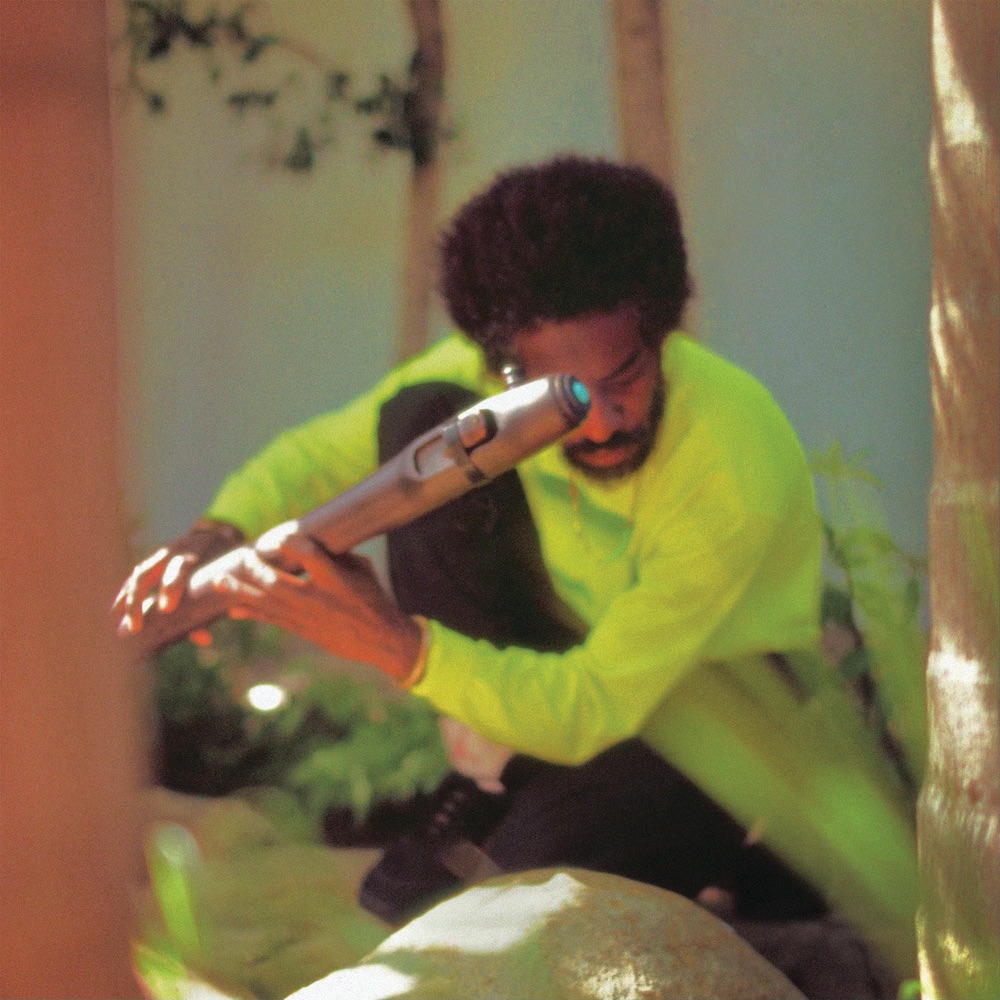
I was intrigued when I heard that rapper André 3000 would release a flute album. The Outcast was a hip-hop act I was actually into. They were artsy yet pop. When I first listened to New Blue Sun, my first reaction was that it was ambient jazz without hooks – a snoozefest. I have been listening to the new Kamasi Washington, and there is a track that André 3000 is on, and I dig it. Per Kamasi’s website:
André 3000, perhaps rap’s finest stylist, whose guest verses are coveted by all, offers up his very first flute feature on “Dream State.” A song about moving on from struggle is an apt contribution from an artist searching for freedom. “Andre is connected to music in a way that’s inexplicable, and he still has that same magic on the flutes,” says Washington.“That honesty, and that trueness to his spirit is there.” When he showed up to the studio with a bag of flutes, Washington and his bandmate and fellow Fearless Movement composer Brandon Coleman invited him to jam. Together, they found the song on the first pass. “We’re not easy musicians to swim around with. We moved kind of fast and free, and he was just with us,” says Washington.
So, that had me returning to New Blue Sun. Given the excellent performance of “Dream State” on the Kamasi album and Kamasi’s story of the making of that song, I felt I owed André 3000 flute album a second look – plus I am a flute player.
Listening to New Blue Sun with more open ears, my revised take is still ambient jazz without hooks. However, it is not a snoozefest. It is pretty cool music. It is engaging if you give it a chance. It is the kind of ambient music that can be enjoyed both passively (background music) and actively (full engagement with the music: no distractions with a quality playback rig – or at least good headphones).
So, what does it sound like? There is a lot of synth, percussion, and flute (both organic and with electronic manipulation). It is mostly quiet, but there are occasional swells. At times, it invokes the ambient side of Pink Floyd. But most of the time, it is narcotic jazz, that is, slow-motion jazz.
I can’t imagine being in a New Blue Sun mood often, but I appreciate André 3000’s experiment. It is just not my thing – I need my music a bit more caffeinated.
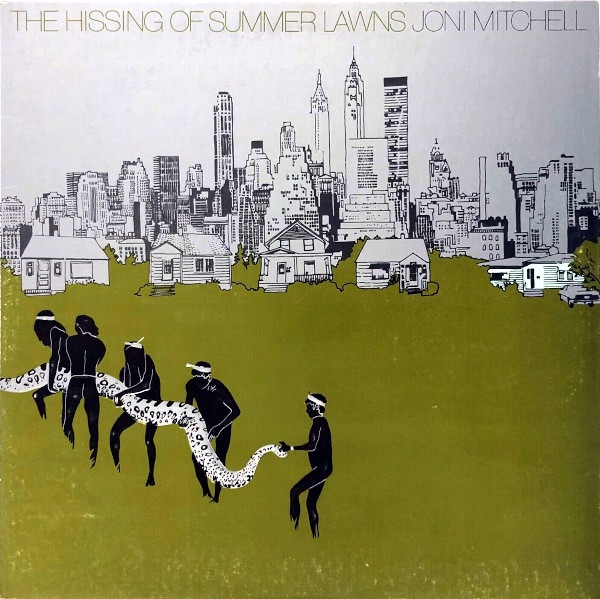
I recall Joni Mitchell’s The Hissing Of Summer Lawns (1975) as a weird and artsy album. Upon revisiting it, I had misremembered it. Most of the album is accessible and in the style of its predecessor, the jazz-pop masterpiece Court and Spark. However, it has two significant weird and artsy songs: the second track, “Jungle Line,” and the final track, “Shadows and Light.” These two tracks stuck out in my memory, not the “Court and Spark Volume 2” tracks. It is a fascinating follow-up to Joni’s most commercial album, foreshadowing how seriously Joni would soon abandon the mainstream. The album’s lyrical themes are a woman’s frustration with society’s patriarchal norms and the music industry (those two things are often the same issue). One of the fascinating things about Joni’s art is its focus on romantic relationships between men and women, yet she has a healthy skepticism and criticism of men.
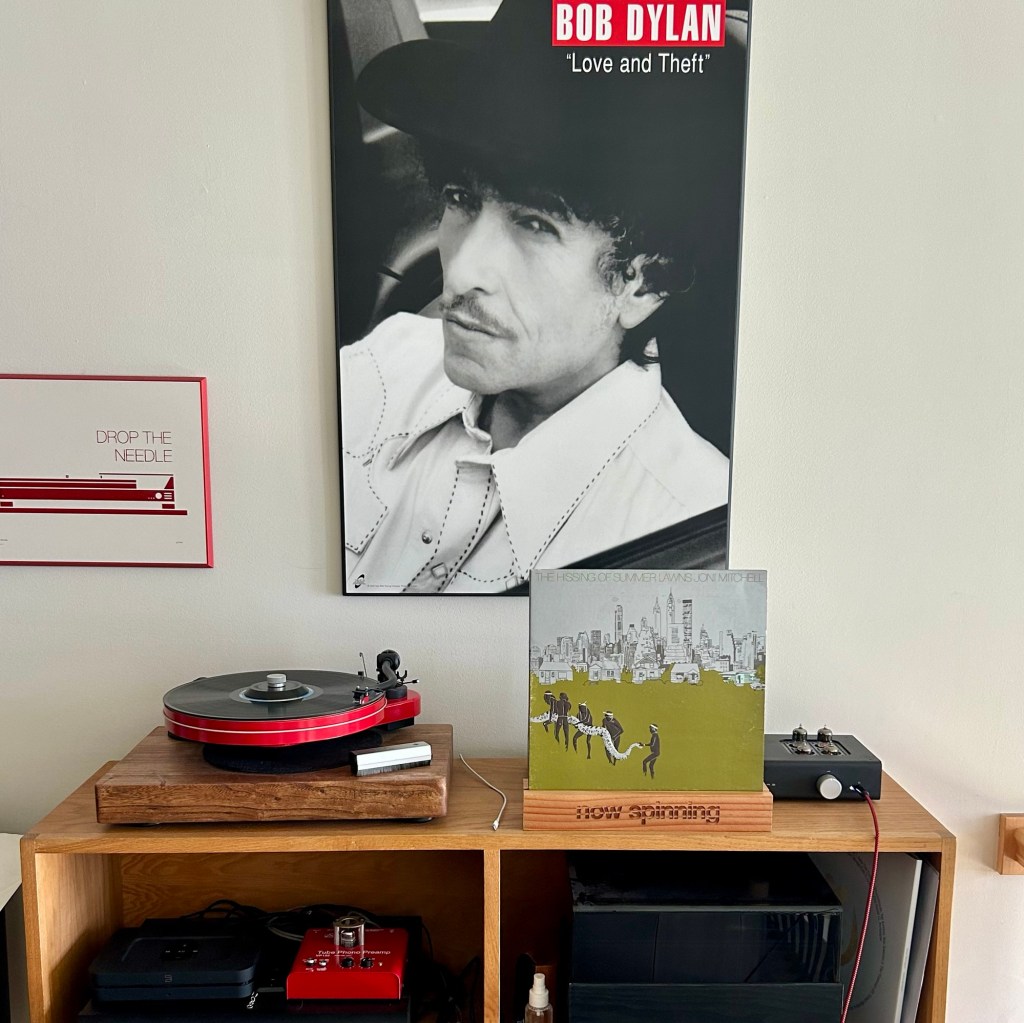
The album opens with “In France They Kiss On Mainstreet,” which would not have sounded out of place on the Court and Spark. Lyrically, the narrator recalls their 1950s teenage years—a time of innocence and playfulness—quite a contrast to the treacherousness of the 1970s that dominates the rest of the album.
On the second track, she takes a bizarre sonic turn with “Jungle Line,” which doesn’t sound like anything in her catalog. She samples The Drummers of Burundi (credited as “warrior drums” on the album) and mixes it with a Moog synth, guitar, and her voice. The drum sampling is one of the earliest uses of sampling in a commercial recording. This would become a convention in hip-hop a few years later. The sound is jarring after the sheen of the first track. Lyrically, Mitchell blends images of painter Henri Rousseau’s work with city life, the music industry, and drug culture. It foreshadows where she would go with her own career and where peers like Paul Simon would go (for example, Graceland). At first, this song feels out of place after the naivete of the first track, but it is an excellent transition to the darker themes of the rest of the album.
The next several songs are a sonic return to the jazz-pop of Court and Spark. “Edith and the Kingpin” tells the story of a gangster picking out a prostitute and then snorting coke with her. Things have turned dark indeed.
“Don’t Interrupt the Sorrow” is dominated by a classic Joni acoustic guitar riff. Lyrically, it is a stream-of-consciousness musing on patriarchy. Mitchell, one of her generation’s great songwriters, must have been frustrated at being dismissed as a mere “girl singer.” This song is a glimpse of that frustration. In the liner notes, Joni writes: “The poem, “Don’t Interrupt The Sorrow” was born around 4 a.m. in a New York loft. Larry Poons seeded it and Bobby Neuwirth was midwite here, but the child filtered thru Genesis at Jackfish Lake, Saskatchewan, is rebellious and mystical and insists that its conception was immaculate.”
“Shades of Scarlett Conquering” is piano-driven. This is another song of the narrator chaffing under the patriarchy. The images are based on a southern belle like Scarlett O’Hara in Gone With The Wind.
The titular song, “The Hissing of Summer Lawns,” tells the story of a Stepford Wives-like character who is owned by her husband. The song title refers to the sound of sprinklers on a perfect suburban lawn.
After several songs about the patriarchy, in “The Boho Dance,” the narrator turns to muse on an artist who betrays their artistry for commercial success. This must have been at the top of Joni’s mind after the commercial success of Court and Spark.
A common feature in Joni’s songwriting from Court and Spark and beyond is to create a collage of her songwriting with a cover song. “Harry’s House – Centerpiece” is a combination of her composition (Harry’s House) and a jazz cover (jazz standard “Centerpiece” by Harry “Sweets” Edison and Jon Hendricks). The song tells the story of a deteriorating marriage: the husband is obsessed with his job, and the wife struggles with her housewife/mother role. In the middle of the tale, she seamlessly integrates “Centerpiece.” Joni takes what is supposed to be the jazz song’s complement: “‘Cause nothing’s any good without you/Baby, you’re my centerpiece” and turns it into a backhanded compliment. This song shows the brilliance of Joni: seamlessly mixing her pop sheen with a straight jazz cover.
“Sweet Bird” updates her acoustic guitar/piano sound before Court and Spark. Lyrically, it returns to her early albums’ “confessional” singer-songwriter mode. The narrator is mourning the loss of youth—especially as a woman, where youthful beauty is so defining. In the liner notes, Joni writes: “”The Boho Dance” is a Tom Wolfe-ism from the book “The Painted Word.””
The album ends with sonic experimentation. “Shadows and Light” is a synth-based riff with Joni’s vocal overdubs. Lyrically, it is a litany of contradictions and opposites, like shadows and light. This song must be meaningful to Joni, as she named her 1980 live album after it and opened that tour’s concerts with the tune (accompanied by the acapella group The Persuasions adding gorgeous textures—I saw that tour).
Joni always has excellent album art and packaging. This cover art is created by Joni (a common feature of her albums). It uses the African theme of “The Jungle Line” by superimposing an image of dark-skinned people carrying a giant snake (both were embossed on the original vinyl album cover) on the Los Angeles skyline, with Mitchell’s house on the back cover. On the interior of the gatefold are the lyrics, liner notes, and a swimming Joni radiating her femininity.
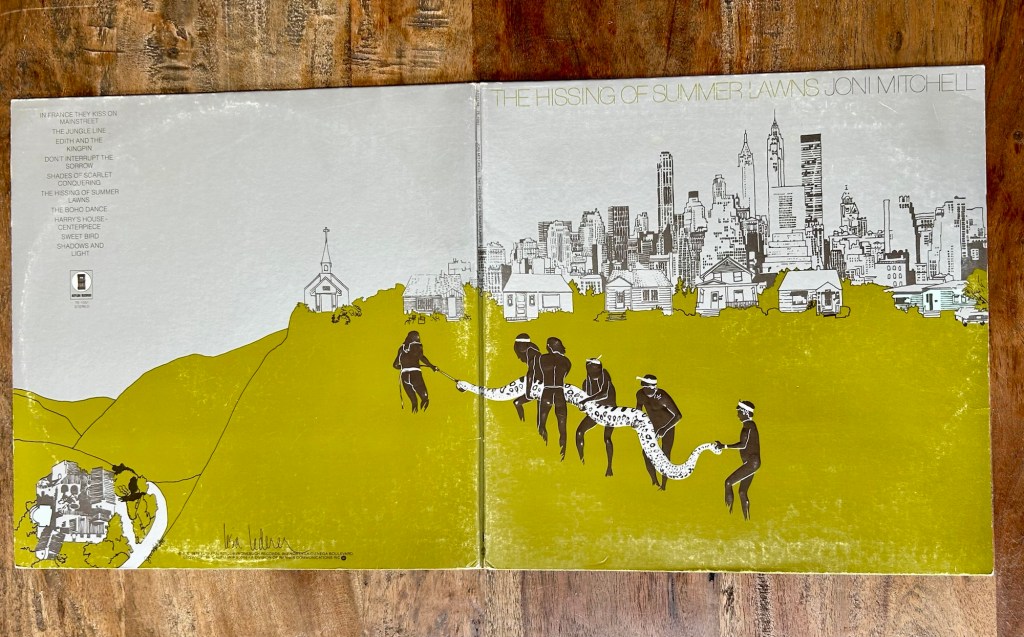

The album has aged well and is as solid as anything in her catalog. Prince was a huge Joni fan (Mitchell told New York Magazine in 2005: “Prince used to write me fan mail with all of the U’s and hearts that way that he writes”) and frequently gushed about Hissing in several interviews.
In the liner notes, Joni writes: “This record is a total work conceived graphically, musically, lyrically and accidentally – as a whole. The performances were guided by the given compositional structures and the audibly inspired beauty of every player. The whole unfolded like a mystery.”


