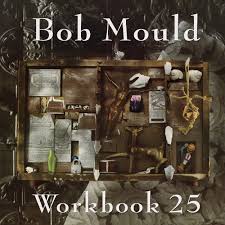
Bob Mould’s Workbook is one of the most important albums in my music library. I had not been a Hüsker Dü fan (I was a Replacements guy and if you read this blog you know I am consistently late to the party). I had some of their albums (I had to – I am a Minneapolis guy), but they never resonated with me. When I picked up Workbook in the spring of 1989 I was sold – Bob Mould was a genius.
I was a big Richard Thompson fan at the time and I was blown away by how much Mould channeled him – yet Mould claimed to be ignorant of the influence at the time he put these tracks down. On the surface Workbook denies Mould’s hardcore punk reputation. But Hüsker Dü always was much more than a typical hardcore band – they were subversives – sneaking melody and pop under buzz-saw guitars. In the review mirror of 25 years it should not be a surprise that Mould would pull a subtle masterpiece out of the ashes of Hüsker Dü.
The back story is that Bob was recovering from the nasty breakup of Hüsker Dü. He was living in a farm-house outside of Minneapolis. He wrote these songs and demoed them alone. He shopped them to Virgin who was trying to gab a foothold in the American indie-rock hot bed of the late 80s. Virgin got lucky – they bought a masterpiece.
Workbook mixes folk and rock to stage the reflections of a thoughtful man who just survived a hurricane. It is tender and edgy. It is joyful and cynical. It is the mature statement of a once angry teenager who is now a man. I am roughly the same age as Mould (and now that we are both in our mid-50s we even look a bit alike); this album really resonated with me – I was about to become a real man myself just a few months later with the birth of my son. The album has stuck with me over the years and as recently as a couple of years ago it was back in heavy rotation as I was recuperating from surgery while reading Mould’s memoir.
It has only been in the last few years that I finally “got” punk music and Hüsker Dü in particular. It is easy to see now why they were so important. It is tragic, yet only right, that they would self destruct despite recently hooking up with a major label. The foreshadowed by five years Nirvana who would take their innovation to the masses (Cobain would be the first to admit the influence).
I was excited to see Mould was reissuing Workbook on LP (on vinyl for the first time) and in deluxe CD package. When I went the Electric Fetus to pick up the LP, I was disappointed to see they vinyl did not have the bonus live stuff on the deluxe CD package – so I opted for the CD.
The CD sounds great. A much livelier mix; much more presence and wider sound-stage than the original CD (I like to think we have learned a thing or two about mixing CDs in 25 years). The original was great sounding CD – the reissue is even better. A great remaster.
But the real treasure here is the bonus CD (since I have listened to the original hundreds of times) of a live concert from 5/14/89 in Chicago (The Metro). The live presentation of the Workbook songs is more what you expect from a rocker like Mould – so it’s fun to have rough and raw rocking versions of the songs. The live set has a couple of songs that did not make the album, a brilliant cover of Richard Thompson’s “Shoot Out The Lights” that alone is worth the price of admission (Mould must have been curious about the comparisons that were being made), he rounds out the set with an acoustic solo rendition of three Hüsker Dü chestnuts. I am so sick of being screwed over by crappy bonus disks – this is redemption I needed to keep being “that guy” (AKA sucker) buying deluxe editions.

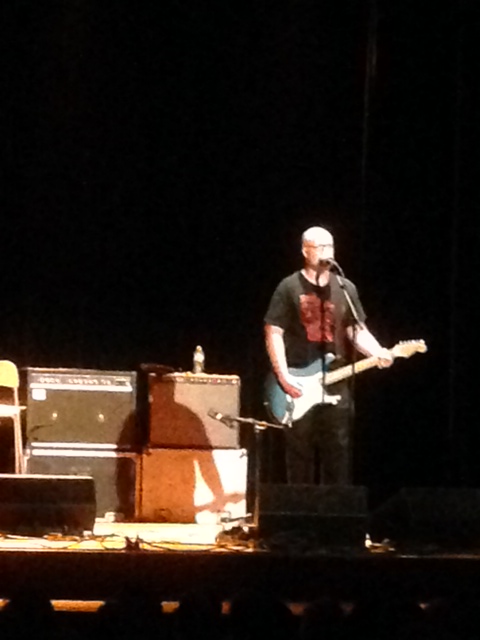
A joyful Bob Mould – photo from City Pages and my sorry iPhone snapshot
On to the recent Workbook 25 show in Minneapolis. For a professional review, a set list and better photos see City Pages.
I really enjoyed the show. First the venue is great – The Women’s Club Assembly is the perfect size for an artist like Mould and the theater seating is just what the doctor ordered for Mould’s aging fan base. The crowd was the most impressive collection of 50+ hipsters I have ever witnessed. Bob was in great form – he was energetic and joyful. He really seemed like he wanted to be there and the quote of the night from him was “For this record, I can say it: It’s good to be home.” He even wore a Minnesota themed shirt.
Mould attacked Workbook as the true Hüsker Dü alum he is – he was rocking. But that was also a bit of a disappointment too – as cellist Alison Chesley was pretty much silenced by Bob’s roaring strat. If he was going to play like this I would have rather had a drummer than a cellist – but that is really my only disappointment.
In addition to the Workbook songs, Bob played a smattering of his other solo work, a couple of Sugar songs (damn I loved Sugar! in the 90s!), a song by his backup players’ band (Verbow) and a Hüsker Dü song as a tease. Over all a great show – good enough to help me forget my aching back (that is another story) for 105 minutes of rock and roll nirvana. PS – “See A Little Light” gave me goosebumps (see Bob play it a couple of nights later on Letterman).
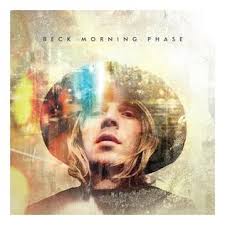
I came to Beck well after his first splash in the early 90s. When “Loser” was in ubiquitous rotation I assumed that Beck was just a novelty act. I somehow completely missed Odelay the first time around. I became a fan after the one two punch of the “R&B Beck” of Midnight Vultures and the “sad-Beck” of the melancholy classic Sea Changes at the turn of the millennium. Then I backtracked and realized what a true genius he was on Mellow Gold and Odelay. After Sea Changes I would religiously pick up his latest release, but those albums never resonated with me. So I as pretty excited to hear the pre-release hype for Morning Phase which suggested a return of the “sad-Beck” and a sequel of sorts to Sea Change.
Well it lives up to the hype. If you liked Sea Change you are going to like Morning Phase. As much as I liked Sea Change it seemed like an experiment, whereas Morning Phase feels more natural/organic. A suitable album for a pop star’s first album in his 40s. The album has lots of Classic Rock flourishes: a bit of a Moody Blues, the mellow side of Pink Floyd, the ballad side of Elton John, Nick Drake, Neil Young and even some Simon and Garfunkel. It is very atmospheric and wonderfully melancholy. The arrangements are rewarding and only reveal themselves slowly after repeated listens – the first couple of passes it sounds muddy and dull – so hang in there and give it at least five attentive listens – there is a payoff. It is great to have the Beck I love back in rotation. A little taste below:
Well I was seriously jonesing for vinyl yesterday – I braved miserable driving conditions to visit the winter installment of the just west of Minneapolis RockNRoll Music Sale. But it was worth it. This visit was about quality over volume – rather than stock up on the dollar records, I focused on the top-shelf stuff. I had a 50 bones and I spent every one.
My top find was a near mint copy of Buckingham Nicks for $12 – not an original gate-fold, but still a great value. The recent passing of Lou Reed had me searching for some of his work and I found two mid-70s classics: Coney Island Baby and Street Hassle. A couple of Material albums found their way into my hands along with a couple of Robert Cray albums. I have been looking for a long time for a reasonably priced Grateful Dead Wake of the Flood – found one. A real surprise was a sealed copy of a 2005 Blue Merle album (that kind of predates the recent vinyl craze – why was that there?). Style Council’s Internationalist rounded out the more than a dollar stuff. The dollar bin was looking good, but I only had $3 bucks left so I had to practice some restraint: Everything But The Girl (eponymous), Gram Nash’s Songs For Beginners, and Hall & Oates Abandoned Luncheonette. Look forward to some reviews of some of these LPs.
This sale (and its companion sales through out the rest of the year – watch their Facebook) has a great selection and very reasonable prices. For example the Buckingham Nicks at $12 – that would be twice that at a record show or on Discogs.com. Most titles are well under a fin. Add the funky location (Jeffery’s garage when the weather permits or a recording studio when the weather does not), friendly proprietors and you have one great crate digging experience – worth risking you life to get there in post blizzard treacherous conditions!
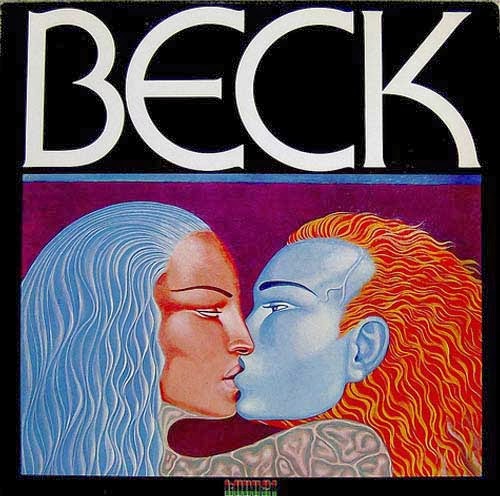
I bought this LP for four reasons (in order of importance):
- The Mati Klarwein cover art (which I had never seen before, but instantly recognized as Mati Klarwein)
- The fact that it was on the Kudu/CTI label
- I was vaguely familiar with Joe Beck as Miles Davis’ failed first attempt at hiring an electric guitar player
- It had a cool line up: David Sanborn (sax), Don Grolnick (keys), Will Lee (bass), Chris Parker (drums) and Steve Kahn (guitar)
Double bonus – it is a great LP. This is quality smooth jazz. If you didn’t know, you would think this is a David Sanborn album. His sax overshadows the proceedings. This was David Sanborn before he was David Sanborn. His horn is instantly recognizable to smooth jazz fans and to fans of early Saturday Night Live (listen to Sanborn’s solos all over this album and you will know what I mean).
According to allmusic.com smooth jazz is :
“Smooth Jazz is an outgrowth of fusion, one that emphasizes its polished side. Generally, smooth jazz relies on rhythms and grooves instead of improvisation. There are layers of synthesizers, lite-funk rhythms, lite-funk bass, elastic guitars, and either trumpets, alto, or soprano saxophones. The music isn’t cerebral, like hard bop, nor is it gritty and funky like soul-jazz or groove — it is unobtrusive, slick, and highly polished, where the overall sound matters more than the individual parts.”
Not a very flattering definition, but fair. Joe Beck’s Beck manages to sound great, despite being smooth jazz. Why? I really don’t know. But every genre has great music and every genre has crap music. Great music defies labels, especially unflattering labels. Perhaps this is a great smooth jazz album because it was one of the cornerstones of the genre. Or maybe it is more soul jazz than smooth jazz. Or maybe because David Sanborn has more genuine personality in his playing than any of his peers. Or it could be the just plain great playing by an ensemble of studio/session rats on a busman’s holiday. I hate most smooth jazz as much as the next guy, but there are some masterpieces of the genre and I stumbled on one because of the cover art. Do judge a book by its cover – if it is a great cover!
For a little taste check out the You Tube below of the opening cut “Cactus.” Note the not so cool cover art which was from an now out of print reissue of Beck called Beck and Sanborn to take advantage of Sanborn’s fame.

It is hard for me to be objective when it comes to Pat Metheny as I am true fanboy when it comes to his music. With that admission in place, I wan to state that 2012’s Unity Band blew me away even more than the typical Metheny release. Metheny had held out 32 years to have a release with sax and 1980’s 80/81 with Michael Brecker is one of my favorites from the Metheny catalog, so I was thrilled to hear Metheny was going to release a second album with his horn infused (Chris Potter) Unity Band (now dubbed Unity Group due to the addition of mufti-instrumentalist/vocalist Giulio Carmassi).
Where Unity Band was pretty straight ahead jazz, Kin is Metheny jazz. The album falls into the highly arranged/orchestrated “Group” albums of the past. The album is richly textured and appeals to my conventional Metheny “Group” fanboy along with the my love of the more adventurous side of Metheny.
But the key for me is Chris Potter’s sax – he adds a spice to the “Group” sound that is separates if from the rest of the Metheny “Group” catalog. The horn gives the album a much jazzier feel than if it was not there. Metheny has always had a “horn” feel to his solos so for him to actually play with a horn player is magic.
Even before hearing this album – on paper this album would be on my best of 2014. Metheny delivers, not just in concept, but in a true sonic tour de force.
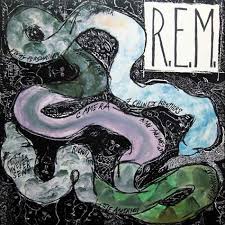
I missed this album the first time around in 1984. I had listened endlessly to Murmur, but for some reason I lost track of R.E.M. until 1987’s Document. At which point I backtracked to Dead Letter Office and have been a loyal fan of everything since then. That being said “So. Central Rain (I’m Sorry)” and “(Don’t Go Back To) Rockville” are somehow embedded in my psyche. I assume it has to do with the greatest hits package Eponymous that I listened to regularly in the late 80s.
A few months ago I picked up a nice pristine vinyl edition of Reckoning for $4 bucks but did not listen to it until a couple of days ago. Well holly shit! This gem has been sitting under my nose for 30 years? What a pleasant surprise.
Where most bands fall on their face with their sophomore album, R.E.M. hit it out of the park. This album did not sell that well nor did it make the kind of impression that Murmur did, but man this is exhibit #1 of the R.E.M sound. To quote R.E.M.’s Peter Buck: “Minor key, mid-tempo, enigmatic, semi-folk-rock-balladish things.” Reckoning is all of that and it rocks too.
Looking back with the benefit of 30 years of hindsight, Reckoning is actually a better and album than Murmur – it is more confident and fully formed – more of an album than a collection of songs. That hindsight also reveals how influential a band they would become: everything from Nirvana to Radiohead to Wilco sprouted out of early R.E.M. The early years set a solid foundation for R.E.M.’s own late 80s/early 90s mega-success when they were right in the mix with U2 for the greatest band in the world. I am so glad to have rediscovered this masterpiece. If you have never listened to it, take the time. If you are an old fan treat yourself to a reprise.
PS while listening to this album I stumbled on a great Wikipediea article: “Timeline of alternative rock.”
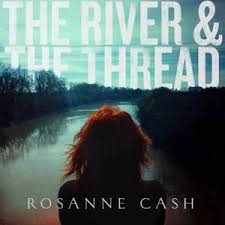
I am always amazed that a recording artist can produce a masterpiece 35 years into their career. Rosanne Cash has just done that. Cash has always produced high quality work and already has a few masterpieces under her belt, so I guess I should not be surprised.
If you are not familiar with Cash’s voice, it is distinctive without being odd. A touch of country, folk and pop. She has always surrounded herself with top-notch musicians and great arrangements and this album continues that tradition. The music behind her voice and lyrics is absolutely gorgeous and the sound of the recording is pristine. She conveys emotion with phrasing and tone – for me the lyrics are secondary – she could be singing in another language and she would get her point across.
Cash’s art has been an open book: the good, bad and the ugly of emotions and relationships. This album is more guarded, but no less emotional. More a novel than a memoir. Not quite a concept album, it does have a consistent them of a road trip. Cash is traveling and uses travel metaphors to explore her middle-aged soul.
Cash has been alt-country before that was even a gene. She is clearly out of the country tradition, but she does not let that tradition own her. She is not pop or rock either. Her music is seeking – it is contemplating. It is adult music – joy and melancholy at the same time. I guess she sings truth.
I have been savoring this album for 3 weeks now and continue to find new pleasures in it. I have a feeling this will make the top-ten list for 2014. Bravo to the Blue Note label – they have reinvented themselves from a jazz label to a curator of sophisticated rootsy pop.
Well I am disappointed in myself – I wasted 3.5 hours last night watching this year’s Grammy Awards. It was kind of like watching Saturday Night Live – you keep watching thinking at some point this show is going to have a glimmer of brilliance right? Well at least I got 10 shirts ironed while I was watching.
It was not awful, it just lacked magic. Since most of the music is boring, the artist are forced to do over the top production numbers that emphasize the visual vs. the musical. Beyoncé was hot, but her song was forgettable. Lorde gave me no reason to want to see her live (rather than twerking she convulses). I love Daft Punk’s Random Access Memories, but I love the groove and could care less about the robot shtick. I can’t believe I waited up for the grand finale of NIN, Queens of the Stone Age and the Dave Grohl – what a let down (except that Lindsey Buchingham rocked harder than any of them) – I was actually grateful when the credits rolled and cut them off.
There were a few highlights for me, but they were not-musical:
- Taylor Swift dorky dancing from her front row seats when everyone else was sitting
- Playing music nerd by trying to name the members of Ringo’s band
- Wondering who, besides me, knew the has-been songwriter representing Daft Punk for Album of the year
- Wondering where Norah was during the Phil Everly memorial
- Reading the morning after that the ratings were comparable to an episode of The Big Bang Theory (not much of an event)
- Jay-Z saying “I want to tell Blue, ‘Daddy’s got a gold sippy cup for you.’”
Usually I am blown away be some new artists that I have heard of, but never heard (e.g. Miguel, The Civil Wars, etc.) but not this year (blame that on Spotify I guess). Ho hum.
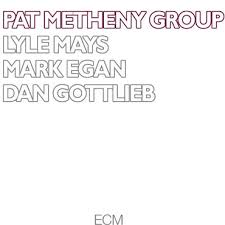
This was not love at first sight. When I first listened to this album in 1978 I thought it was elevator music. I had read several positive reviews and a guitar playing college buddy of mine raved about it. Given the endorsements I stuck with it (obviously or it would not be in my “hall of fame”) and slowly I fell in love with it.
I remember being impressed by the absolute simplicity of the cover. I would later learn this was part of the ECM record label’s charm – they had a distinct (and still do) visual aesthetic. To this day I can pull an ECM record out of a crate, and just by its front cover (not even knowing the artist), identify it as an ECM release. The sparse cover art is a perfect match for ECM’s music which also has a distinct aesthetic: atmospheric, tasteful, lean and mellow. “The Group” album cover is Scandinavian beige with a simple font that would make Steve Jobs proud. ECM had the coolest inner sleeves too – a flat plastic with one side having paper in it to give it a little body – I swear it is anti-static.
As I continued to listen I started to realize this was not elevator music or what would ultimately become soft jazz. This was a quite storm. This would be confirmed a few months later when I saw the PMG at Minneapolis’ Children’s Theatre Company stage – they surprisingly rocked!. This is fusion music: jazz, folk, and rock.
Soon I was pretty well seduced and I can’t even being to imagine how many times I have spun this LP (and then CD, then digital files and now back to LP) – probably thousands of times. The keys are: Metheny’s tone, the compositions, the arrangements and the production values. Metheny had a big sound palette and over the years it has become even bigger.
I remember wanting to share the album with my girlfriend – setting up a romantic night – presenting it to her as a sonic gift (and by that time a piece of my soul). I still have that LP and the girl (this fall we will be married 30 years), both are still in mint condition.
As for the music, Metheny has very distinctive fat guitar tone that has its foundations in great jazz guitar players like Wes Montgomery. The opening cut “San Lorenzo” perfectly defines a folk and jazz fusion. This is gentle music that is the musical equivalent of a tropical vacation sunset. The next cut, “Phase Dance” has a more rocking feel, but still mellow. Side one of The Pat Metheny Group is so solid – twenty minutes of pure ear candy: Pat’s fat guitar squeezing out long fluid notes, Lyle Mays’ supporting and soloing keyboards (busy, but not disruptive), Mark Egan’s Jaco imitation and Dan Gottlieb’s muscular drumming. All presented on a wide and spacious sound stage. Generally piano and guitar don’t mix well in jazz (similar in sound with too many overlapping overtones), but somehow Metheny and Mays made it work extremely well for several albums. Although Metheny is the star, this is a true ensemble – that is a group!
I bet I have played side one at about a 10:1 ratio over the years; to the point I am always pleasantly surprised at the beauty of side two. Side two opens with “Jaco” which is an opportunity for Mark Egan to do his best Jaco Pastorius imitation. After a Metheny introductory solo he hands off to Egan to strut his stuff. Egan unleashes a serpentine bass solo and you can see how Jaco and Metheny were kindred spirits in fat tone – it is a shame they did not get to play more together.
“April Wind” is a short solo guitar meditation that foreshadows the great solo guitar work that Metheny will do throughout his career. “April Wind” is the set up pitch for “April Joy” which is a return to the great ensemble play of the first side. The two songs are a real one-two punch, perfectly complementing each other.
The album ends with “Lone Jack.” Throughout the album Metheny is restrained and deferring to gorgeous melodies. On “Lone Jack” he reminds you he is a guitar god with an absolute kick ass solo – a 400 meter sprint that he hands off to Mays for an equally impressive piano solo before the ensemble ties it all up into a bow.
This is truly one of the great jazz-fusion albums. It is the bridge between 70s jazz-rock and 80s soft jazz (soft jazz is not always a bad thing, but unfortunately it is most often schmaltz, but there are gems hidden in the frosting). It has it foundations in folk vs. funk. It is atmospheric, yet it shreds. I have never tired of this album in the 35 years I have been listening to it. It has become part of me – a musical reflection of my soul.
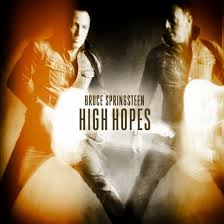
I was not impressed by the pre-release hype: a collection of covers, remakes and throw-aways from the last ten years. But it was Bruce so I had to give it a listen. My first couple of listens did not impress, but I gave it some time to marinate in my ears and then I got it. Turns out this was a brilliant idea. The covers are inspired. The remakes are better than the originals. And the throw-aways are lost gems. Bruce found a great rock and roll bromance in Tom Morello.
Every song on the album totally works and despite being a hodgepodge, High Hopes holds together as an album. I have been struggling with the last several Bruce albums – they didn’t suck, but they weren’t classics. And lets face it with a talent like Springsteen we are expecting every release to be a classic.
This album summarizes everything Bruce has been doing for a while now: E Street rebooted, atmospheric rock, folk rock, and Celtic rock. The addition of Tom Morello clearly inspires Bruce. Bruce has always needed a foil and Morello is perfect. They share liberal working man politics, they appreciate folk and they both now how to rock. Morello is just young enough to mess with Bruce in a positive way and his foundations in hip hop and modern rock songs undermines Bruce AARP membership.
Whenever a classic rock act like Bruce Springsteen pulls out a late inning masterpiece I am amazed. The titular song summarizes it all – a brilliant merger of classic E Street band jam, Springsteen dirt under the fingernails optimism and Morello’s hip hop rock guitar. It sets the table for a brilliant album. The songs are political, personal, sentimental, anthems, gritty and rocking – classic Bruce – not bad for an aging rock star in his mid 60s – relevance.

 Axl's Catch Groove