
November of 2014 has been Dylan month from me: Dylan live at the Orpheum in Minneapolis, The Basement Tapes Complete (Bootleg Series Vol. 11) and The New Basements Tapes.
I was pretty excited late this summer when it was announced that Dylan was doing a theater tour and that he would be doing a three-night stand at his old real estate the Orpheum Theatre in Minneapolis. I had attended a couple of his shows at the five-night stand he did at the Orpheum in 1992 and those were the finest Dylan performances I have ever have witnessed (I have seen Dylan about 20 times over the years) and those 1992 shows would be on my all-time top-5 concert list.
My wife and I decided this would be a family affair if we could get tickets. My daughter was able to secure 10th row center for night number one (November 4th 2014). My son lives in Chicago and I was tempted catch one of the Chicago shows (Dylan headed there next after Minneapolis) with him. But 4 tickets, flying my son home and a pre-show dinner was plenty to spend on Bob – in the end that was a good decision (more about that later).
The show was great – especially if you are a fan of Dylan’s post Time Out of Mind renaissance. Most of the show was from this era and he played half of his most recent album Tempest. I am sure this was maddening for the casual Dylan fan, but I loved it. The best part of the show was that my wife, son and daughter were there with me – as my wife has commented to questions as to how was the show: “I like the concept of the show – our family together with Bob in a smaller venue.”
I was disappointed with the sound – I expect a theater show should sound great – these old venues are designed for musical performance. However Dylan’s sound crew missed the mark – it sounded like the PA was aimed at the balcony. Now that I have a live sound reference (the recent Ryan Adams show at the recently renovated Northrop Auditorium which was the best sounding gig I have ever heard in my life), I am particularly annoyed when you pay top dollar for poor sound. This hurt even more because Dylan’s voice sounded better than it has in years. Another mild annoyance was the instance of the main floor crowd to stand for the whole show. This was no a ruckus rock show – but Dylan at his most contemplative and jazzy. Great sound and my butt in the seat and this would have rivaled the 1992 shows. I guess I am getting old an curmudgeonly.
But don’t let my whining get in the way – this was a great show: Dylan in fine voice, a super cool set list, great arrangements, tremendous lighting and Dylan’s crack band playing their asses off. Again for a true Dylan fan the set list could not be beat.
I was savoring the aftertaste of the show that night when I started Googling the set list – it was not yet available, but other shows on the tour were – the set lists for the last several shows were identical. Turns out Dylan would play the exact same set the next two nights and that continued on in Chicago with the same set list – glad I did not follow him down there – it was great once – but part of the charm of Dylan is that he usually mixes up the set list (and back in the day the arrangements). See The Current Blog for a well done review of the 3-night stand in Minneapolis.
Here is a play list based on the set list:
Since the show I have been listening to this playlist and it reminded me what a masterpiece Time Out of Mind is.
This is on my top-5 Dylan albums of all time. Every few years since Dylan has released a similarly great album and this tour celebrates the great material he has released over that last nearly 20 years. Not bad for a guy “past his prime.”

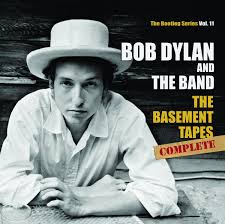
Coinciding with the November 4th 2014 show, was thee release of the 6 CD collection The Basement Tapes Complete (Bootleg Series Vol. 11). So November 4th was the single most expensive day in my 35 years of being a Dylan fan. I have been working through this definitive collection and it is a total treat to be a fly-on-the-wall of a 1967 Dylan, in hiding and on the lam, from the burden of being the voice of his generation.
As a long time Dylan fan I have heard so much about this collection over the years it is great to finally hear this not so secret stash (the 1975 version was highly doctored – this is the real and raw deal). This new release in the Bootleg Series is well documented – so I don’t feel any need to repeat the story here. The quality of the recording is terrible at times, but the underlying material is so amazing you don’t really care. In fact the CD 6 is the worst recording quality in the collection and yet the most magical. Dylan never intended these recordings to see the light of day and they have a relaxed rehearsal feel – but who wouldn’t want to peek through a knothole to watch a Dylan rehearsal? This collection is not for the casual fan (or the impoverished fan at $140 after taxes/shipping or from purchase from you local independent – PLEASE SUPPORT YOUR INDIE RECORD STORE!), For the curious and the impoverished, Spotify has a nice little taste where you can learn to believe the hype:
Finally there is The New Basement Tapes (a super group) with their Lost on the River album which also came out in November. If 6 CDs of Dylan is not enough for you there is a pile of Dylan Basement Tapes era lyrics that was recently handed over to T Bone Burnett who then assembled a super group to write music to the lyrics and perform them. This is a well hyped and documented release that does not need any further explanation by me. But I can speak to the final result – it is magnificent! Some of my favorite artists assembled and inspired by Bob: Elvis Costello, Mumford guy, Dawes guy, My Morning Jacket guy, etc. And who the hell is Rhiannon Giddens? She steals the show with her version of Spanish Mary.
It is going to take me weeks to fully digest the two Basement Tapes releases and the Dylan show has me digging back into the Dylan archive of the last 20 years of renaissance material. Oh the responsibility is overwhelming!

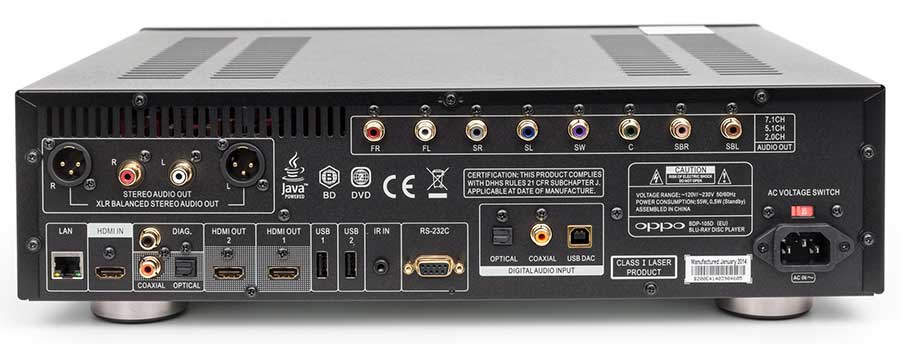
I have had techno-lust for an Oppo Blu-Ray for a long time because it is a relatively reasonably priced piece ($1300 – they also have $500 models too) of audiophile gear that will meet most of your digital needs.
My wife and I recently celebrated our 30th wedding anniversary – she go a ring and I got an Oppo. I got to give her a lot of credit: she knew what I wanted and went outside her comfort zone to travel to planet nerd (the back of Best Buy store to their Magnolia section to buy it). True love! Of course I was a brat by returning the 105 for a 105D (more about why later).
First let me point out that I never intend to use the Oppo as a video device – I plan to use it for pure audio. So if you want any opinions on how it performs in the video world you will need to go somewhere else.
What attracted me to the Oppo 105 was that it has a good quality DAC that I could play files and stream from my Mac and that, as an audio buddy of mine pointed out, it can play any spinning shiny object you can put in its transport short of a dime (conventional CDs, HDCD, Super Audio CDs, DVD Audio, Blu-ray, etc). In addition you can play almost any file imaginable via a USB port. So this is your new digital music friend.
So far I have been playing mostly conventional audio CDs (Red Book), HDCDs and streaming Spotify and Tidal from my Mac. I have tried a few Super Audio CDs too. I have not gotten around to DVD-A, Blu Ray audio and HD files. It all sounds great! A huge upgrade from my previous CD player (Pioneer DV-563A DVD Player) and DAC (Jolida FX DAC Mini). Everything sounds less harsh and with more definition – much closer to the vinyl experience I love. Of course this is very dependent on the source material. I have a huge CD collection and I expect to move toward HD streaming/downloading so I needed a quality device to facilitate all of this. The Oppo appears up to the job.
The Oppo is impressive visually. It is in a solid case (the thing weighs a ton compared to a flimsy $100 Blu-Ray). It has a nice simple look to it. Solid easy to read and use remote with back lighting.
Set up provided me some challenges. Plugging in and playing a CD was a piece of cake. I could not get my Mac to play through the DAC. The hefty manual was of no help. No help on Google either. On a lark I called Oppo customer service and they were shockingly helpful. Turns out I had to adjust a setting in the Mac’s Audio MIDI Setup. My Mac sometimes forgets that the Oppo is its DAC – but I have not really figured out a pattern here – assume it is because the Oppo’s DAC is not always on. It does seem to help to have the Oppo turned on and set to USB input before sending sound from the Mac. I guess this makes sense – my old DAC was always on.
Most of the setup and controls require a monitor – most of the user interface is via a monitor and not the face of the device. Not an issue for most users who are using the device in a home theater setting – but a bit of hassle for a two channel audio guy without a TV in my listening room.
A cute feature is that Oppo has an app that allows you to use your iPhone or iPad as a remote. I set this up and was charmed. A couple of days later my phone seemed to have forgotten the set up and it no longer worked. I have not taken the time to reconfigure it.
The Oppo needs to boot up – it is not an instant on device. It does seem to remember last settings (USB DAC input vs. CD) and where it was on a CD when it was turned off.
I have had random problems with the disc controls on the face of the Oppo not working. The remote’s disk controls have always worked. A complete shut down and unplugging seems to solve the problem. But something I will be watching.
As I write this blog I got up to change a CD and the device decided after I ejected the CD to do a firmware update and shut itself down. Fortunately this was just a few minutes event and it did give you a percentage complete status on the face of the devices so you had an idea of what was going on.
In addition to the universal nature of the device, the thing that really appealed to me about the Oppo was that it is really too players in one – there are distinct electronics for the home theater multi-channel output stage and one for stereo audio. I won’t go into the gory details – you can go to Oppo’s site to see that.
Why the 105D vs. the 105 – why spend the extra $100? The main reason for most people would be the enhanced video quality provided by Darbee processing (I don’t have a clue what that is and I don’t care). For me it was that 105D is Oppo’s latest and greatest as evidenced by a small feature that will likely be important later – an upgraded USB DAC to support DSD 64/128. I have not done any test driving of HD files of any format – only streaming through Tidal (and that is merely CD quality).
In summary, I love this device, but it is not for a technophobe. This a complex device that will require the user to invest some time and patience in its operation and set up. But the rewards are there – this has been a huge upgrade in the sonic quality of my digitally sourced music. This is as exciting as my first CD player in 1985. My last universal device (Pioneer DV-563A DVD Player) sounded terrible. My first DAC (Jolida FX DAC Mini) was a major step beyond my Mac’s on board DAC, but this is yet a another huge step forward – I know have a legitimate rival to my turntable and beloved LPs.
PS – another bonus is the Oppo has built-in headphone amplifier too!
Joining Spotify last year was a game changer in my enjoyment of listening to music. A huge catalog was available at my fingertips from any device (legally) for a mere $10 a month. I mainly listen via my iPhone – so fidelity was less important than convenience. Spotify is about as convenient as you can get. My estimate is they have about 95% of the catalog I would ever want access too.
When I would listen on Spotify and if I really liked something I go out and buy the CD or the vinyl. Spotify sounds fine on the iPhone at the gym or in the car, but it does not quite cut it at home for serious listening through “the system.” I recently upgraded the home system with an Oppo 105D – that was a major DAC upgrade for me and Spotify sounded much better than through my old DAC – but not CD quality.
I was one of the first to lay my money down on Kickstarter last spring for one of Neil Young’s Pono players, but I ultimately balked – I could not see downloading HD tracks to a one-dimensional mobile device. If I was going to listen to HD it was going to be at home via a computer, DAC and “the system.” Plus could HD streaming be far away?
Well HD streaming is almost here with Tidal which calls itself “high fidelity streaming.” It is not HD, but it is CD quality (vs. the 320 MP3 quality of Spotify). Tidal costs $19.99 a month and uses the ALAC and FLAC lossless format at 1,411 kbps, 44.1kHz/16-bit. That is roughly four times the 320 kbps bit rate of most music streaming services like Spotify. Tidal boasts 25 million songs and 75,000 music videos (I could care less about the videos). That is comparable to Spotify (but my cursory experiment with Tidal is that I have been disappointed that it does not have many of the indie titles I have found on Spotify.
I have been taking advantage of the 7 -day free sample for the last several days. I was not able to get songs to load on my Mac via the Tidal app and so I had to use the web version. I found the iPhone app via 4G it was less reliable than Spotify (break ups/pauses) – this seemed reasonable given how fat the stream is. The better sound quality was undetectable via cheap earbuds or plugged via headphone jack to the car stereo. My assumption is you would want to download music to your device or dial back the streaming quality when mobile (which brings you back to Spotify quality) .
So is Tidal worth twice as much as Spotify? I think it depends on your listening habits (do you have a large collection of music already, do you have a quality home stereo, do you listen mainly at home or mobile, etc.). If you are listening to music mainly through inexpensive earbuds via your iPhone I would be hard pressed to see the value. If you have a decent home stereo with a DAC I would say the improvement in sound quality is worth it. Personally I am not sure if I would use Tidal enough at home to justify the cost as it does not beat out vinyl or CDs (I have a huge collection and I am never wanting something to listen to). I am still trying to adjust to the notion of streaming vs. my fetish of possessing CDs and LPs (I never was fond of downloading due to sound quality more than object fetish – perhaps if I had that chapter in my history streaming would be more comfortable).
I did a serious ear test through my home system using Stanley Turnentine’s Salt Song (the titular song from the album of the same name on CTI from 1971). I compared the Spotify, Tidal, a vintage vinyl LP and remastered CD (2011) versions of the song. The Tidal version definitely sounded better than Spotify. It was less harsh and had more detail than Spotify. It compared favorably to the vinyl LP and the CD (both of which did sound slightly better than the Tidal stream). Overall Tidal had a much more natural and organic sound than Spotify – similar to comparing a CD vs. a 320 MP3. But the increased quality is subtly that would escape most undiscerning listeners. For most listeners cost and convenience win – and Spotify has cost and convenience.
I did a final headphone test via my Grado SR80s via my iPhone. Tidal was again a richer experience than Spotify. But I have to be honest – most of the time when I am listening to my iPhone it is not going to be in quite room with decent cans.
Final judgement? Tidal does sound better. I would likely need to dial down the quality when mobile to avoid interruptions. My biggest concern is will the catalog be as good as Spotify? I was disappointed when I tried to find the recent Toki Wright and Strugill Simpson albums (both were on Spotify, but not on Tidal). Understandable, given they are on independent labels and this service is brand new. But what about the new Led Zeppelin remasters? They appear available, but are grayed out on Tidal (yet available on Spotify). I guess I am not willing to pull the trigger quite yet to pay double for a service like this. I might have a different opinion if I did not have such a huge LP and CD collection for quality listening at home. I will check back with this and other HD/high fidelity services over the next few months to see of they make progress.

Lucinda is some kind of musician – at 61 she has thrown down a masterpiece – a collection that rivals anything on her resume. I am a long time fan having seen her live at the 7th Street Entry (Minneapolis) in the late 80s when she was touring behind her brilliant 3rd album Lucinda Williams. She was a powerful performer and I can still see her standing alone on the stage in a white tank top and guitar in hand. 1998’s Car Wheels on a Gravel Road is on my all time greatest album list. I have continued to buy every release since Car Wheels on a Gravel Road, but the lightning never quite struck twice for me – until now. Down Where the Spirit Meets the Bone is right there with Car Wheels on a Gravel Road.
This is a huge set – 20 songs spread across 2 CDs. The PR machine says there is a whole another album in the can (featuring guitarist Bill Frisell – I can’t wait). So clearly Lucinda is bursting in creativity 35 plus years into her career. This is the definition of “an embarrassment of riches.”
Lucinda’s lugubrious snarl is dressed in several genres on the album, yet it is a unified whole. There is country, blues, R&B, folk, swamp and rock – each a glass slipper made for Lucinda. There is not a bad song on the album. The arrangements are well crafted, yet there is a gritty authenticity that keeps the album from being slick. Sonically this is one of the best sounding records I have heard in recent memory.
Oh and that voice – it is so unique – so richly flavored. It has aged exquisitely – it is weary and wise. It is dripping with life’s experience like an ice-cold beer on a hot humid day.
If you are a fan of Americana roots music – grab Down Where the Spirit Meets the Bone. It will be like slipping on a well-worn pair of jeans and a soft flannel shirt after a hard day’s work. It is reflective relief – fine bourbon neat.
PS – What about that album title? It is such a powerful phrase. It was adapted from Lucinda’s poet father (Miller Williams) poem “Compassion.”
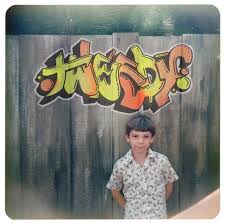
I am always intrigued when a bandleader like Jeff Tweedy of Wilco feels the need to make a solo album. What does he need to say solo that he can’t say through his band? Is Wilco really a band and not Jeff Tweedy and the Wilcos?
In the past Jeff Tweedy has toured solo where he typically plays acoustic music – just the man and his guitar. Tweedy is something else. Most tracks include Jeff’s son, 18-year-old Spencer, on drums and a couple of vocalists (Jess Wolfe and Holly Laessig of Lucius). Guitarist Scott McCaughey (Minus 5) is sprinkled on a few tracks. Jeff Tweedy is calling this a band and not a solo effort: Tweedy. Jeff Tweedy’s voice and vision are clearly dominant, but it does sound like something more than Jeff multi-tracked with back up musicians – there is a band feel here.
Some tracks sound like Wilco (more Being There than Yankee Hotel Foxtrot), others sound like the folky side of Beck and others have a George Harrison feel (a dominant influence in Wilco music in my opinion). All of the album has a casual demo aesthetic. This demo aesthetic doesn’t sound lazy as much as intimate. It is mostly a subtle album – a quite album – it sneaks up on you. As a long time Wilco fan this is treat – another side of Jeff Tweedy.
A special shout out to Tweedy for taking care of the audiophile fan with the vinyl edition: 180 gram black vinyl and a CD for the digital version. I am so sick of novelty vinyl that emphasizes the visual over the audio. And crappy companion MP3 digital downloads are a crime against humanity. Thank you Tweedy for providing some value at $30.
PS – the “Low Key” video is a hoot!

This album will be legendary if for no other reason than U2 tarnished their brand by becoming spam. They broke the number one rule of online marketing: get the customer’s permission. But they are not the first mega-band to overreach. There has been plenty written about the U2/Apple fiasco – I am here to talk about the music – which is actually pretty damn good.
I haven’t touched iTunes in a year because of Spotify. Giving this away for free forced me to use it. But it will not bring me back unless iTunes goes HD. Who needs the trouble of a download? We are streaming baby!
My first impression was that is hard to be U2 – they are so imitated it is hard to sound like the original U2. My first listen made me think of Imagine Dragons. I wondered where was Danger Mouse (so much of the per-release hubbub was about that collaboration)?
I am a U2 fan and despite the bad PR and the first impressions I was determined to give it a fair listen. It is a grower – it is a good album. On a real stereo (vs iPhone and crappy buds) the textures are revealed – Danger Mouse’s fingerprints are obvious. Bono’s voice sounds as good as ever and Edge sounds more like a guitar hero than his usual atmospheric self.
I have read a several reviews. So far only raves and haters. They must be doing something right. Here is a quick overview of the songs.
The Miracle (Of Joey Ramone) – This a little devotional to the power of rock and roll and has U2 sounding more like their disciples than themselves.
Every Breaking Wave – This sounds like classic U2.
California (There Is No End to Love) – This is the strongest and most ambitious cut on the album. It opens with a wink to the Beach Boys. As Bono gets warmed up he sounds like Police era Sting. A powerful pop song.
Song for Someone – This includes a rare acoustic guitar as the lead instrument, yet it does not sound like folk – it is pure U2.
Iris (Hold Me Close) – To me this has a bit of a Coldplay feel – and that is not a bad thing. Coldplay are clearly inspired by U2 and it is fine with me if there is a bit of a volley between the two bands.
Volcano – The song has a nice pre-Joshua Tree feel to it.
Raised By Wolves – This has a career spanning sound – a little bit of all U2’s bag of tricks is sprinkled throughout this song.
Cedarwood Road – Bono sings about his boyhood street without getting misty.
Sleep Like a Baby Tonight – By this point in the album I am hearing Danger Mouse and this track reeks of the Mouse. It is a very inspired pairing: the Mouse and U2. U2 is a band who is not afraid of a producer and they are typically better off when they are in a collaboration. They have had some great ones over the years.
This Is Where You Can Reach Me Now – Perfect collaboration of U2 and the Mouse. Almost a Black Keys feel.
The Troubles – A nice atmospheric ballad that allows Bono to show off his amazing rock and roll pipes (really he has not sounded better). The song is punctuated by Lykke Li’s very prominent “backup vocals.”
In summary this is a solid late career offering. I appreciate that U2 is not comfortable becoming just a legacy act and that they need to put out new material and that material has some ambition to it. But let’s be honest they have not put out anything truly innovative since Achtung Baby (1991). I like the fact that the album has a reminiscence theme – that seems age appropriate for mature rock stars.
I wrote most of this blog within the first week that this album came out, then I got busy and never finished it and set the album aside for a few weeks. I forced myself back to finish off this blog, feeling like the enthusiasm had worn off and thus maybe this was not such a good album after all. But it is a good album and it is a nice updating of the U2 sound with a gentle nod to their progeny.

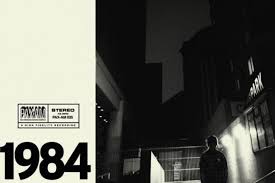
I have been hooked on Ryan Adams since I stumbled upon his band Whiskeytown’s Strangers Almanac CD back in 1997. I bought that album (at Target of all places) without any idea of who Whiskeytown was – it was low-priced and the cover art appealed to me. It is one of my all time favorite albums.
I then got into his solo career – but honestly I could not really keep up with the raw volume of his output. I caught up with him again in 2011 with his brilliant Ashes and Fire LP. Adams has kept a low profile for the last couple of years and so I was excited to hear there was a new album coming. He released a couple of singles from the album this summer and they sounded great – I was really anticipating.
Then on August 19th 2014 he released a 10 song 45 (1984). 1984 is nothing like the new album Ryan Adams. Ryan Adams is “classic rock” and 1984 is hardcore punk. On Ryan Adams Adams taps his inner Tom Petty and on 1984 his inner Hüsker Dü. This album will likely not appeal to Adams mainstream fans. If you have read about Adams you know this punk side is a very real side of his musical personality. So even if hardcore punk does not appeal to you, as a fan of Adams you need to give it a listen – think of it as an adventurous appetizer before the main course. From a marketing perspective it created a nice little pre-album buzz (and became an instant collectable – the $6 single is now on eBay at $40 – fortunately it is available on Spotify with a bonus song)
Ryan Adams will absolutely appeal to his mainstream fans. It is not alt-country, but classic rock. This album would not have sounded out-of-place in the mid-70s. But it is not an anachronism – instead it sounds pretty timeless. Which is what all Adams best work is. There is a bit of Tom Petty, Bruce Springsteen, Lindsey Buckingham and Paul Westerberg on Ryan Adams. The album whispers and it screams.
It is a grower (sounds better with each repeated listen). I listened a few times last week on the NPR First Listen preview – and it sounded OK. Similar on Spotify. But on vinyl the album really reveals itself. Adams is a serious analog and tubes guy and he clearly took care in the vinyl presentation: high quality 180 gram BLACK vinyl (thank goodness!) and a lyric sleeve – but wait that is just for looks – the actual LP is encased in an audiophile sleeve. Thank you Ryan for not treating the vinyl customer as someone with a fetish, but as a music lover and audiophile. Interesting gimmick: the MP3 download that accompanies the vinyl LP is a vinyl rip.
Clearly this will be on my best of for 2014 and I can’t wait to see him live this fall. This is as good as any of Ryan Adams’ best stuff.
PS – for a real treat check out Bob Mehr’s long read on Adams on BuzzFeed.

Barely Brothers Records has been in business about 6 months. Today was my first visit and I was very impressed. This is a vinyl only record store.
About 1/3 of the inventory is new at prices comparable to other retailers. Their used was appropriately priced to grade. Not over priced, but not discounted either. It was a deep inventory with a broad selection in several genres. They had a generous selection of $1 titles in good to very good condition. They had a big pile of $.50 LPs – this was for me either uninteresting titles or in dubious condition. But hey for half a buck what do you expect (my daughter who happened to be there today was able to find a handful of appealing titles in the $.50 crates)? The overall inventory was interesting enough that I had to limit myself to stay within budget.
I’m not a 45 guy, but it looked like they had a great supply (and it appeared well-organized). They had a nice selection of used turntables too.
The overall vibe of the place was cool. They had a nice performance space in the back. They had great lightning that facilitated both crate digging and examining titles for condition. My only complaint was that the crates were too full – it was hard to browse certain sections. But I will take that over too thin an inventory. Staff was friendly and helpful. There was plenty of street parking (however this was a Sunday). They had some chairs too – a necessary accessory when crate digging with your lovely wife who is more than tolerant (supportive) of your vinyl obsession.
In summary this is a nice addition to the Twin Cities record store landscape and I will be back. Look forward to some reviews in the near future of my crate digger’s gold from Barely Brothers.
.

This is a 1975 classic on the CTI label. Unlike most CTI releases this is not soul jazz, but one side of bop and another side of classical music (a jazz interpretation of Joaquin Rodrigo’s 1939 piece for classical guitar and orchestra, “Concierto de Aranjuez”). If that piece sounds familiar it is because it is on Miles Davis’ masterpiece Sketches Of Spain.
The LP boasts a dream line up of Hall on guitar, Roland Hanna on piano, Ron Carter on bass, Steve Gadd on drums, a temporarily straight Chet Baker (who is on top of his game) on trumpet and Paul Desmond on alto sax. The music is arranged by Don Sebesky and the album is engineered by the great Rudy Van Gelder (at his studio). Creed Taylor produces of course.
This very tasteful mellow bop. This is late night music, but it also plays well on a slow-moving hot summer Sunday afternoon (as I write this post). The interplay between the musicians like overhearing a most pleasing gentle and intimate conversation between fiends.
This is a fairly easy vinyl LP to find (and it is available on CD and various digital services with bonus cuts) in the $5 to $10 range. There is no excuse not to check it out.
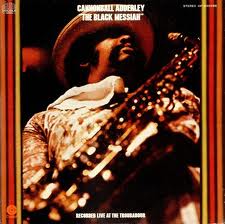
A few weeks ago I was at the RockNRoll Music Sale in Maple Grove MN when I stumbled upon this release for just $1. As I examined it, proprietor Jeff warned me that this was a great album, but there was some non-visable damage and the double LP was priced accordingly. I figured for a buck if just one of the four sides was playable it would be worth it.
The album is damaged with a heavy thump on the first minute of each side (but it did not skip), but who cares this is the definition of Crate Digger’s Gold:
- An unknown album to me
- Cover art suggested this was likely to be some funky shit
- Credits that are a who’s who of fusion greats from the early 70s (recorded live at a club date in 1970)
- Priced so low you can’t miss
- And when you play it the first time your jaw drops as you realize this is jazz rock fusion that rivals what Miles Davis was doing around this time
The Cannonball Adderley Quintet (Cannonball on alto and soprano sax, brother Nat on cornet, Roy McCurdy on drums, Walter Booker on bass and George Duke on electric piano) is augmented by percussion great Airto Moreiara on all the cuts. The Wrecking Crew’s Mike Deasy plays guitar on most cuts. Ernie Watts plays sax and flute on a few cuts. Buck Clayton plays African drums here and there and Alvin Battiste plays some clarinet. Cannonball announces from the stage that all these players are the Cannonball Adderley Quintet and “I don’t give a damn how you count.” Turns out the Quintet is a concept and not a literal name. Oh and the great David Axelrod produces.
This a bit more accessible that Miles’ Bitches Brew, but it has its pretty far out moments too. Deasy gives the proceedings a bit of a Grateful Dead feel at times. My favorite cut is “Dr. Honouris Causa” (sp) by the Quintet’s old piano play Joe Zawinul. The cut predates the Weather Report version by a couple of years and is allegedly a salute to Herbie Hancock for being awarded an honorary Doctor of Fine Arts degree from Grinnell College (Hancock had earned an undergraduate degrees in electrical engineering and music at Grinnell).
This must have been some show: there is some pretty straightforward blues rock, Miles era fusion, some Brazilian folk, jazz, some vocals, but mostly this is not category music – it is good music. Although Zawinul is not present, but you can tell Weather Report was more influenced by Cannonball than Miles – a revelation to me.
It looks like Real Gone Music has recently reissued this on a remastered 2 CD set if can’t find it in the crates. Online vinyl copies are about $20. It is treasures like this that keep me in the game.

 Axl's Catch Groove