Catchgroove’s Hall of Fame: Neil Young and Crazy Horse – Live Rust

Live Rust
1979
This is the album that hooked me into being a Neil Young fan. It is a live double album drawn from several shows in October 1978 (the album wa released in November 1979). About half the album is solo acoustic, and the other half is electric with Crazy Horse. The album is back in my consciousness due to picking up a nice vintage German pressing at a recent Phoenix record show.
When I went to college (fall of 1977), I was barely aware of Neil Young. I may not have known him at all; I can’t remember. I quickly got to know his music in college. After the Gold Rush, Harvest was in heavy rotation in the dorm. Comes a Time (1978) was a new record (with a Harvest vibe) with some songs on FM AOR radio. Rust Never Sleeps arrived in the summer of 1979, and on that album, the hippie superstar tipped his cap to punk, earning him some refreshed hipness.
Live Rust was the first Neil Young album I bought. I was attracted to it because it was a kind of greatest hits album. The live show supporting Rust was reportedly epic (this album documents that tour), and Neil and the Horse were on fire. Live Rust was an economical on-ramp to Neil Young.
Side one opens with a solo acoustic guitar version of “Sugar Mountain, ” a song first released on the 1977 compilation Decade. This live version was from a performance at the Cow Palace near San Francisco. Most of the songs on Live Rust come from that Cow Palace show (I will indicate when it is from another show. “Sugar Mountain” is a melancholy lament to lost youth from a young man’s perspective. This track immediately hooked me when I heard it back in 1979, as I was a melancholy young man. I have never tried it.

Neil continues the solo acoustic guitar with harmonics with “I Am A Child” from the 1968 Buffalo Springfield album Last Time Around. Although the song has an innocent vibe, lyrically, it is dark, asking the bleak question: “What is the color, when black is burned?”
“Comes A Time” was a newer song at the time of this live recording; it is from the 1978 studio album by the same name. This is another solo acoustic guitar and harmonica track. “Comes A Time” is one of my favorite Neil songs.
“After The Gold Rush” is the titular track from the 1970 studio album. Neil performs on solo acoustic piano from a Boston Garden show. At the time, this was a very familiar song—as I mentioned earlier, the After The Gold Rush album was in heavy rotation in my college dorm. Its lyrics are engaging yet mysterious—I have no idea what the song is about. Dolly Parton, who covered the song, once posited, “I think it’s about the Second Coming or the invasion of aliens, or both.” Neil has been vague about the song’s meaning. Still, we know it was inspired by a movie screenplay of the same name (that was never produced), which apocalyptically described the last days of California in a catastrophic flood. The screenplay and song’s title referred to what happened in California, which took shape due to the California Gold Rush.
Neil plugs in for a solo version of “My My, Hey Hey (Out Of The Blue)“ from his latest album at the time: Rust Never Sleeps. Side four has its rock counterpart, “Hey Hey, My My (Into the Black).” Both songs were inspired by the electropunk group Devo, the rise of punk, and Young’s perception that he was becoming irrelevant. Ironically, the song significantly revitalized Young’s career and positioned him as the godfather of grunge a decade later.
Side two opens with Neil and Crazy Horse going at full throttle with “When You Dance I Can Really Love” from After the Gold Rush. This live version is more raucous than the original studio recording.
“The Loner” is a Crazy Horse jam from a Chicago Stadium show. The song comes from his 1968 eponymous debut – his first solo single. The original song has fuzz guitar, which became the template for the Neil and Crazy Horse sound. The song is rumored to be about his Buffalo Springfield bandmate Stephen Stills.
“The Needle And The Damage Done” is from the 1975 album Tonight’s the Night. The song is a song about friends that Neil had lost to heroin addiction. This version is from a show at the St. Paul (Minnesota) Civic Center – a venue where I have seen a lot of shows but unfortunately not this one (a month after this Neil show, I saw my first Springsteen show at the Civic Center). This version opens with a recording from Woodstock of the “No Rain” rap. In the background, Neil’s voice can be heard yelling, “My guitar?” I’m not sure of the significance of including this. One theory I read online was Young was juxtapositioning the innocence of Woodstock with the horror of drug addiction. The song is performed solo.
“Lotta Love” is another new song from Comes A Time and another track from the St. Paul show. The song is performed with the band but in a folk-rock style similar to the studio recording rather than the typical Crazy Horse howl.
“Sedan Delivery” is Neil’s version of a punk rock song. He introduced the song by saying: “Let’s play some rock ‘n roll!” It was a new song from Rust Never Sleeps. Neil and the Horse are fierce. Neil can rock for a guy who has gotten rich with his soft rock songs!

Side three is my favorite side of the album—pure rock with Neil and the Horse: “Powderfinger” (from Rust), “Cortez the Killer” (from 1975’s Zuma performed in St. Paul), and “Cinnamon Girl” (from 1969’s Everybody Knows This Is Nowhere performed at McNichols Sports Arena in Denver). This side would be on my curriculum for a budding Neil Young fan—lots of power cords and beautiful distorted electric guitars.
Side four opens with “Like a Hurricane” from 1977’s American Stars ‘n Bars at the Chicago Stadium. This is one of my favorite songs in Neil Young’s catalog, and this is where I heard it first. The song is a signature song for the Neil/Crazy Horse sound. It is about a tempestuous romance. Young described it as “She had so much love he couldn’t handle it. She was always a step away, but he loved her forever. He just couldn’t reach her. But he did, and she never forgot that.”
“Hey Hey, My My (Into The Black)” is the rock companion to the song on side one. This is the proto-grunge.
“Tonight’s the Night” is the titular track from the 1975 album. This is a depressing song to end the album. The song was inspired by the fatal heroin overdoses of Young’s roadie Bruce Berry. This version sounds more defiant than the studio version. This is the definitive version for me. Full on rock and roll – a perfect remembrance of Berry. Rolling Stone magazine said this version became an “unlikely stadium-shaking rock anthem…where you can hear the fans whoop, cheer and whistle along with a funeral dirge.” The final chant of “Tonight’s the Night” is followed by an epic guitar riff that is genuinely epic.
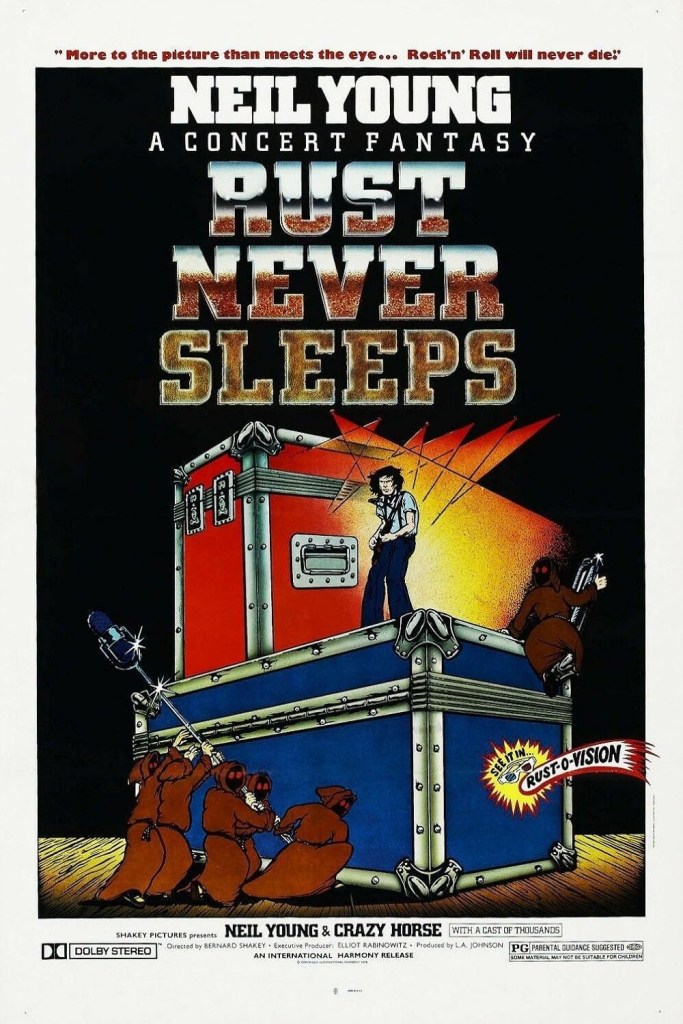
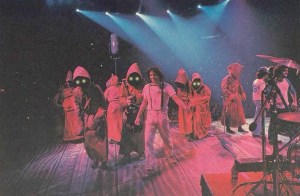
There is a film version of the Rust Never Sleeps tour featuring the October 22, 1978, concert performance at the Cow Palace. It has a few more songs not on the Live Rust LP. The Rust tour had some fantastic visuals: oversized props of amps and mics. Neil’s roadies (called “Road Eyes”) are decked out like the Tusken Raiders from Star Wars.


 Axl's Catch Groove
As a Canuck. This was my gateway into Neil Young in the Fall/Summer of 1985, 10th Grade High School. Music was so Shyte during the 1980’s.
Discovering Prog Rock and NY was my saving grace in the mid 1980’s. Genesis, Yes, Pink Floyd, and in ‘86 Emerson, Lake, & Palmer were my musical Heroes at the time. Especially. ELP.
Aug. 1985 CNE Grandstand, Toronto. My 1st ever Concert was Neil Young & The Stray Gators with Kris Kristofferson as the opening act.
The 1st half of the show was Acoustic NY solo and then some Country stuff off of Old Ways with the Gators.
2nd half of the show was all electric with him on “Blacky” his beat up black Les Paul Guitar.
Next time would be in my hometown of Hamilton , Copps Colliseum with Crazy Horse. Amazing shows !
”Thanks for the memories James” !
Joey G
Love it Joey G! My first Neil show was during the Trans tour. He performed the hits solo. Did an electronics/Trans segment and for an encore he came out as a 50s rocker with the Shocking Pinks. It was amazing. This must have been 1983.