Bob Dylan – Original Mono Recordings Boxed Set (2010)
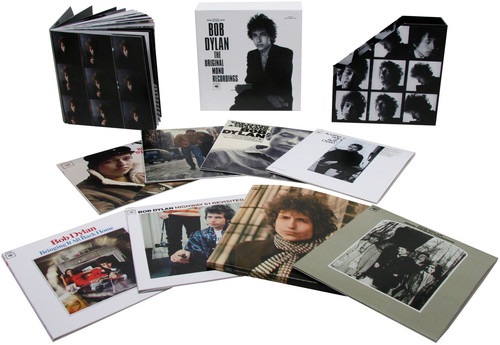
“This box collects Bob Dylan’s first eight 12-inch LPs…as most people heard them, as they were expected to be heard, and as most often they were meant to be heard: in mono.” Greil Marcus in the liner notes
Well, that is news to me. I grew up listening to stereo mixes. Actually, I knew the mono story. The Beatles had taught us the importance of the mono mix with The Beatles in Mono (2009) the year before. 60s albums were envisioned as mono mixes; the stereo mix was an afterthought. Mr. Marcus is wrong and right: more people have heard the stereo mixes, but the mono mixes are better.
Specific to Dylan, Bob Johnston, the producer of Blonde On Blonde, told this story:
“We mixed that mono probably for three or four days, then I said, ‘Oh shit, man, we gotta do stereo.’ So me and a coupla guys put our hands on the board, we mixed that son of a bitch in about four hours!… So my point is, it took a long time to do the mono, and then it was, ‘Oh, yeah, we gotta do stereo’.”
I picked up this box set when it came out: I was a serious musichead with a nice stereo and a Dylan fan – I was very ripe for this.
The box is the mono mix of Dylan’s first eight studio albums on nine compact discs, the album Blonde on Blonde being issued on two discs as in its original vinyl format. The packaging gimmick was that each album was a mini version of the original LP, and the CD label was a facsimile of an LP label.
I played this a lot when I got it, and it predates this blog – otherwise, there would have been a post on it. I have not listened to the set for a long time. But I have enhanced the Desert 🌵 Sessions for CDs this winter, so I brought down a 14” x 14” box of CDs, and Original Mono Recordings was part of the bunch. This seems like a good time to break into the Mono Box as a pre-game to seeing A Complete Unknown on Christmas (2024)*.
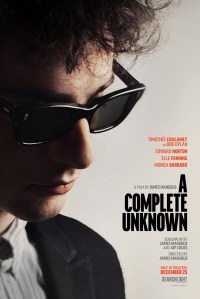
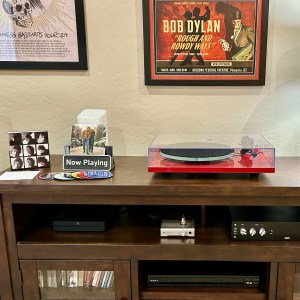
I listened to the albums in a haphazard order. Starting with my favorites, and kind of random. BLONDE ON BLONDE (1966) was the first album for the Desert Sessions. It is one of my favorite Dylan albums—my favorite of the first eight albums in this box.
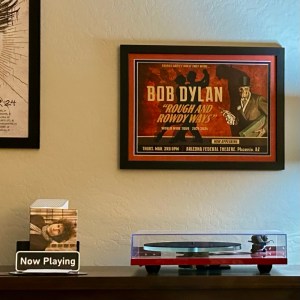
Experiencing albums that are well known to you in stereo in mono is quite a shock. First, the soundscape is way better than you would expect. Just because it is mono does not mean it is lo-fi. The production values of the 50s and 60s were excellent. The studios sounded good, and the engineers were highly skilled. I have listened to the mono reissues of the Beatles, Miles Davis, and Dylan; they all sound fantastic. The big difference is that the mono mixes sound immersive – surprisingly immersive on headphones, but best on speakers. When stereo became available to consumers in the late 50s and before mono was phased out in the late ’60s, stereo mixes were often gimmicky. The worst was jazz, where one instrument would be panned far left, and the other was far right. It did not sound natural at all. The glory days of mono were the ’60s for several reasons: the recording profession was highly skilled, overdubbing had been perfected, and sound engineers knew that at least some of their audience were audiophiles with great playback equipment, so they made an effort to make things sound good.
Blonde On Blonde is well known to me, and as I have already mentioned, it is one of my favorite Dylan albums. It was the final piece of the “Bob Goes Electric” trifecta: Bringing It All Back Home (1965) and Highway 61 Revisited (1965) being the other two. Bob headed to Nashville with keyboardist Al Kooper and guitarist Robbie Robertson, got the Nashville A-Team stoned, and made his psychedelic masterpiece before promptly checking out of pop culture at his first apex. It is widely considered one of the first double albums in popular music with complete original recordings by the artist. Even in the CD era, at seventy-three minutes, it can barely be contained on a CD (which has an 80-minute max, but best practice is to keep the audio under 74 minutes).
I have multiple versions of this album: vinyl (stereo), CD (stereo), SACD (stereo), and the mono CD that is part of this box. The mono is my favorite because, as I have already mentioned, it sounds immersive. I have learned that CDs sound best with a good CD player with a good DAC (onboard or separate), as a quality DAC warms up the digital to near analog perfection.
I drew out THE FREEWHEELIN’ BOB DYLAN (1963) next. Although this is his second album, I consider it his first as it is mostly original songs (one cover and one co-write). The recording is just Dylan playing solo: voice, guitar, and harmonica. There is no reason to have a stereo mix. The mono mix is like having Bob in your room singing to you directly. The album shows Dylan’s genius with absolute classics that would become Dylan standards, if not pop music standards, including: “Blowin’ in the Wind,” “Girl from the North Country,” “Masters of War,” “A Hard Rain’s a-Gonna Fall,” and “Don’t Think Twice, It’s All Right.”
Some very early pressings of the album contained four songs that were ultimately replaced by Columbia in all subsequent pressings. These songs were “Rocks and Gravel”, “Let Me Die in My Footsteps”, “Rambling Gambling Willie” and “Talkin’ John Birch Blues”. Copies of the “original” version of The Freewheelin’ Bob Dylan (in either mono or stereo) are extremely rare. Unfortunately, this mono reissue does not include those early-pressing songs.
HIGHWAY 61 REVISITED (1965) is the album that turned Dylan into a pop star. Dylanogist Michael Gray argues the 1960s “started” with this album. If someone had never listened to Dylan before and asked for a one-album recommendation, this would be the one. If they could listen to one song, it would be “Like a Rolling Stone.” Every song on the album is significant in Dylan’s canon. This is the first Dylan album with a full rock and roll aesthetic. A lot is going on here. Unfortunately, this is the one album in the box that doesn’t sonically shine. The original first-generation mono master tapes could not be found, and this album is made from a second-generation overseas copy of the mono mix.
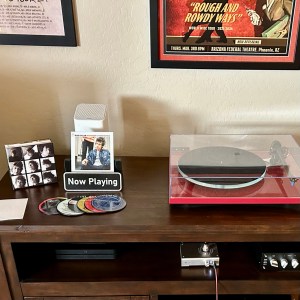
BRINGING IT ALL BACK HOME (1965) is half electric and half acoustic. I fully appreciate Dylan’s folk era, but when he went electric, that was something special – next-level shit. This is part one of the most fabulous hat tricks in pop/rock history. Every song on this album is essential. This is when Bob Dylan became BOB DYLAN! Not only does he go electric, but lyrically, he abandons the protest singer themes and becomes psychedelic. This mono mix sounds fantastic – both on the electric and acoustic songs.
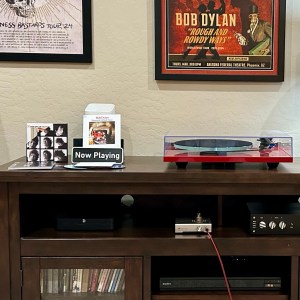
After checking out from being the voice of his generation and going electric, Dylan returned with a new vibe: what we would now call Americana. JOHN WESLEY HARDING (1968) is not folk nor rock ‘n roll – it is something else. It includes one of Dylan’s most famous songs, “All Along the Watchtower,” that Jimi Hendrix rocked up. On JWH, it is an acoustic folk instrumentation song with Dylan’s electric vocal snarl. Dylan’s live performances have been influenced by Hendrix’s cover to the extent that they have been called covers of a cover. Dylan tries to create a new vocal affectation in almost every song on the album. This is the final mono recording – subsequent albums would be envisioned as stereo.
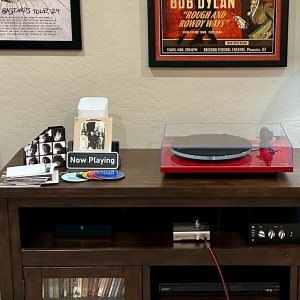
BOB DYLAN (1962) is Dylan’s debut, featuring folk standards and two original compositions, “Talkin’ New York” and “Song to Woody.” This is Dylan’s solo: voice, guitar, and harmonica – which works flawlessly in mono. The album stiffed initially but sold more copies once Dylan became more successful. Although it is primarily covers, it shows Dylan had a clear vision of his folk style at age twenty.
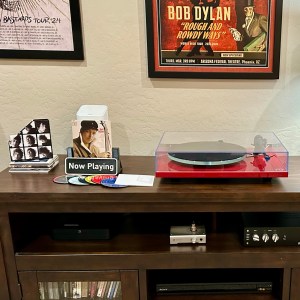
THE TIMES THEY ARE A-CHANGIN’ (1964) is Dylan’s third album but the first to feature only original compositions. The songs mainly concern racism, poverty, and social change. The titular track is one of Dylan’s most famous. Dylan is at the height of his folksinging skills.
The original master tape for THE TIMES THEY ARE A-CHANGIN’ could not be found for this reissue, so a new master was mixed from the original three-track tape, using the original vinyl pressing as a guide. Again, this is just Dylan’s voice, guitar, and harmonica, and it sounds great in mono.
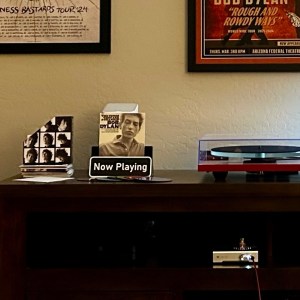
ANOTHER SIDE OF BOB DYLAN (1964) was the last of the pure acoustic folk albums before Dylan went electric. The lyrical themes are personal (“All I really want to do / Is, baby, be friends with you”), psychedelic (“Motorpsycho Nightmare”), and his folk protest thing (“Chimes of Freedom”). When I first discovered Dylan at the end of the 1970s as a budding musichead, this was one of my favorites. I loved the novelty song with a yodel: “All I Really Want to Do,” the reflective “My Back Pages” (a hit for the Byrds), and the prototype for the classic cruel Dylan love song: “It Ain’t Me Babe.”
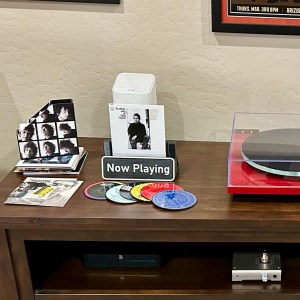
The Mono Box includes a liner notes booklet with photos, an extended essay by Greil Marcus, and recording details. As best I can tell, the Mono recordings are unavailable on streaming services. However, the CD box is readily available for about $80. The vinyl LP version is also available but is ridiculously expensive ($600 plus).
There is an old joke: “Do you like Dylan?” to which the response is “Which one?” These first eight albums were a fantastic foundation to build a career on. If Dylan had never recorded another album after Freeweelin’ he would still be considered consequential in pop music. But that was just the beginning. He wore the folk musician coat for a while, and at his apex as a folkie, he changed to a psychedelic rocker – changing the world only to check out of the culture. Only to return as something else – an Americana artist before there was such a thing. Not even mentioned here is he took an obscure backup band and made them The Band. The original point of this post was to reflect on the Mono Box, but the gift was being reminded how brilliant the first decade of Dylan’s career was.
*Postscript: A Complete Unknown – my wife and I saw the movie at the first showing at our local theater on Christmas day and were blown away. I came into the film with a lot of trepidation. Most biopics suck. I think what the movie did right was to capture Dylan’s vibe as his career blew up rather than try to be historically accurate – it is accurate enough. You understand how fast his career took off after arriving as a Midwest nobody in New York. You also get a good understanding of how Dylan bristled under the orthodoxy of the folk movement. Despite every indication that he should stay the course with folk music, he could not help himself and go electric. For those who don’t know the Dylan story, this does a good job of telling it. For those who know the story but were too young (which includes me – I am almost 66) to witness it in real-time, it is emotional (my eyes welled up, and I got goosebumps from several scenes) to see a glimpse of the early magic. Highly recommended.


