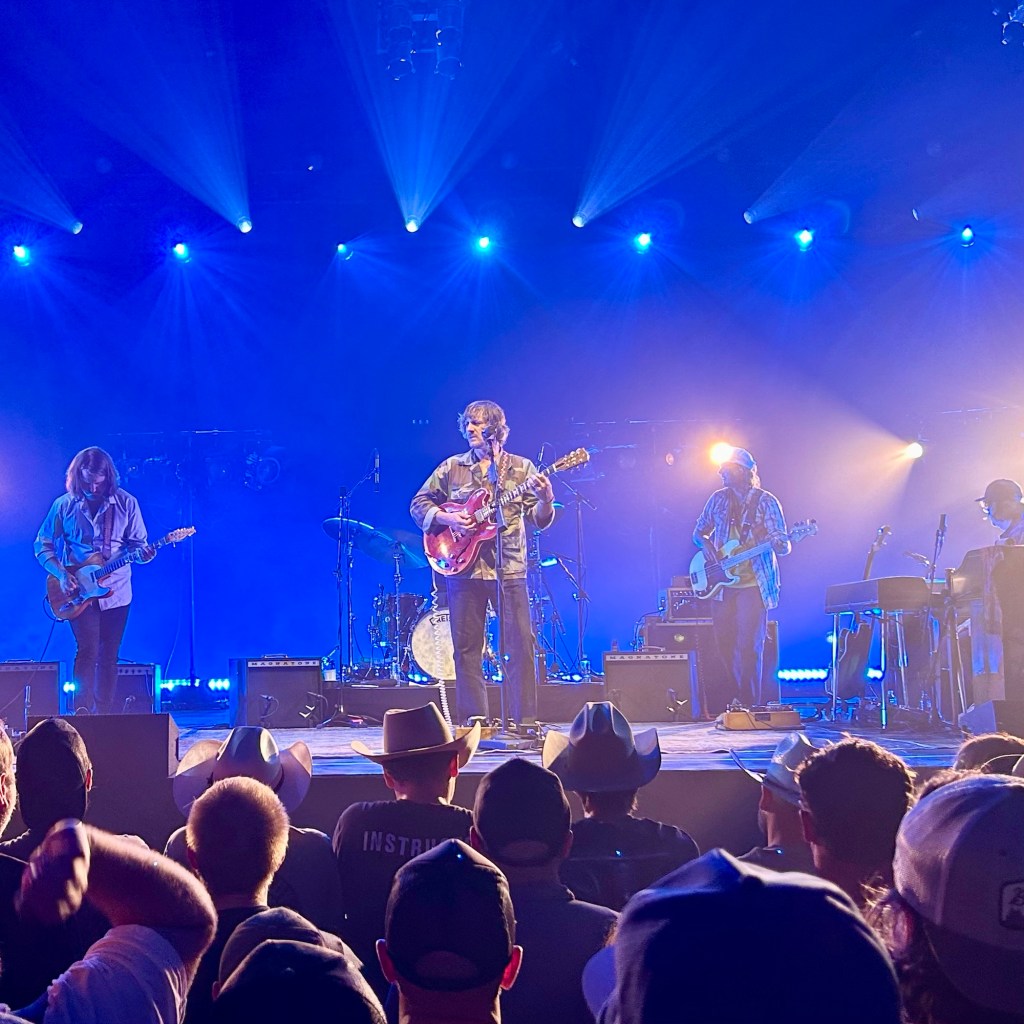
This was a great show—the best show I have attended this year. But I almost did not go because of the venue. Roy Wilkins Auditorium, AKA “The Roy,” rivals US Bank Stadium as the worst-sounding venue in the Twin Cities (it is bad enough that it has not been used as a concert venue for several years). Sturgill was stuck playing there because the more appropriate venue, The Armory, had been previously booked by pop star Gracie Abrams. The Roy lived up to its bad reputation for the Sturgill Simpson show, but Sturgill is such a great performer that he transcended The Roy. I suspected Sturgill could pull off this magic trick as the new album is excellent, and he is a great live performer. He doesn’t tour much (it has been eight years since he played in the Twin Cities), so I didn’t want to miss the opportunity. The show sold out instantly (I am not the only one in town “in the know” regarding Sturgill’s greatness).
Sturgill is a no-nonsense performer. He played on a stark stage for three hours with his four-piece band (drums, bass, guitar, and a keyboard player who could also play the sax) – Sturgill is a heck of a guitarist himself – he shredded! There was minimal stage banter, and most songs segued into the next song. Except for his rock album Sound & Fury (2019), Sturgill comes across as an alt-country/Americana singer-songwriter on his recordings, but in concert, he is a rocker (maybe even a jam band rocker). He played a nice cross-section of his catalog and some inspired covers. Each album has a different flavor, but he made their variety seamless in concert.
One of the most incredible things Sturgill and the band did was to start a song with a ZZ Top riff (”La Grange”) as an intro to his Sound & Fury song “A Good Look,“ which then transitioned to The Doors’ “L.A. Woman.” It was an epic fifteen-minute jam. Later in the show, he nodded to the Southern Rock masters The Allman Brothers Band with a cover of “Midnight Rider.” In Minnesota, we are used to being patronized with a cover of Prince’s “Purple Rain,” but Sturgill just likes the song, as I have seen it on this tour’s setlist in other cities. He performed “Purple Rain” at The Roy in Sturgill Simpson style—I didn’t initially recognize it.
As for his songs, he rocked up the yacht-rock meets the Grateful Dead songs from his new Johnny Blue Skies’ Passage du Desir, which was a fun interpretation. The rest of his catalog mostly took a rock approach, but there were some great country moments, too. Overall, the show was much more jammy than the last time I saw him, which fit Sturgill’s new songs and created an excellent concert vibe.
Sturgill’s vocals sounded fantastic despite his rupturing his vocal cords in 2021—he appears to be fully recovered. His band is tight and can easily switch between country and rock. Sturgill has a shy charisma, which is pretty engaging.
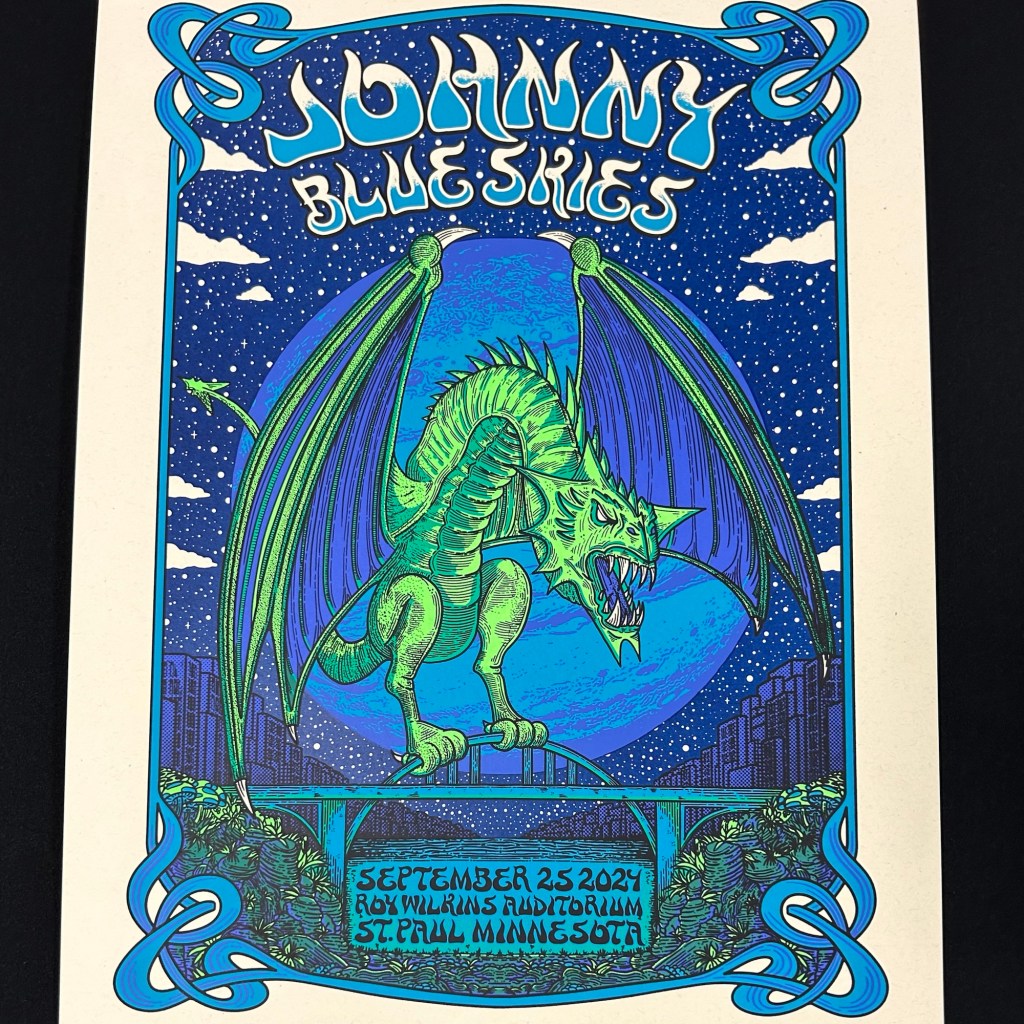
Shout out to poster artist Danny Evans for an epic gig poster:
One more thing. The ticket said an 8:00 start, and damn, it started on time! I love that.
Set List:
- Juanita
- Life of Sin
- Turtles All the Way Down
- Railroad of Sin
- The Promise – a When in Rome cover
- A Whiter Shade of Pale – a Procol Harum cover)
- Time After All
- I’d Have to Be Crazy – a Steven Fromholz cover – made famous by Willie Nelson
- Right Kind of Dream – a Johnny Blue Skies song
- All Said and Done
- Long White Line – a Buford Abner of the Swanee River Boys cover
- Fastest Horse in Town
- Mint Tea – a Johnny Blue Skies song
- If the Sun Never Rises Again – a Johnny Blue Skies song
- A Good Look – with a ZZ Top intro
- L.A. Woman -a The Doors cover
- Welcome to Earth (Pollywog)
- Best Clockmaker on Mars
- I Don’t Mind
- You Don’t Miss Your Water – a William Bell cover made famous by Otis Redding and also The Byrds in their country phase
- Living the Dream
- One for the Road – a Johnny Blue Skies song
- Purple Rain – a Prince cover
- Just Let Go
- Jupiter’s Faerie – a Johnny Blue Skies song
- Scooter Blues – a Johnny Blue Skies song
- Brace for Impact (Live a Little)
- It Ain’t All Flowers
- Water in a Well
- Midnight Rider – a The Allman Brothers Band cover
- Call to Arms
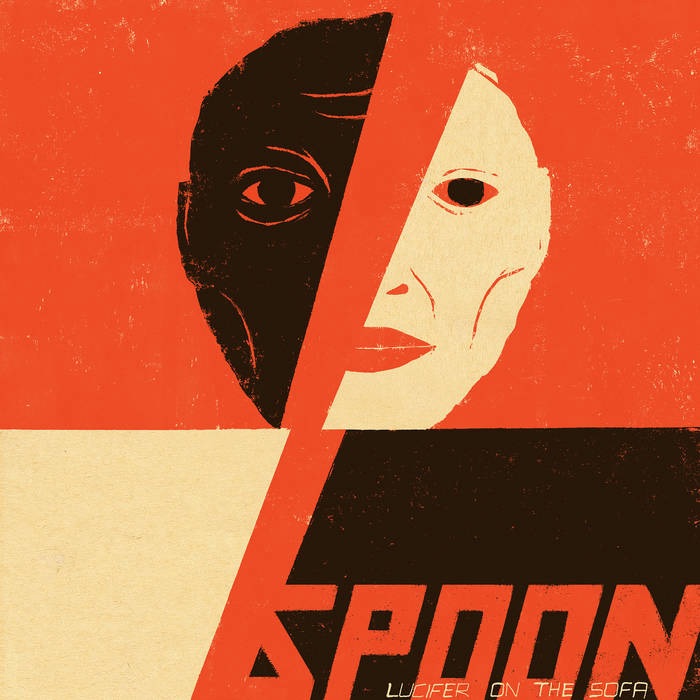
Lucifer On The Sofa
2022
Spoon has been around for over thirty years. I am neither a fan nor a hater, and I have a few of their albums in my collection, but they have never truly clicked for me. In festival situations, I found them engaging live. One of my daughter’s coworkers requested that I review this album.
After listening to the album for the first time, my first impression of Lucifer On The Sofa is a pretty impressive album by a band three decades into their career—a rarity for a tenth album in a successful rock career. Googling, you learn Lucifer on the Sofa received widespread critical acclaim (an impressive 85 on Metacritic) and was nominated for Best Rock Album at the 65th Annual Grammy Awards (2023 – Patient Number 9 by English Ozzy Osbourne won).
Even the band themselves had a sense they were on to something. Per the band’s website:
“Spoon’s tenth album, Lucifer on the Sofa, is the band’s purest rock ’n roll record to date. Texas-made, it is the first set of songs that the quintet has put to tape in its hometown of Austin in more than a decade. Written and recorded over the last two years –both in and out of lockdown –these songs mark a shift toward something louder, wilder, and more full-color.”
Enough of what others think; what do I think? I have always admired Spoon’s frontman, Britt Daniel. He has a cool rock voice and epic guitar riffs. This album perfectly displays both. It is a guitar-forward rock album, and it resonates with me in a way that no other Spoon album has. I appreciate that I was prompted to listen to it; otherwise, it would never have been on my radar. It is an impressive late-career statement from the band.
The opening track, “Held,” has an enormous aggressive rock riff. In juxtaposition to the riff, the lyrics are about emotional surrender.
“The Hardest Cut” is another nice riff, this time bass-forward. It has excellent guitar solos. Lyrically, the narrator is dreading a life change.
“The Devil & Mister Jones” sounds like Hall & Oats if they were an edgy indie-rock band. Mister Jones is a recurring character in pop/rock music (for example, Dylan’s “Ballad Of. A Thin Man”. Per Britt:
“I’m super aware of the legacy of songs about Mr. Jones. I thought about it for half a second and then I decided I do like the idea of contributing to the canon of that work. I’ve heard so many of them and I don’t think I’ve heard one that I didn’t like yet. Mr. Jones never seems to be a good guy, does he? And the guy in my song definitely is a bad man.”
Spoon’s Mister Jones is a charismatic grifter compared to Dylan’s uptight square. Given this album’s orange branding, it is hard not to think of Trump as Mister Jones. A bonus is Steve Berlin’s (Los Lobos) baritone sax. Double bonus: this song is danceable.
“Wild” was co-written by Jack Antonoff and Britt Daniel. Anonoff’s claim to fame is song co-writing and production work with female pop artists like Taylor Swift, Sabrina Carpenter, Lana Del Rey, and many more. The song has a beautiful 80s new wave vibe.
“My Babe” slows the pace; it starts as a ballad and then revs up to a full-on rocker. Lyrically, the narrator is in an emotional rut, and then his lover shakes things up – in a good way.
“Feels Alright” sounds like it could be an Oasis hit – a nice punchy pop-rock tune. Per Daniel, the song is
“…about feeling good and feeling alive, about the great feeling you have about a really great night. It’s not super deep, but if I think about it more, I’m writing about when I was young.”
“On the Radio” is about the power of music and the medium it used to be delivered (radio). I am old enough to remember when radio and music were synonymous (and symbiotic). I no longer know anyone who listens to terrestrial radio for music. This ends up being a sentimental song about an old paradigm.
“Astral Jacket” has a dreamy Beck feel: it sounds like searching. I’m not sure what an Astral Jacket is, but my guess is some kind of transport to a higher place.
The sonics of “Satellite” sound out of place with the rest of the album. This song has been a part of the band’s live repertoire since 2014. It is not a bad song, it just doesn’t fit the aesthetics of the rest of the album.
“Lucifer On The Sofa” is a cool title and an interesting image. Sonically, it returns to the aesthetics of the rest of the album. I struggled to understand what the song was about. There are several references to Austin, Texas (the band’s HQ). Fortunately, Daniel has this quote about the song to help reveal its meaning:
“That Lucifer on the sofa, it’s the worst that you can be, that you can face in times of stress. It’s a part of yourself you have to deal with. It’s a representation of bitterness or loneliness, and it’s that thing that can keep you on the couch and maybe doing nothing for a week, self-indulging. So, this song, to me, is about the battle between yourself and that character you can become.”
This is an excellent album, and I am surprised that, with all its critical acclaim, I missed it. But there is so much great music in the world it is easy to miss a masterpiece. Spoon is not the first band that I became a fan through their late era catalog, for example I also became a fan of The National and the Drive-By Truckers that way. If you are unfamiliar with Spoon, this is the place to start.
Postscript: Spoon simultaneously released Lucifer on the Moon, a dub remix of Lucifer on the Couch by British dub producer Adrian Sherwood. It is a nice bonus to the original album.
My social media presence concerns music, food, beverages, and fun with family and friends. My blog is mostly about music—primarily album reviews. Despite being very interested in and opinionated about politics, I have deliberately shied away from posting about it. I read my local paper (Minnesota Star Tribune), the New York Times, and the Wall Street Journal and listen to political podcasts. I consider myself an informed citizen, open-minded, and non-emotional about politics. I am a centrist Democrat.
I want to write about politics, so I have started a Substack Newsletter/blog focused on U.S. politics. I plan to keep the music blog focused on music. I plan to keep my Facebook and Instagram non-political (except for invitations to my Substack). But if you want to engage with me on politics, follow my Substack. I plan to post at least once a week. Warning: these political posts are generally center-left, wonky, and long-winded.
For those unfamiliar with Substack, it is a blogging/Newsletter platform where you subscribe to a writer and get an email each time they post. Substack also has an app that is great if you follow several writers. There are many topics on Substack, but writers typically stick to a lane. You do need to sign up to follow a writer like me, but there is no cost, and as best I can tell, they don’t abuse you with unwanted emails, notifications, and texts. Some writers charge for their content, but mine will be free.
Writing about politics helps me form my own opinion. I hope to garner feedback from this newsletter to hone my opinion and better understand those who disagree with me. I live in a bubble—I talk about politics with friends who share my views, and I shy away from talking about politics with people who disagree with me. I am uncomfortable talking about politics on Facebook and Instagram, but I hope my Substack will be a comfortable and respectful place to discuss politics.
Here is a link to my Substack – please click, subscribe, and comment. I hope to see you over on Substack!

I recently saw Morgan Wade at a festival (Yacht Club in St. Paul, MN). I was vaguely aware of her – she made enough of an impression on me that I prioritized seeing her Friday afternoon set. I was blown away by that live performance. She was rockin’ country and the perfect appetizer for Joan Jett and Alanis Morissette, the more prominent names on the festival poster.

Morgan initially caught my attention because her first two albums were produced by Sadler Vaden (guitarist, singer, songwriter, and producer best known as a member of Jason Isbell’s band, The 400 Unit). I am a big Isbell fan, and Vaden is a critical ingredient in The 400 Unit. If Sadler produced Morgan Wade, it would be worth listening to it.
I listened to the two Sadler-produced records, Reckless (2021) and Psychopath (2023), but neither album resonated with me. But the new album, Obsessed (2024), is clicking with me based on seeing her live, the album’s raw honesty, the stripped-down arrangements, and its Americana/alt-country sonics.
The background on Obsessed is that Psychopath was a bit of a flop. After the success of her debut, Wade had the traditional sophomore slump. Wade is quoted in Rolling Stone as saying, “My record wasn’t talked about, and that really messed with me.”
Instead of the typical Nashville co-writer approach of Psychopath, Wade wrote most of Obsessed alone and on the road. Her touring guitarist, Clint Wells, produced the album. Re-listening to Psychopath, I find it overproduced, and Wade gets lost in the production. After listening to Reckless again, I can see why it succeeded: it was a classic singer-songwriter Americana. Obsessed is a return to the straightforward Americana sound of Reckless with improved songwriting.
Obsessed has a theme: the album’s protagonist is on the road (weary, lonely, and homesick) clutching their sobriety and recovering from a romantic breakup. On paper, that sounds depressing, but the album is not; it is elevating because the bleakness (both sonically and lyrically) is so beautiful – it is classic country music “high and lonesome.” The album feels autobiographical, but I don’t want to make that assumption. The songs’ protagonist is raw and honest, with just enough hope that it feels like they will make it. This is a breakthrough album for Morgan Wade – she has found her voice – a voice that aspires to Rosanne Cash territory (deeply personal songs that blended country music with pop and rock). Morgan Wade’s vocals are twangy country, but with an indie-rock snarl – edgy and soft at the same time. There isn’t a wasted track on the album – all fourteen tracks are essential.
“Total Control” opens the album and is an excellent example of the Rosanne Cash vibe. The song sets the stage for the weary on the road theme:
“I’m tired out here on the road
I’ve spent too many nights on my own
Every way I turn just feels wrong
I’m tired out here on the road”
“Department Store” is a recollection of the narrator’s troubled teenage years. The song has one of my favorite lines on the album: “Your parents were gospel, they gave birth to rock and roll.”
In “Time to Love, Time to Kill,” the narrator recalls a breakup and the lie that they both agreed to move on, but in reality, the breakup was a significant setback for the narrator.
“Obsessed” is precisely what you would expect; the narrator is obsessed with a love interest. Here is another great line: “You’re my favorite story, won’t you give me a role? / Write all my lines, and I’ll do what I’m told / Keep me around until I’m good and old.”
In “Juliet,” Wade plays with the Romeo and Juliet trope – the narrator, who is not Romeo, is trying to seduce Juliet. “Romeo ain’t what you need / I think you should run away with me.”
“2AM in London” is a bleak song (both lyrically and musically) of loneliness and homesickness. In the past the narrator would have gotten drunk, but: “It’s a good time to get into trouble / But I don’t do that stuff anymore.” She doesn’t want a drink she just needs her lover by her side:
“I just need you to be here
I want two shadows on my wall
It’s 2 a.m. in London, baby
And I just wanna come home”
“2AM in London” is the best song on the album. It is beautiful sadness.
I had to remind myself of the “Hansel and Gretel” fairy tale: Hansel and Gretel are siblings who are abandoned in a forest and fall into the hands of a witch who lives in a bread, cake, and sugar house. The witch, who has cannibalistic intentions, intends to fatten Hansel before eventually eating him. However, Gretel saves her brother by pushing the witch into her own oven, killing her, and escaping with the witch’s treasure. The song is about former lovers that can’t get back together. I am bewildered by the line: “Like Hansel and Gretel, we put kettle on the level / But we just won’t make it back.”
“Spin” is yet another song of regret of lost love. The narrator pines for the dizziness of love: “Spin me around once more.”
In “Reality” the narrator is begging their lover to stay the night “’Cause I don’t wanna face reality / Won’t you stay with me?” Wade’s voice is a gorgeous plea dripping with twang.
“Walked on Water” (feat. Kesha) is a raw breakup song. I don’t know why this is a duet. It is a great song. Kesha and Wade’s voices go together perfectly despite their different styles. Typically, two voices would be two characters in a song (or a bit of schizophrenia), but in this song, the two voices are the same person in the same mood. So again, I am not sure why Wade made this a duet.
“Halloween” is a recollection of the moment our narrator fell in love; ironically, that moment is after the break up has already happened (caused by the narrator’s career).
“I knew I loved you that Halloween
When I saw you and I got mad
You came in with someone that wasn’t me
And I’ve never felt pain that bad
So I cried in my car at the liquor store
And I almost relapsed”
“Crossing State Lines” is a song of unrequited love with a Stevie Nicks vibe. The narrator is devastated by the breakup, and the assumption is her love interest could care less:
“Now you’re crossing state lines
And I’m trying real hard to get over you
You never wanted me and I wanted you to”
The penultimate song, “Moth to a Flame” is a about the one that didn’t get away:
“And I wrote all the songs
About the ones that got away
Thank God I could finally write
The song about the one who chose to stay”Although this might not be the healthiest relationship, as our narrator might be giving up her soul:
“And I gave up on dreams I thought would never come true
I’d trade in my Friday nights for life with you”
“Deconstruction” finishes the album on a positive note—the narrator has found a new lover. However, there is still some darkness, as the love interest lacks self-esteem, and the repeated line: “Where have you been?” has a sense of foreboding—will this love really last?
This is an outstanding album. Given that Wade straddles country, Americana, and rock, I hope she can find a fan base. The fact that this past summer (2024), she supported Joan Jett and Alanis Morissette on tour suggests she is aiming at the right audience.
I’m revisiting the Dixie Dregs (DD) catalog in reaction to acquiring The Great Spectacular, a Record Store Day 2024 release. The Great Spectacular was the band’s original 1975 demo tape, pressed on vinyl by the band (1000 copies), and it was recently reissued for Record Store Day 2024 (1200 copies). I was a DD fan in the late ’70s but have not listened to them in forty years. The Record Store Day release reminded me of my fondness for the band, so I have rediscovered their first six albums.

World’s worst band photo:
Back row: Rod Morgenstein and Steve Morse
Front Row: Stephen Davidowski, Andy West, and Allen Sloan
The DD are the ultimate 70s fusion band: they played rock, jazz-fusion, Southern Rock, country, classical, bluegrass, and prog – sometimes all in the same song. They are an instrumental band, except for two songs with vocals on their final album for Arista, Industry Standard (1982). I realize that an instrumental band is a non-starter for many. This is complex music, and so come with an open mind. The variety throughout an album can be head-spinning. But if you dig it, you will be rewarded with a fantastic music catalog. If you give it a legitimate listen and don’t like it, no problem; they aren’t for everyone. It will work, or it won’t.
The DD were initially signed to Capricorn Records, whose roster at the time was a who’s who of quality Southern Rock (Allman Brothers Band, Marshall Tucker Band, Sea Level, Wet Willie, etc.). They recorded three albums for Capricorn, and then that label went bankrupt. They were quickly picked up by Arista for three more albums. In the late 70s and early 80s, the Dixie Dregs had great press, critical acclaim, and Grammy nominations. Still, they never broke through and ultimately fizzled out after their most commercial-sounding album (Industry Standard) in 1982. Yet, to this day, The Dixie Dregs remain a loose collection of its former members, reuniting briefly for short tours and rare studio work.
The band’s star, guitarist Steve Morse, has continued a solo career and is a gun for hire (working for Kansas in the mid-80s and Deep Purple in the mid-90s through the present). Morse is considered one of the greatest guitarists of his generation, and the readers of Guitar Player magazine voted Him “Best Overall Guitar Player” five years in a row (1982-1986), qualifying him for the Guitar Player Hall of Fame.
Drummer Rod Morgenstein has been awarded Modern Drummer’s “Best Progressive Rock Drummer” for five years (1986-’90) and “Best All-Around Drummer” (1999) and was inducted into the magazine’s Honor Roll. He worked for twenty years as a professor, teaching percussion at Berklee College of Music in Boston, Massachusetts. He has been in the band Winger for years. Keyboardist T Lavitz, who joined the band during the Arista era, had an impressive career post-Dregs, playing in various bands (including Jazz Is Dead) and as a studio musician (unfortunately, he passed away in 2010). Bassist Andy West was an unsung hero in the band and kept his toe in the music business post-DD but pursued a career in the software industry as his primary gig. In addition to T Lavitz, the band has been blessed by two other great keyboard players: Stephen Davidowski on their debut and Mark Parrish on the final two Capricorn albums.
Although Morse gets most of the attention in the DD, fiddler Allen Sloan is an equally important co-star. Sloan can fiddle like the hottest Nashville cats and play the violin in classical and prog music styles. Over time, Sloan was challenged to stay with the band due to his medical career as an anesthesiologist. Revisiting the catalog, I am struck by what a fantastic performer Sloan is and how critical the violin is to the DD sound. On their last album, when Sloan had to attend to his medical career, he was replaced by an equally brilliant fiddler, Mark O’Connor.
The DD should appeal to the current jam band crowd, especially country/bluegrass fusion fans of Billy Strings, Trampled By Turtles, Nickel Creek, etc., and Allman Brothers-influenced bands like Tedeschi Trucks Band, Gov’t Mule, etc. They should also appeal to 70s jazz fusion fans (Weather Report, Herbie Hancock, Mahavishnu Orchestra, etc.). Finally, there is enough prog here (albeit with a country flavor) for old-school prog fans of ELP, King Crimson, UK, Jethro Tull, etc.
The DD debut on Capricorn, Free Fall (1977), set the template for their catalog. The band came out of the starting gate with a fully realized vision of who they were, and they were consistent in executing that vision across six studio albums. Ultimately, they were an instrumental jazz fusion band with a unique approach to jazz fusion from their peers (Pat Metheny Group, Weather Report, Return To Forever, etc.). That approach was to leverage Southern Rock, Country, and Bluegrass. Songs across their six albums generally fall into the following five categories:
- Southern Rock—imagine the most far-out The Allman Brothers Band solos, and that is DD territory, yet there are plenty of big dumb riffs to make you smile.
- Hoedown – Bluegrass or Country dance music with a little Broadway vibe and a high fun factor.
- Baroque – their take on the music of Bach – typically, this is guitar and violin duos.
- Prog—Although ultimately a jazz band and their modus operandi is a jazz aesthetic, they do have this prog thing—it was kind of Baroque rock.
- Country-fried funk – a country Curtis Mayfield or Herbie Hancock

Each album has at least one song in each of these categories, and many times, a single tune will use more than one of these categories. The dominant style is Southern Rock, but it always has a jazz aesthetic – ultimately, they are a jazz fusion band.
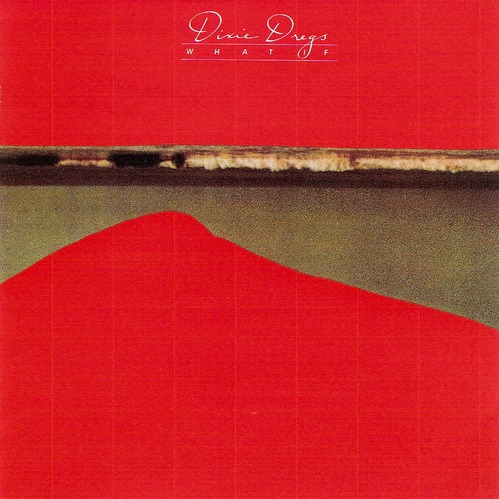
What If (1978)
The three Capricorn albums are similar, except the band got better/tighter with each release. The debut, Free Fall (1977), is remarkable in that it was a fully realized vision of the band. I purchased this album shortly after it was released and played it to death in the late 70s. The second, What If (1978), was unfamiliar to me until recently. Given my fondness for Free Fall, I don’t know why I never acquired it. I picked up a near-mint copy for 49 cents at one of the Electric Fetus (Minneapolis record store) garage sales sometime in the last five years. But even that purchase didn’t motivate me to listen, and it sat on my shelf until working on this blog post. What If is not significantly different from Free Fall; however, the band perfects the DD concept. The only personnel change is that Mark Parrish takes over from Stephen Davidowski on keyboards. The third Capricorn album, Night of the Living Dregs (1979), continues the pattern; however, the second side is selections of a live show at the Montreux Jazz Festival on July 23, 1978 (the complete show can be found on Live At The Montreux Jazz Festival 1978, available for streaming on Spotify). The live set shows this was a powerful live act, not just studio rats.
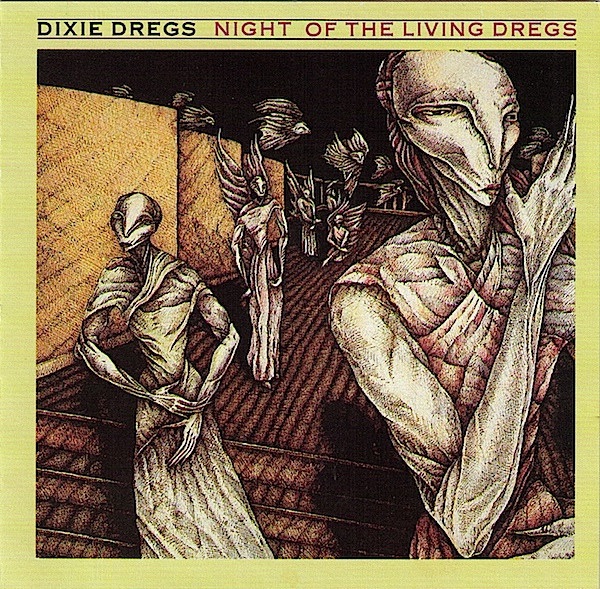
(1979)
After three studio albums, the DD were without a label. Capricorn had declared bankruptcy in the fall of 1979. Fortunately, the band was able to snag a three-album deal with Arista. In addition to the label change, keyboardist Mark Parrish left and was replaced by T Lavitz.

Steve Morse, Mark O’Connor, Rod Morgenstein, Andy West, and T Lavitz from an Arista Records photo shoot.
At the time, the move to Arista seemed like a good thing. Arista was more commercial and successful than Capricorn (they are still in business today as part of Sony), yet it was artist-friendly; for example, the label allowed Steve Morse to produce the DD albums. The downside was that Arista had expectations for an ROI; they wanted hits.
The DD were at the top of their game as they joined Arista. The band’s core had been at it for a decade; they were critically acclaimed and regularly received Grammy nominations. But it was hard to imagine how they would fit into the star-making pop machinery at Arista. Their eclectic style was going to be hard to market: it was too jazzy for the rock audience, too rock for the jazz audience, too country for the rock and jazz audiences, and the country audience was not going to go for weird improvisational instrumental music. But in the early 80s, record labels were willing to take a chance on a band like the DD, given how much money the music industry made (avant-garde saxophonist Anthony Braxton was an Arista artist during this era, for example)
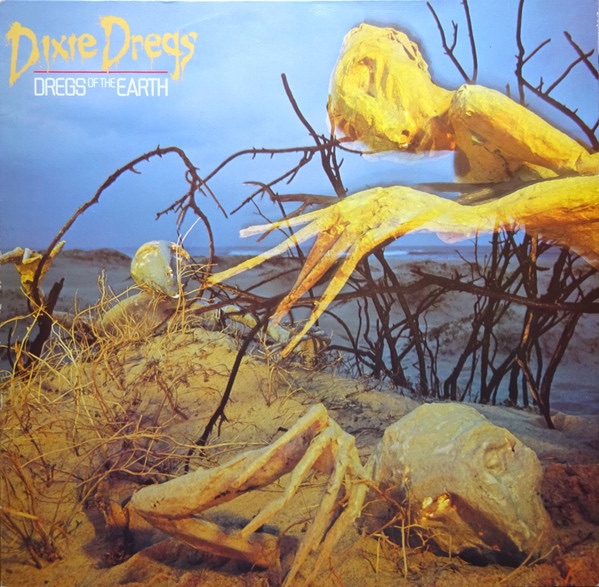
The first album on Arista was Dregs of the Earth (1980), which is similar to the Capricorn albums. It is a step forward, a bit more commercial in that it is more rock-focused but still plenty adventurous. This would be a great entry point for the band.

With Unsung Heroes (1981), Arista and the band doubled down to become an instrumental band with the album title and cover art. They ditched “Dixie” from their name and were rebranded as The Dregs. This is the “genius” of the label suits: the band is not selling well; it must be the Dixie in their name. Fortunately, the music didn’t suffer; it is the same eclectic gumbo of styles as their previous four studio albums. Unsung Heros sounds the most commercial of all of their albums thus far, yet it has an adventurous spirit that tempers it from being a sell-out. Morse is quoted as saying: “Unsung Heroes is the peak of me getting the most out of the band—certainly as a producer. I got a chance to try out all the stuff I learned from Ken Scott on previous albums. So, a lot of work and attention to detail happened. It was a very satisfying project for me.”
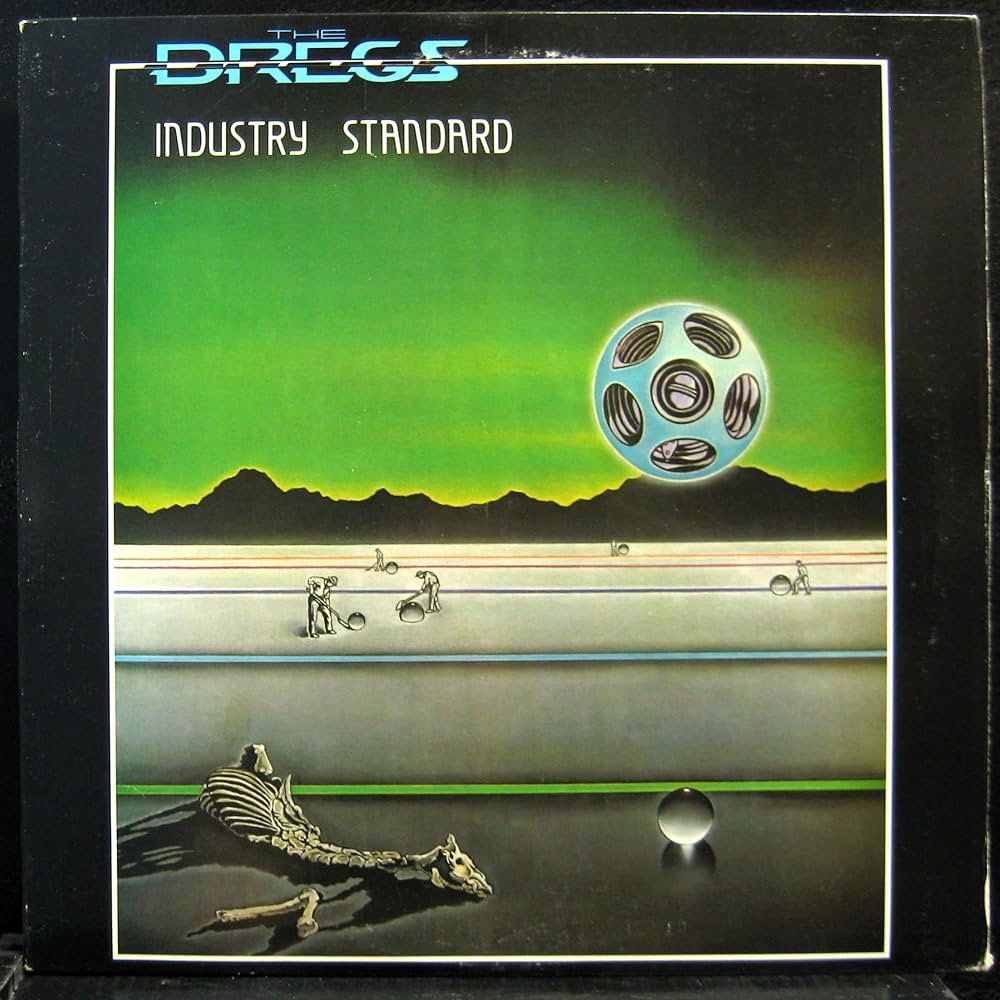
With Industry Standard (1982), their final album on Arista (and created a hiatus – their next studio album would be Full Circle in 1994), the band made their first mistake: adding vocals on two tracks. I can’t imagine the pressure the label must have put on the band to be more commercial. Morse shares the production duties with prog producer Eddy Offord (who had commercial and artistic successes with ELP and Yes). It didn’t work commercially, and Arista released the band after this album. The band disbanded; however, they have reunited occasionally, including this past spring (2024) for a tour—I missed that, but I heard they were great. The vocal tracks (“Crank It Up” featuring vocalist Alex Ligertwood, who was with Santana at the time, and “Ridin’ High” featuring Patrick Simmons of the Doobie Brothers) are generic classic rock. This is the weakest of their albums. It is not that their playing deteriorated; it is just that they were trying to be commercial, and that was just not who they were.
Today, DD would be a jam band, and there is now an audience for this kind of adventurous music. Today, it is easier for a band like the DD to make it. Not in the “hits” sense of making it, but in the sense they could do 35 shows a year (75 if ambitious) in 2500 – 5000 seat venues, making a nice living. But it was more challenging in the late ’70s and ’80s; it was a hit-on-the-radio-economy. In hindsight, it is a miracle a band like the DD made six studio albums between 1977 and 1982.
In the end, the DD had run its course. Their brand of jazz fusion was not going to generate a hit, and there wasn’t a jam band-like scene to support them. The Dregs were not a viable commercial concept in the early 80s. Jazz fusion was deteriorating into light jazz, and the DD were anything but light. But the band was not a failure; they were just at the wrong time. Steve Morse is a brilliant guitarist – he has all the soul and swagger of Jeff Beck but with a broader palette. I have spent many hours listening to the Dixie Dregs over the last month, and with every listen, I made a new discovery and grew in awe of each player. The core guitar, bass, and drum players remained constant, and the band attracted fantastic talent at the keyboard and violin. They are a band deserving more fame – they are truly unsung heroes of late 70s/early 1980s jazz fusion. They are so eclectic that it hurt their marketability at the time. I feel like their concept would work better now.
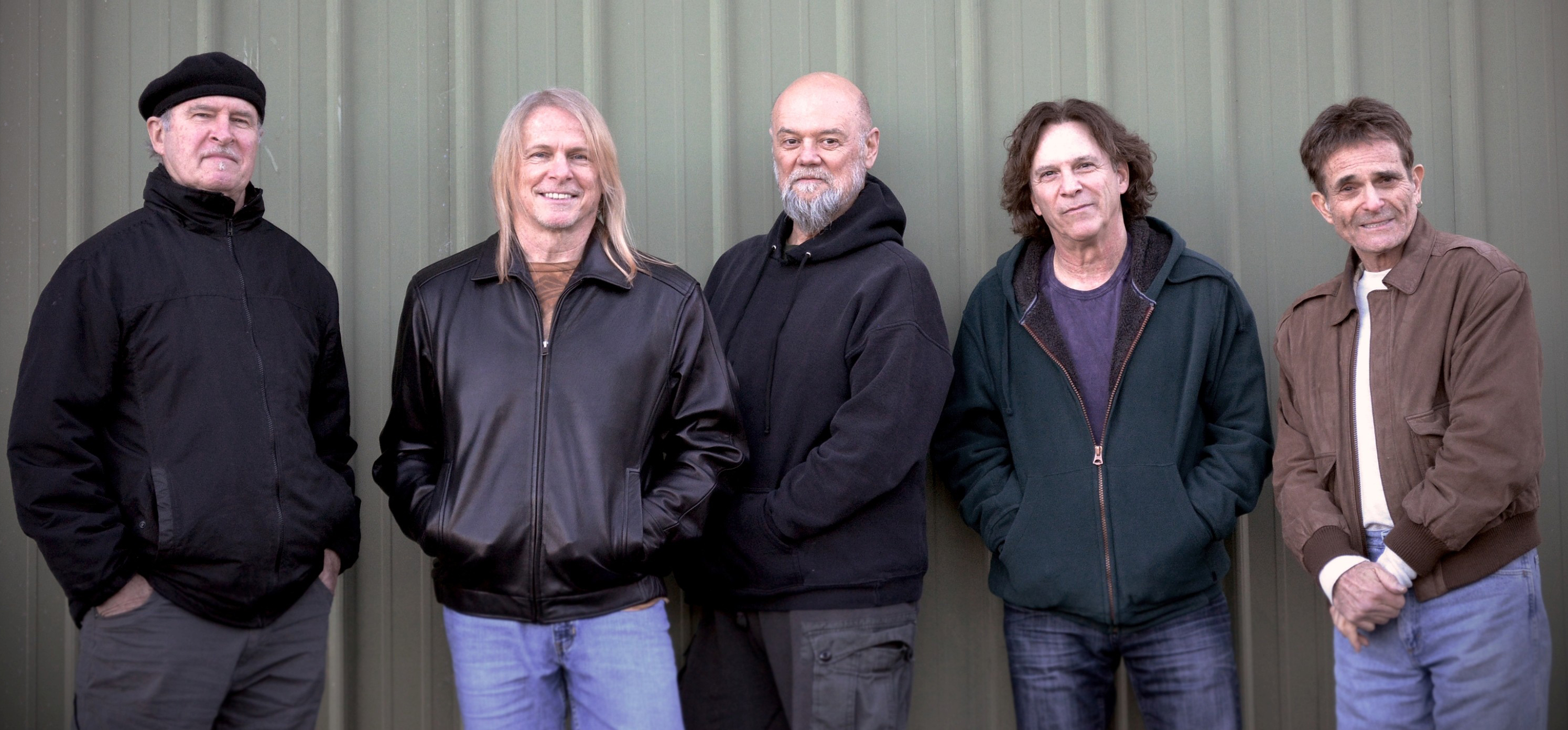
Steve Davidowski, Steve Morse, Andy West, Rod Morgenstein, and Allen Sloan
Photo: Dixie Dregs
I am grateful I never sold my vinyl records during the CD era. Even though the DD’s Capricorn and Arista catalogs are available on streaming services, having near-mint vinyl copies of these three records (and the three Capricorn records) is a beautiful legacy.
Post Script: The Great Spectacular (1975/2024)

The Great Spectacular sounds like a Greatest Hits collection for those familiar with the band. The band re-recorded The Great Spectacular songs and used them on several studio albums. These are some of their most beloved songs. Steve Morse even used one of the songs during his short stint with Kansas. On the tracklist below, I indicate what album the songs ultimately appeared in parenthesis.
“Refried Funky Chicken” (Free Fall), “Holiday” (Free Fall), “Wages of Weirdness” (Free Fall), “T.O. Witcher” (Steve Morse with Kansas on their album In The Spirit Of Things), “The Great Spectacular”(Dregs Of The Earth), “Ice Cakes” (What If), “Leprechaun Promenade” (Night of the Living Dregs), “Country House Shuffle” (Night of the Living Dregs), “What If” (What If), and “Kathreen” (never subsequently re-recorded, but it does appear on the DVD Live At The Montreux Jazz Festival 1978).
The band on the album is Rod Morgenstein (drums), Steve Morse (guitars), Allen Sloan (violin), Andy West (bass), and Frank Josephs – Fender Rhodes electric piano. Here are some comments about the album from a relatively recent interview with Steve Morse:
“The preparation for that album is the part I liked best. We were together as an ensemble and playing—usually for free—somewhere on campus at the University of Miami or around the city of Miami. The recording itself was stark and unpolished. We had to record it in one night after a long day of school and classes. It was done late at night. We were 19-20 years-old. It wasn’t really a studio. They just put the recording equipment in a live concert hall. We were set up in there with headphones. My amp was in an elevator shaft. The violin, Fender Rhodes and bass went direct. The drums were on stage. It was bizarre. We had to trudge upstairs to the very back where the projectionist would be in the movie theater and do the mix there. So, there was nothing great about the sound. But the preparation was the magic. The songs were in a good place because we had come together as a band.”
The sound on the album is way better than Morse suggests, but I get his point, as the Dixie Dregs studio albums sound fantastic. The album sounds like a high-quality demo; it is dry sonically. The biggest things I notice are the arrangements (which are more straightforward than the studio recordings), the performance of the band (they are not nearly as tight as their debut, Free Fall), and the lack of keyboards (Josephs’ playing is fine, but the Rhodes is pretty wimpy compared to the wall of keyboards the studio albums have on them). The Record Store Day vinyl is a quality pressing.
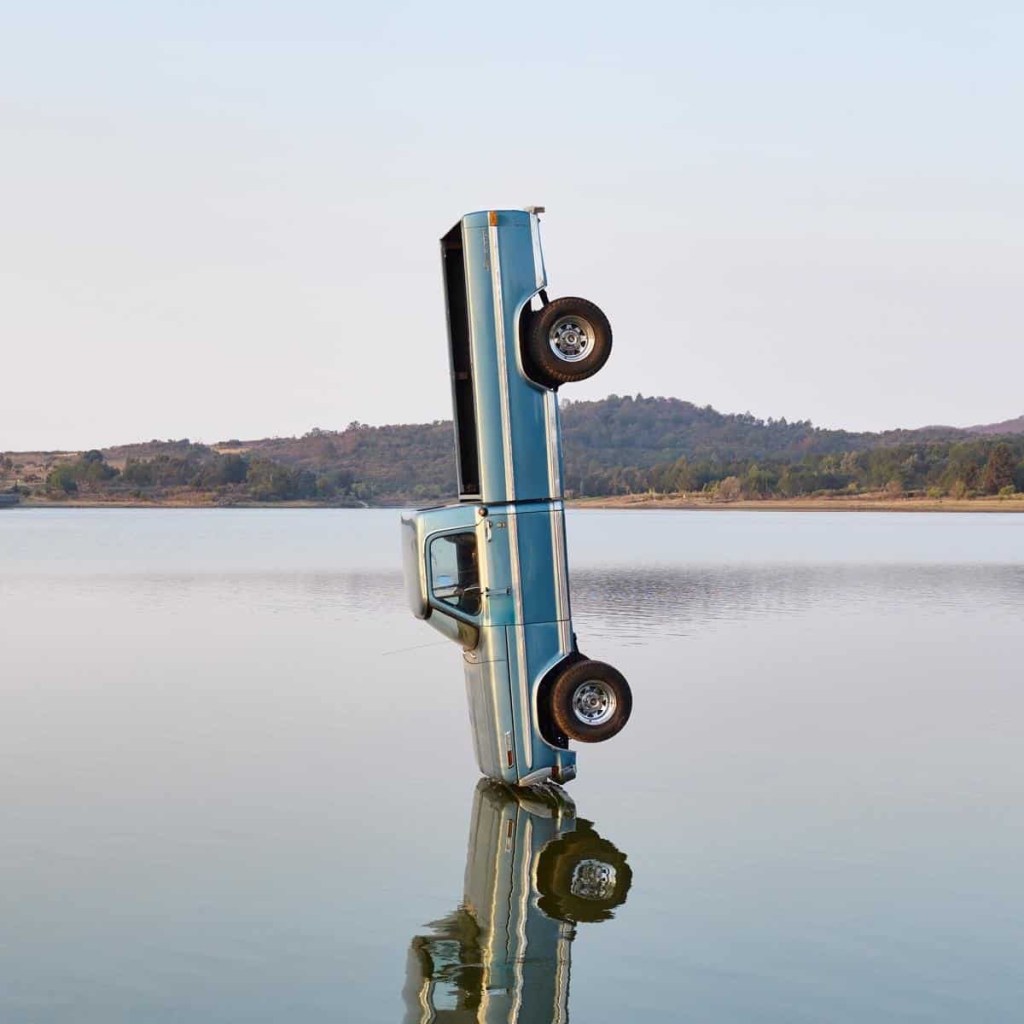
Austin Post, AKA Post Malone, is a rapper, singer, songwriter, record producer, and guitarist who has performed in a variety of genres, including hip hop, pop, R&B, trap, rock, and now, with his new album, F-1 Trillion, country.
F-1 Trillion features a bunch of guest appearances, including Tim McGraw, Hank Williams Jr., Morgan Wallen, Blake Shelton, Dolly Parton, Brad Paisley, Luke Combs, Lainey Wilson, Jelly Roll, Ernest, Sierra Ferrell, Chris Stapleton, Hardy, and Billy Strings. There are three solo songs, too. There is a deluxe edition (Long Bed) with nine more solo songs.
Post’s take on country is conventional contemporary pop country. Post takes country seriously, but the dominant vibe is fun – he clearly loves country music. It is not a stretch for Post to “go country,” as he has been evolving in this direction for a while. Post has occasionally performed country covers in concert, so it is not a surprise that he has released a country album and plans to promote it with a country-focused tour this fall. California rapper Lil B wrote on Twitter in October 2017 (when Post was considered a hip-hop artist): “Post Malone is slowly turning into a white dude! Lol he’s pushing it, give it a few years he gonna be full country and hate blacks lol“, with Malone replying in an interview, claiming that his white skin has been “used against him“. Well, country Post has fully arrived.
Post has a pleasant voice, although it is a bit thin and electronically enhanced (this is true for his pop material too – electronically enhanced vocals are common in contemporary pop country). His voice is not particularly country, but the arrangements and lyrical themes are country. His voice mixes well with his collaborators – a little too much – at times it is difficult to differentiate Post from his collaborators. In general, I found that I preferred the Post solo tracks as I was less distracted by identifying the collaborator. I assume this will diminish as I get more familiar with the album. Ultimately, his vocals work in this country context.
Post wrote the songs with a gaggle of co-writers (as is the Nashville way these days). They are catchy toe-tappers. Post and his writing and production team (many seasoned pros in the country genre) have mastered contemporary pop country.
Post’s country album works because of his devotion to the genre. He is clearly a country music fan. F-1 Trillion is neither a novelty nor a vanity project but a labor of love. It is a fun detour in his career. Post is always the king of good vibes – a modern-day Jimmy Buffett. On F-1 Trillion Post continues the good vibes.
Main Album Track list:
“Wrong Ones” feat. Tim McGraw
“Finer Things” feat. Hank Williams Jr.
“I Had Some Help” feat. Morgan Wallen
“Pour Me A Drink” feat. Blake Shelton
“Have The Heart” feat. Dolly Parton
“What Don’t Belong To Me” (solo)
“Goes Without Saying” feat. Brad Paisley
“Guy For That” feat. Luke Combs
“Nosedive” feat. Lainey Wilson
“Losers” feat. Jelly Roll
“Devil I’ve Been” feat. ERNEST
“Never Love You Again” feat. Sierra Ferrell
“Missin’ You Like This” feat. Luke Combs
“California Sober” feat. Chris Stapleton
“Hide My Gun” feat. HARDY
“Right About You” (solo)
“M-E-X-I-C-O” feat. Billy Strings
“Yours” (solo)
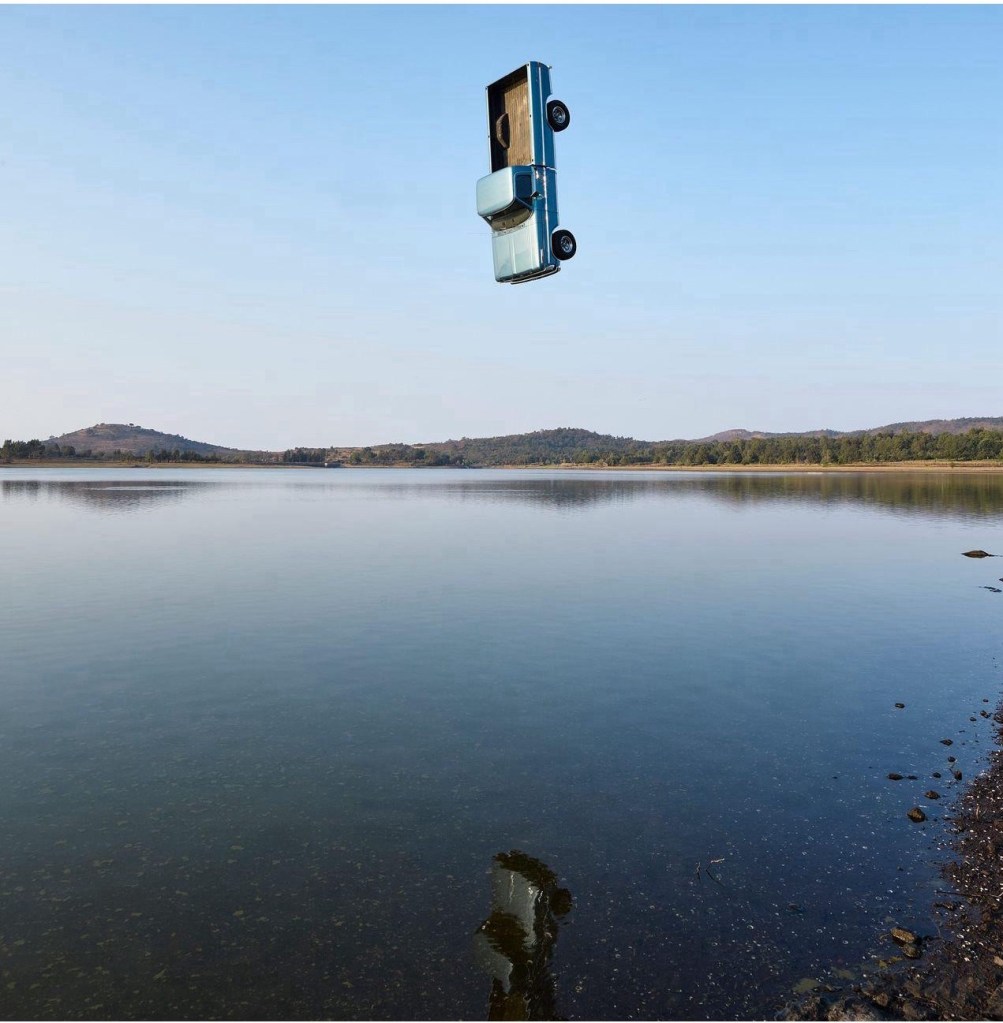
Deluxe edition (AKA F-1 Trillion: Long Bed) additional tracks:
“Fallin’ In Love”
“Dead At The Honky Tonk”
“Killed A Man”
“Ain’t How It Ends”
“Hey Mercedes”
“Go To Hell”
“Two Hearts”
“Who Needs You”
“Back To Texas”
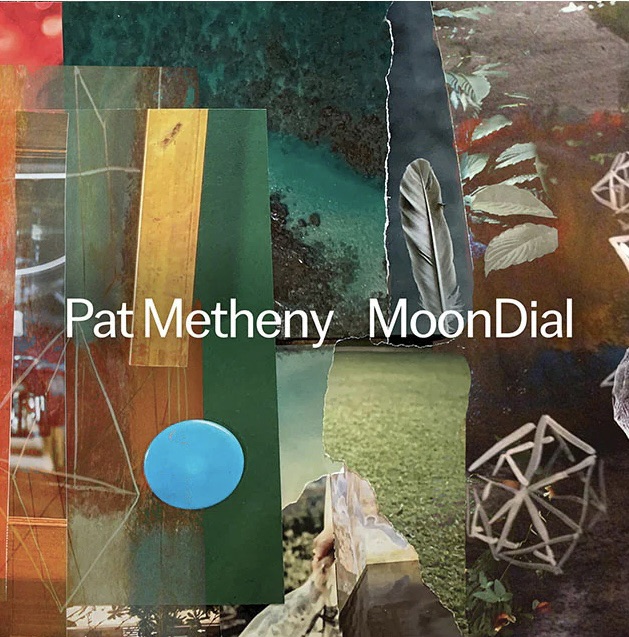
MoonDial is a companion to Metheny’s last album, Dream Box. Per Meheny’s website:
“With the release of Dream Box in the spring of 2023, I took off on a long solo tour around the world, sitting alone onstage for two and a half hours for the very first time. I had played a few tunes here and there by myself each night for years but had never built a presentation that focused solely on solo guitar playing for such an extended run of concerts.“
While on tour, Metheny acquired a new baritone guitar from luthier Linda Manzer, but he commissioned it with nylon strings vs steel like his other baritones. There were challenges with the new instrument – again, from Metheny’s website:
“My deep dive into the world of Baritone guitar began when I remembered that as a kid in Missouri, a neighbor had shown me a unique way of stringing where the middle two strings are tuned up an octave while the general tuning of the Baritone instrument remains down a 4th or a 5th. This opened up a dimension of harmony that had been previously unavailable to me on any conventional guitar.
There were never really issues with Linda’s guitar itself, but finding nylon strings that could manage that tuning without a) breaking or b) sounding like a banjo – was difficult.
Just before we hit the road, I ran across a company in Argentina (Magma) that specialized in making a new kind of nylon string with a tension that allowed precisely the sound I needed to make Linda’s Baritone guitar viable in my special tuning.
There was suddenly a whole new palette of sound under my fingers, just like that.”
Metheny began introducing his new instrument on the Dream Box tour, and soon, he had an album’s worth of material. During a tour break in December 2023, he recorded MoonDial.
The songs mix originals and covers (Corea, Lennon & McCartney, Bernstein & Sondheim, Mercerr, jazz standards, and traditional folk music). The music is mellow, quiet, and acoustic, or as Metheny puts it:
“This record might offer something to the insomniacs and all-night folks looking for the same sounds, harmonies, spirits, and melodies that I was in pursuit of during the late nights and early mornings that this music was recorded.”
There were a lot of clear nights during that December, and in my imagination, it seemed like the moon was checking out what I was searching for up on the upstate NY mountain where I was recording.“
I prefer Metheny’s ensemble work, but this music has its place. It is excellent background music without being musical wallpaper. One of the appeals to Metheny’s music, beyond his brilliant sense of melody, is his guitar tone. Nothing is better than Metheny discovering a new toy, like when he found the Roland guitar synth in the late 70s/early 80s. He takes these new instruments and makes them sing in his singular voice. Manzer’s baritone guitar and Magma strings are Metheny’s latest muse, and MoonDial is the beautiful result. The baritone guitar has a unique tone: rich and thick like an electric hollow body guitar, but clearly acoustic. It has a deep bass and lots of overtones. It often sounds like two guitars or overdubs, but it is Methany playing solo. It is a pretty great sound.
I am consuming the album via a high-resolution Tidal stream (24-bit/96 kHz FLAC). The album is also available in Atmos format on Tidal, but I don’t have the proper equipment to listen to that format. Typically, I would buy the vinyl, but given how quiet this album is, I can’t imagine how vinyl surface noise would improve the listening experience.
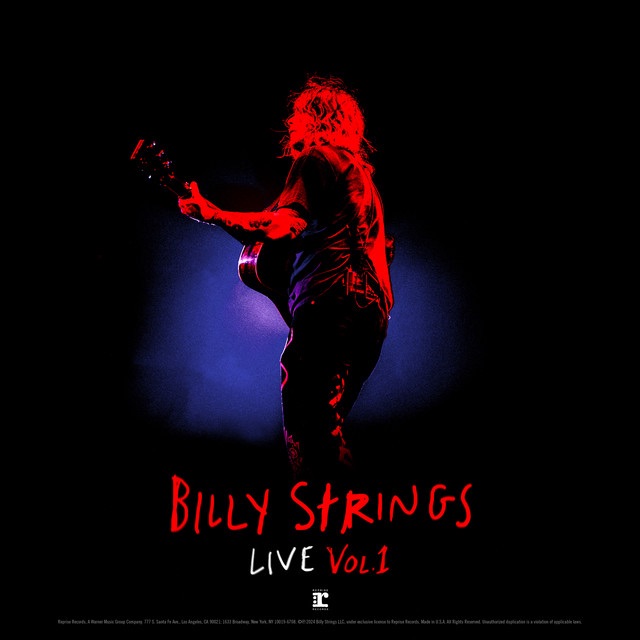
Billy Strings, né William Lee Apostol, is one of my new favorite musicians. Wikipedia describes him as “an American guitarist and bluegrass musician.” Yes, he is that, but he is so much more: he is bluegrass plus metal plus jam band. Bluegrass and metal have always had a “fastest gun in the West” mentality, and Strings and his band are fast. Jam bands are characterized by their psychedelic meandering, Strings and his band do that also. But their secret sauce is their sense of melody, adventurous spirit, and creating rock drama in their live shows.
My son was the first to alert me to Strings by raving about Strings’ brilliant set at the 2022 Lollapalooza in Chicago. I have been to Lolla several times, and I was hard-pressed to imagine how a bluegrass band could succeed on the big stage of a pop music festival. So I checked out Billy Strings on streaming, and frankly, I was unimpressed. Strings and band were good, but so are a hundred other bluegrass bands, and they can’t command the attention of fifty thousand fans at a pop festival. So I kept listening, and the band grew on me, but I still didn’t fully get it.
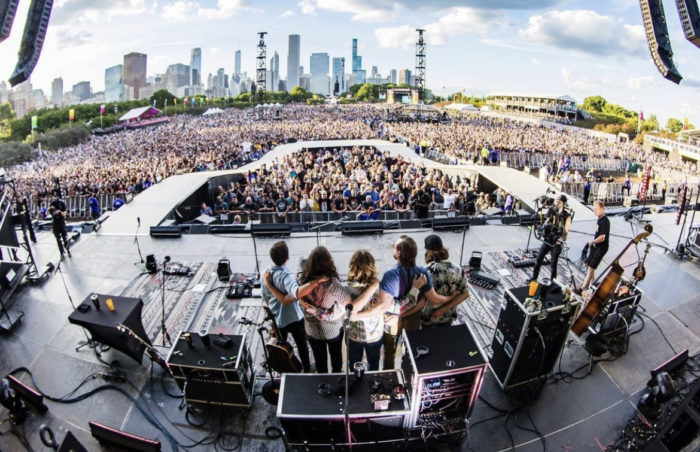
Then I saw Strings live in Phoenix in the spring of 2023, and I got it. It reminded me of when I saw Bruce Springsteen for the first time in 1978. I was barely a fan, but I thought I should check out what all the hype was about. Bruce blew my mind. The next day, I went to a record store, bought Greetings From Asbury Park, brought it back to my dorm room, dropped the needle, and was disappointed – this was nothing like the amazing show I witnessed the night before. My Billy Strings experience was similar – I was underwhelmed by the studio albums, blown away by seeing him live, and still underwhelmed post-live with the studio albums. I saw Strings again this summer; his live performance has improved in a year – I became more impressed, but still, the studio recordings did not resonate with me.

Fans now have a live album that matches up to the live show – a recording that genuinely represents the Billy Strings experience. I am excited to see that the album title includes the phrase “Vol. 1” – I hope this means there is more to come (Googling this, there has so far been no word from Billy’s camp regarding any potential future live albums). Strings has most of his shows available on nugs (legal bootlegs), but Live Vol. 1 is a deliberate live album properly mixed and pressed to vinyl and CD (and available on streaming services with two bonus tracks – and a different track order).
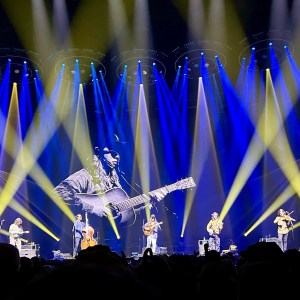
The Billy Strings band consists of Strings on guitar and vocals, Billy Failing on banjo, Royal Masat on bass, Jarrod Walker on mandolin, and Alex Hargreaves on fiddle—and they are all great musicians. Although they are primarily an acoustic band, Strings occasionally runs his acoustic guitar through pedals/effects and a guitar synth to create a rock sound. He also uses effects on his vocals. On studio recordings and live, the band primarily plays original compositions. They also cover traditional folk/bluegrass songs. Still, they also are not afraid to play rock and pop songs (at the Minneapolis show, he played some traditional country covers, and at the Phoenix show, he played a Dylan cover – online, I have seen him cover Cher’s “Believe”). The band’s stage presentation resembles a rock show with fantastic lights and video. Billy Strings is not your daddy’s bluegrass band.
Side 1 opens with “Dust in a Baggie” (recorded December 15, 2023, at Mohegan Sun Arena at Casey Plaza, Wilkes-Barre, PA). The song was initially released on the album Rock of Ages, which Billy did with Don Julin (2013) and again on his self-titled 2016 EP. This song is a regular part of the String’s live repertoire. The music is arranged and performed as a traditional bluegrass number but is not a bluegrass standard. Instead, it was written by Strings and Don Julin. Lyrically, the song is about getting busted and incarcerated for a trace amount of meth possession (mere dust in a baggie per the song title and chorus).
“Away From The Mire” (recorded June 2, 2023 at Moody Center, Austin, TX) first appeared on Home (2019). This song captures the Billy String sound – he updates the bluegrass sound by running his acoustic guitar through pedals to give it an electric guitar sound. Despite the manipulation, the bluegrass prevails. Again this is a Billy Strings original (cowritten with Jon Weisberger). In various interviews Strings has suggested this is about a family argument. I particularly like the use of the term “mire,” which means both (per Merriam-Webster) “wet spongy earth (as of a bog or marsh),” as well as “a troublesome or intractable situation.” This live version extends the studio version from seven and a half minutes to thirteen minutes. It is jam-band heaven. This is one of Strings’ most streamed songs.
“Long Forgotten Dream” (recorded September 22, 2023, at Renewal, Buena Vista, CO) first appeared on Home (2019). It is pure bluegrass and another Strings original. Lyrically, it sounds like the narrator is trying to make sense of a dream that he has just woken from.
Side 2 opens with “Heartbeat of America” (recorded February 25, 2024, at the Ryman Auditorium, Nashville, TN) and first appeared on Renewal (2021). This song has more of a rock song vibe, and at times, Strings’ guitar sounds like Carlos Santana fronting the Allman Brothers. Lyrically, the narrator has smoked some weed and has become very creative:
“Now I’m seeing music that nobody else can see
With all the colors like a symphony surrounding me”
“Dos Banjos” (recorded November 14, 2023, at La Cigale, Paris, FR) first appeared on Fiddle Tune X with Don Julin (2014) – it also appeared on his self-titled 2016 EP. The song is played as a duo with Billy Strings on clawhammer banjo and Billy Failing on banjo (referred to as Dos Billys). Lyrically, the song describes despair:
“The times have changed, the times have changed,
Humanity has lost its way
The people now, the people now,
How they survive, I don’t know how”
Side 3 is a medley of “Fire Line” and “Reuben’s Train” (recorded February 25, 2024, at the Ryman Auditorium, Nashville, TN). “Fire Line” originally appeared on Renewal (2021), and “Reuben’s Train” is a traditional bluegrass song that is not on a studio album (however, it is a frequent song in the live set). This track is just over nineteen minutes and is performed mainly with traditional bluegrass instrumentation – as part of the instrumental section, Billy hits the pedals and gets a bit metal. The studio version is slightly more ornate (piano and harpsichord) and considerably shorter.
Side 4 opens with “Turmoil & Tinfoil” (recorded December 31, 2023, at UNO Lakefront Arena, New Orleans, LA), the titular song from Turmoil & Tinfoil (2017). Per Stings in an interview with American Songwriter, “This song is about missing someone who is standing right in front of you. If you’ve ever had a friend who is addicted to hard drugs, you might know what I’m talking about.” Again, this is a Billy Strings original arranged in a traditional bluegrass format but occasionally Billy hits the guitar pedals to give it an electric guitar sound. The band stretches the six-minute studio versions to twenty-one minutes of jam-band glory.
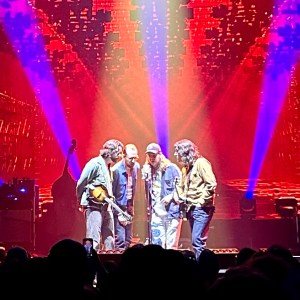
“Richard Petty” (recorded March 1, 2024, at State Farm Arena, Atlanta, GA) is not on a studio album. It must be a newer song, as it has only recently appeared in the live set. It is performed a capella (see photo below from a recent Minneapolis show).
Billy Strings dropped two Live Vol. 1 bonus tracks on his billystrings.live website using a nifty WinAmp player straight out of the 2000s. The two songs are also available on streaming services. The streaming version of the album is in a different track order than the vinyl and CD.
“Hellbender” (recorded April 22, 2023, at St. Augustine Amphitheatre in St. Augustine, FL) originally appeared on Renewal (2021) and is pure bluegrass. It is in regular rotation in the live show. The song describes being on a hell of a drinking bender.
“Highway Hypnosis” (recorded June 16, 2023, at Pine Knob Music Theatre in Clarkston, MI) originally appeared on Home (2019). The band triples the length of the song live from the studio version (although looking online, Billy has doubled the length to nearly thirty minutes at times). The song was written with bluegrass royalty Ronnie McCoury and his son Evan. The song is a driving song where the narrator enters a dream state. There is some amazing solos by Strings and the band. At times, there is almost a funk vibe. Mid-section, sound effects evoke a kind of road chaos that evolves into an audience call and response only to end with some hot picking. This song epitomizes Strings’ adventurous approach to bluegrass.
This album does an excellent job of capturing the excitement of a Billy Strings’ show and is the perfect introduction to Billy Strings. The tracklist is a “greatest hits.” Savoring this collection, I am struck by how seamlessly and tastefully Strings mixes his acoustic and electric guitar textures to create a progressive, uniquely Billy Strings take on bluegrass.
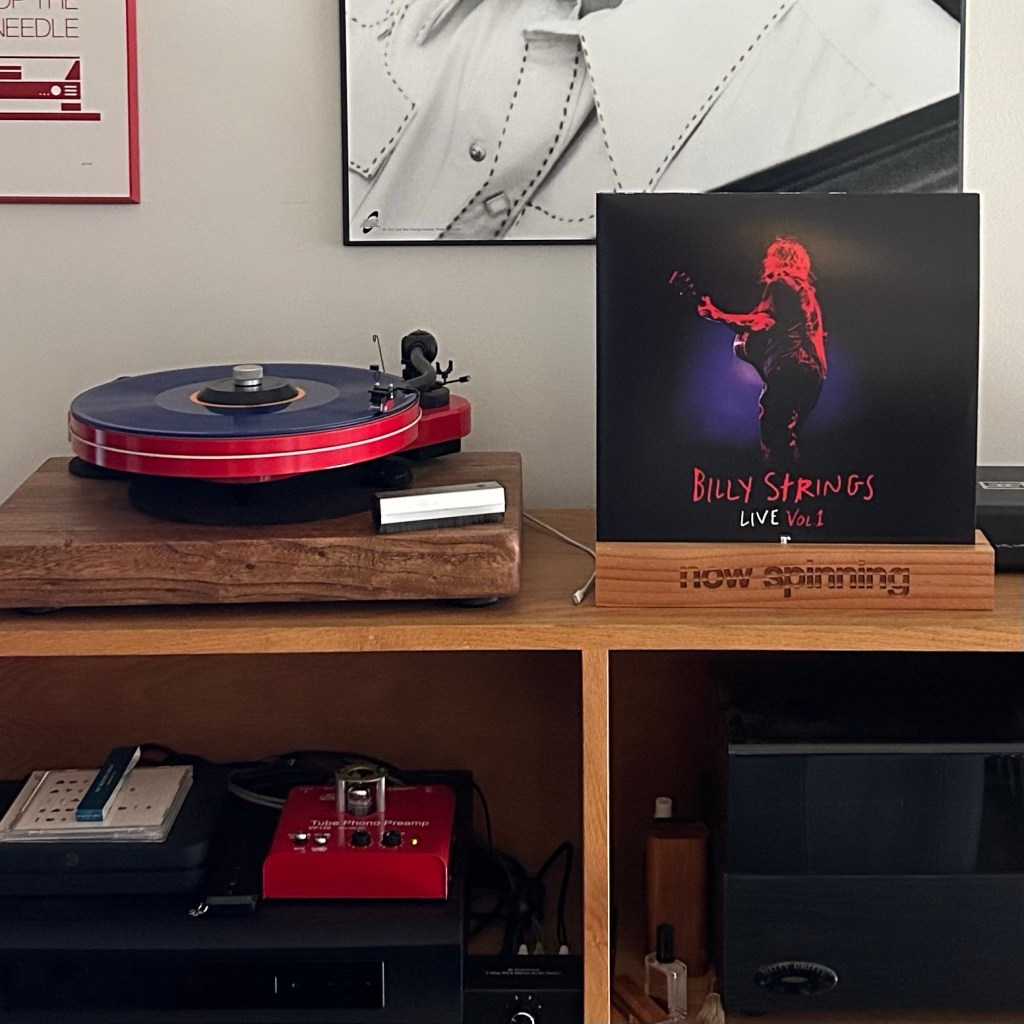
My vinyl edition is the Independent Record Store version, which is two LPs on 180-gram translucent blue vinyl. It is a quality pressing and sounds excellent. The high-resolution stream is 24-bit/96-kHz FLAC (I use Tidal), and it sounds fabulous.
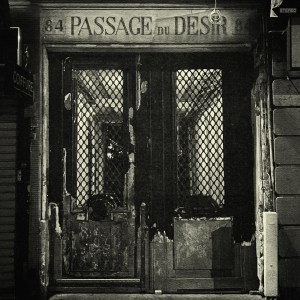
It is great to have a new Sturgill album under the Johnny Blues Skies (JBS) pseudonym; it is a return to his psychedelic outlaw country form of A Sailor’s Guide to Earth (2016). Sturgill Simpson famously said he would only make five studio albums early in his career. He must consider The Ballad of Dood and Juanita, released in 2021, his fifth studio album—even though it was his seventh (he must not count the two Cuttin’ Grass bluegrass remake albums). This claim is significant because his latest album is being released under the stage name Johnny Blues Skies (JBS) – the loophole Simpson has developed to continue to release new music. The bluegrass version of Sturgill on The Ballad of Dood and Juanita never resonated with me. I like the Cuttin’ Grass albums, but they sound like a vanity project. I loved Sound & Fury, but that didn’t sound like a Sturgill Simpson album (it was a rock album – that would have the album use a pseudonym). Passage du Desir (French for “Passage of Desire”) sounds like a Yacht Rock/Countrypolitan version of psychedelic outlaw country Sturgill, and it serves him well. Simpson has been critically acclaimed and has a solid following; he has not broken through to the contemporary country or pop audience. Passage du Desir could be his Chris Stapleton moment.
In a profile in GQ promoting this album, Simpson states: “Sturgill served his purpose, but he’s dead, he’s gone, and I’m definitely not that guy anymore.” The album was written in Paris and recorded in Nashville and London’s Abbey Road. Sturgill had been taking a timeout from the music business after damaging his vocal cords. He traveled the world, spending most of his time in Paris. Eventually, the muse came with a vengeance, and he wrote three to four albums worth of material. “I just wanted to make love songs,” Simpson told GQ, citing the Bee Gees, Fleetwood Mac, Procol Harum, and “grown-ass man records” by Van Morrison and JJ Cale as influences. Despite a new stage name, Johnny Blue Skies, Simpson says: “Honestly, I feel like it’s the most ‘me’ record I’ve ever done because it’s sort of a little bit of everything else, finally realized together.” One of my favorite music critics, Steven Hyden, came to a similar conclusion on Passage du Desir in his review:
“Sturgill Simpson’s first music under a different name is the closest he’s come to making a ‘classic’ sounding Sturgill Simpson LP in quite some time. In true paradoxical Sturgill Simpson fashion, being someone else has given him permission to be more like himself.“
Simpson is backed on the album by many of the musicians he has been playing with for a decade. His long-time engineer/producer/collaborator, David R. “Fergie” Ferguson (Johnny Cash, John Prine, Tyler Childers, etc.), helped Simpson produce the album.
“Swamp of Sadness” opens the album with an intro that combines violin, accordion, and mandolin. After that intro, JBS and the band join, and we have classic Sturgill sonically and lyrically. The song’s narrator is a drunken sailor wandering around Paris, struggling to find his purpose: “Trying to break the cycle of solitude and sin.”
“If the Sun Never Rises Again” has a classic soft-rock vibe – it would not be out of place on a soft-rock radio station in rotation with James Taylor. This is my favorite song on the album. It is sonically beautiful. Lyrically, it is the tale of two broken lovers who have miraculously found each other with the ultimate dream:
“Why can’t the dream go on forever?
Why can’t the night never end?
All we need is starlight in our eyes however
What if the sun never rises again?“
“Scooter Blues” takes a T-Rex riff and country fries it. The narrator is saying “screw it” to the rat race and heads to paradise and goof off:
“When people say, “Are you him?” I’ll say, “Not anymore”
With the wind in my hair, I’m gonna scooter my blues away”
The song also has one of the most ridiculous (in a good way) rhymes (and one of the most wholesome forms of decadence – chocolate milk and Eggos for breakfast):
“Spend my mornings making chocolate milk and Eggos
My days at the beach, my nights stepping on Legos
Wave to the world, screaming, ‘Hasta luego’
Everybody back home will say, ‘Where the hell did he go?’“
“Jupiter’s Faerie” is a melancholy ode to an estranged friend lost to suicide. The song manages to make sadness transcendent:
“I hear there’s faeries out on Jupiter
And there was a time that I knew one
But today I’m feeling way down here on Earth
Crying tears of love in the light of mourning dawn”
“Who I Am” is a crucial track on the album, given Sturgill’s decision to assume the new name Johnny Blue Skies: “I lost everything I am, even my name.” JBS is channeling Waylon on this classic outlaw country tune. The song explores the loss of self and the meaning of life—heavy stuff.
“Right Kind of Dream” musically reminds me of the stuff on 2019’s Sound & Fury, except that the arrangement has been dropped into low gear to match the vibe of the Passage du Desir. Lyrically, the narrator dreams of a better relationship than the one that currently exists: “How I wish that happiness left scars too / Just like you do.”
“Mint Tea” reminds me of the country version of the Allman Brothers (the Dickey Betts songs). The narrator sounds like a dangerous dude trying to convince his lover that he is not so scary: have some tea, sit down next to me, etc.: “Tell me why you’re so afraid of little ol’ me.”
“One for the Road” is a gorgeous ending to a great album. Sonically, it is like a country Pink Floyd song. It is jam band glory. JBS repurposes the one-for-the-road cliche from a last drink to a final confession of a failed lover: “Knowing I’m the one that let us down and I broke your heart.” The song is overflowing with remorse and regret.
Unless you have seen Sturgill live, you don’t realize what a great guitarist he is, but on this album, his beautiful honey-dripping riffs are on full display. As always, The voice is classic country, but he has modified it to a soft-rock Waylon. The lyrics are his typical psychedelic longing. It is great to hear Johnny Blue Skies’ Sturgill Simpson impression: high and lonesome country music with a dash of the blues. This is one for the ages.

The vinyl is nicely packaged, and the LP looks like gold leaf. My copy sounds excellent, but on the internet, several have complained of it being noisy (a common problem with today’s pressings) – so it is a crap shoot. The high-resolution steam is 24-bit 96 kHz FLAC (Tidal) and sounds excellent. The album’s mix is pristine and perfectly represents the arrangements.
So far this year, I have been underwhelmed by this year’s releases and have spent more time listening to old rather than new music. That being said, there are still some excellent 2024 releases to tout. The following list is in no particular order.
Billie Eilish – HIT ME HARD AND SOFT – Billie is 22 years old and can no longer be considered a wunderkind. On her third album, she has released her best. After saying that this list is in no particular order, I will contradict myself and say I have placed the album first as I think it is the best on this list. In my original blog post, I was excited enough to say: “I will stake my measly music-head reputation on the line and say that the new Billie Eilish album is a pop masterpiece and one of the year’s best new albums. I am not saying that it will have any significant cultural impact or that anyone other than her hardcore fans will care about this album in a month; just that it is excellent, and I want everyone my age to hear it.” Some time has passed, and I stand by my original statement.
Cat Power – Cat Power Sings Dylan: The 1966 Royal Albert Hall Concert – In my original blog post, I said: “The arrangements are faithful to the Dylan originals, yet Cat Power’s unique vocals make the material her own. Hearing her interpret these songs opens up new meanings and nuances.”
Kacey Musgraves – Deeper Well – In my original blog post, I wrote: “This album will burnish Kacey’s reputation as a singer-songwriter and recording artist. The songwriting is simple and direct, and the music/arrangements perfectly augment the lyrics. Golden Hour was a huge step forward, moving Kacey from an up-and-coming country star to a brilliant pop singer-songwriter. Deeper Well is evidence that Golden Hour was not a fluke and Kacey is for real.”
The Black Crowes, Happiness Bastards – The Brothers Robinson got back together to celebrate and financially exploit their debut album. That went well enough that they were inspired to record an album of quality new material. I also saw them on tour, and the new material mixes well with their greatest hits. Here is my full review.
Maggie Rogers – Don’t Forget Me – When this came out, I wrote: “On Don’t Forget Me, Rogers has found the Maggie Rogers sound: a soft rock guitar-forward production and an updated version of a 70s singer-songwriter vibe. There is a quiet confidence in Rogers; she sounds comfortable as a pop star.”
Kamasi Washington – Fearless Movement – In my blog post about this album and the tour supporting it, I wrote: “Fearless Movement is my new favorite Kamasi Washington album. At 86 minutes, it is a relatively short Kamasi album, which helps – it is more digestible. I like how it more deliberately incorporates Kamasi and the WCGD’s hip-hop influences. Witnessing this material live has only enhanced my appreciation of the album.“
Kenny Garett & Savoy—Who Killed AI—Earlier this year, I wrote: “The ghost of Miles Davis hangs over this album both in the sound (late-period Miles) and in the experimentation (combining electronics and jazz). Garrett and Svoy’s concept of a Miles-inspired combination of jazz sax with electronica works is inspired—it sounds fresh but also honors the past.”
Vampire Weekend – Only God Was Above Us – I like this album, but it did not pass the “if I like it, I will buy it on vinyl” test. Maybe that will change later this summer when I see them live. In my review, I said: “Overall, this is an excellent album. It is not significantly different from the rest of their catalog, but it distills what they do best. This would be a great introduction to the band.”
Pearl Jam – Dark Matter – The band continues with a nice late-career renaissance (they have been around for nearly 35 years). 2020’s Gigaton was excellent, and Dark Matter is even better. It might be too pop for hardcore fans, but I think it sounds great. It also did not pass my “if I like it, I will buy it on vinyl” test.
Maggie Rose—No One Gets Out Alive—If you like Linda Ronstadt from the 1970s, you will like this album.
Norah Jones – Visions – In my review, I wrote: “Norah has advanced on several fronts. I assume the pandemic gave her a chance to really woodshed. Her vocals are the most adventurous and satisfying in her catalog, and her guitar playing now rivals her piano. Her songwriting is strong. The arrangements are loose but serve the songs.”
Wilco – Hot Sun Cool Shroud EP – This is a last-minute entry as it was released on 6/28/24. This six-track EP (18 minutes) is a collection of leftovers from Wilco’s last album, 2023’s Cousin. They were demos finished by Jeff Tweedy and engineer Tom Schick. I loved Cousin, and these are quality leftovers.
Some albums I initially liked but have not stood the test of time:
- Beyonce—COWBOY CARTER—I was blown away when I first listened to this album. I had not critically listened to a Beyonce album until this one. I wrote a long blog post about it, but I have not returned to it.
- Taylor Swift – The Tortured Poets Department – Simple problem here – it is just too much volume. I recently made a playlist of the TTPD songs she added to her latest leg of The Eras Tour, which was much more digestible. It reminded me that there are some excellent songs on this album. My review is here.
- The Smile – Wall Of Eyes – I completely forgot about this album until I reviewed my blog and Instagram posts. It did not blow me away like the debut did. I originally wrote: “My assumption is that Radiohead is on indefinite hiatus, and so The Smile is likely the closest we will get to fresh Radiohead. The Smile is a satisfying substitute. As for the lyrical content, I have rarely paid attention to Radiohead’s lyrical content, and I am not about to start now with The Smile. Enjoying the soundscape roll over me is all I need.“
And one more thing—I just finished Ann Powers’s outstanding new book on Joni Mitchell (Traveling: On the Path of Joni Mitchell. Rather than writing a typical biography, Powers takes a music critic’s approach. She also takes an autobiographical approach by sharing her relationship with Joni’s music. After five decades of listening to Joni, I gained new insights reading this book.

 Axl's Catch Groove