Nordost Frey 2 Power Cord
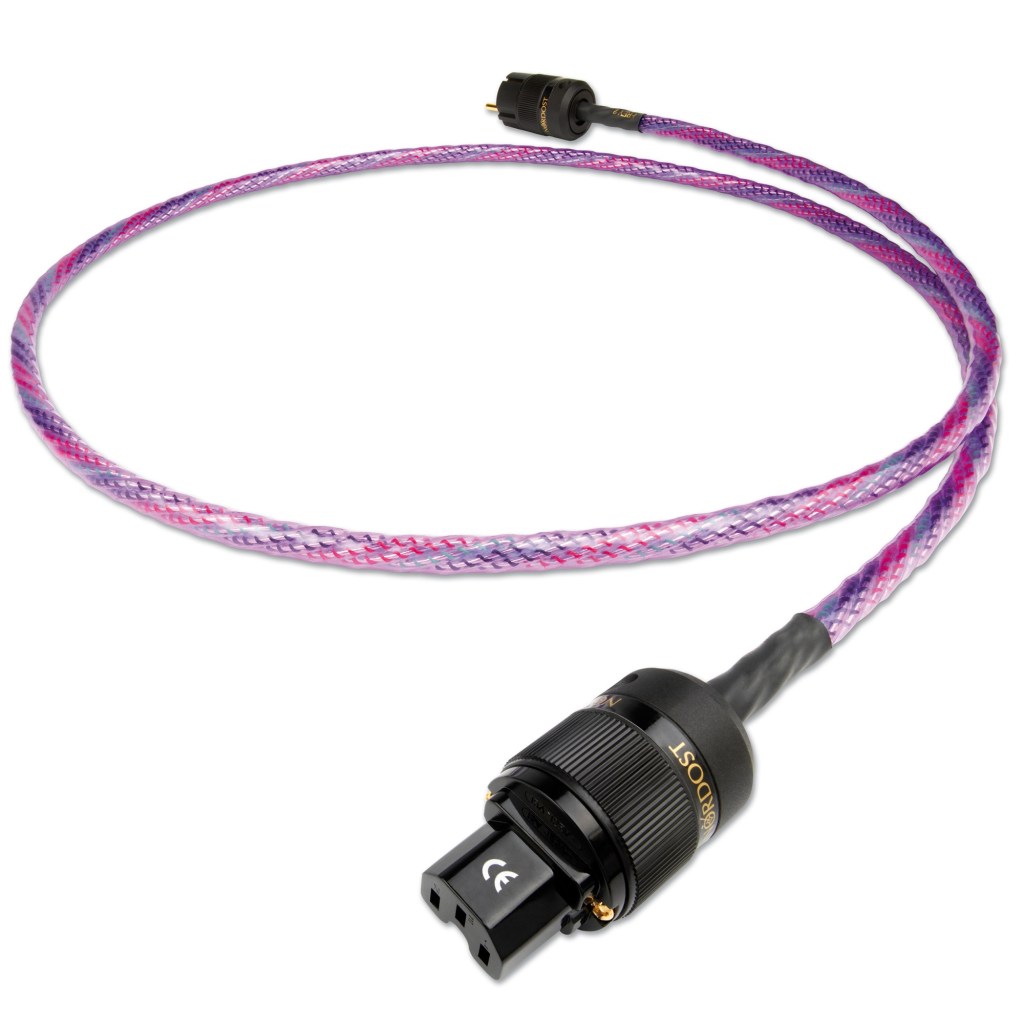
with US wall plug and 15 amp IEC
$2200 for one-meter length
I am a power chord/interconnect/speaker wire agnostic. I have participated in speaker wire blind comparisons and selected the higher-priced wire, but not necessarily the most expensive. In general I have noticed a difference in cables, but not a preference.
An audiophile friend asked me to break in his new Nordost Frey 2 power chord while he was out of town. I was more than happy to do that and compare it to the stock power cord my amp’s manufacturer provided. At first, I assumed that I was using Nordost’s entry-level power cord (the Purple Flare at $260), but I learned that it was the Frey 2, which is up thier product chart (at about $2200) but not at the top (Nordost has a $56K power cord!). Please note my audiophile friend did not pay list price for his Frey 2.
Per the Nordost website: “Norse 2 Series power cords deliver a level of performance not previously possible at their price points. Nordost’s proprietary Micro Mono-Filament construction creates a virtual air dielectric complete with an elegantly engineered suspension system. When combined with silver-plated OFC solid core conductors and FEP insulation throughout, the result is the ideal electrically and mechanically controlled construction for ultra-fast, low-impedance current and voltage transfer. The complex topology of Micro Mono-Filament conductors is especially effective in dissipating mechanical energy present on the AC line, which otherwise enters your delicate electronics rendering dynamic responses sluggish and blurry.”
Well, what ever that means.
This review will be purely subjective – no objective measurements were done. I am not a technical-oriented audiophile – I am more of a musichead with a nice stereo, mid-fi vs. hi-fi.

I tested the power cord on my Croft Acoustics Phono Integrated amplifier, which is part of the Desert Sessions. The Croft is a hybrid tube preamp and solid-state amp. The stock power cord is heavy-duty but nothing special. Speaker wire is generic 16 gauge copper. Interconnects are Amazon Basics RCA cables.
My reference source material was The Pat Metheny Group’s eponymous LP from 1978. I chose this recording because I am intimately familiar with it. It has a lot of dynamics and was beautifully recorded, mixed and mastered. I used both a vinyl version and a streaming version.

(eponymous)
ECM
1978
Tidal (24-bit/96 kHz FLAC) and vinyl
Vinyl—The Nordost cord sounded slightly different than the stock cord. I sensed it was an improvement, but not a two-grand improvement. In summary, I was underwhelmed.
Streaming—Here, the Nordost cord showed a significant improvement. Everything sounded better: highs were brighter, and lows were punchier—in a good way. The overall sound stage was more expansive and richer. It was a $260 improvement when I thought it was a Purple Flare – an upgrade I would seriously consider, given that most of my listening is streaming these days. But once I realized that this was the Frey 2, it was not a two-grand improvement. I am not sure it is appropriate to test such a high-end item on a budget stereo (the Frey 2 costs more than the Croft amp). But it certainly was a fun experiment. After this experiment, I am less skeptical about high-end cords, but I also have a self-imposed limit: if there isn’t an appropriate return on investment, I will not make this kind of upgrade. I also wonder if there would be a difference if the cord were plugged into a power conditioner vs. straight into the wall.
I am not surprised that there was a big difference between the vinyl and streaming test drives, as the Croft amp’s specialty is its focus on its phono pre-amp (a tube-driven stage) – this initially drew me to the amp, given my extensive vinyl collection.
I am grateful to my friend for lending me the Frey 2. This is a component I would never get to experience otherwise. Messing around (speaker placement, A/Bing cords, tube rolling, etc.) makes the audiophile hobby fun, and when you can experiment for free, it’s even better!

 Axl's Catch Groove