Buy or Stream?
Inspired by Miles Davis- Miles In France 1963 & 1964 – Miles Davis Quintet: The Bootleg Series, Vol. 8

Until recently, I gobbled up every Miles Davis CD box set Columbia (and other labels) could produce. But high-resolution streaming (I use Tidal) has disrupted that run. High-resolution streaming offers a lot:
- It is inexpensive (I pay $12 a month for Tidal).
- Quality – at worst, CD quality; at best, 24-bit/96 kHz FLAC.
- Extensive catalog.
- Portability – you can listen on your smartphone – you can even download when you have to be offline.
- Suggested music based on the streamer’s algorithm – I have been pleased with the suggestions.
- Ease of use – you can use your phone as your remote to operate your streaming device – you will never get off the couch again!
Steaming does have downsides, too:
- The artist gets screwed – now this is a debatable point as most of the streaming revenue goes to “rights holders” – which are often not the artists – that is not the streaming services’ fault – but no matter what, when you buy physical media (vinyl and CDs) more money is likely to go to the artist’s pocket.
- There is missing content—often, box sets are not issued in full-on streaming services but are merely a sampler; mono reissues are typically unavailable, some artists refuse to make their content available on streaming, etc.
- Finding content can be challenging, even if you know the artist’s name and album/song name.
- Given reissues – what version is on the streaming service is a crap shoot.
- Packaging: There is no pretty album cover to hold in your hand, no liner notes to read, etc.
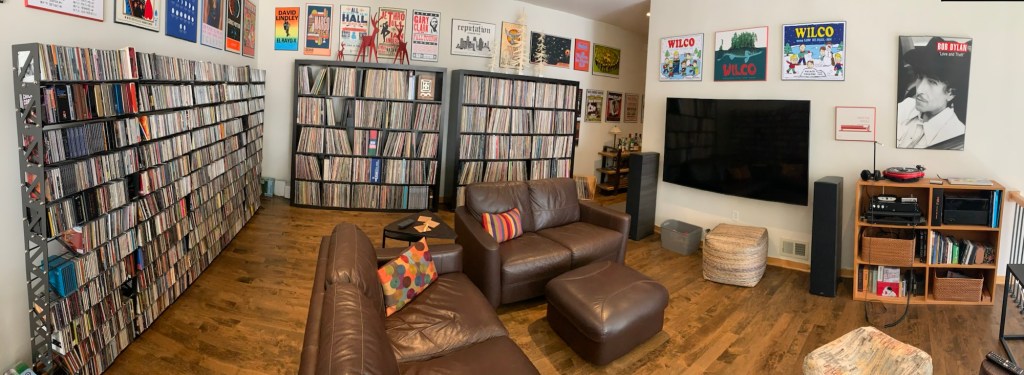
- As a 65-year-old, it is weird not to own physical media (see my collection below).
I immediately wanted a physical copy when I saw this new Miles Davis set. There were two options: vinyl ($225) or CD ($80). But I also saw it was on Tidal as a 24-bit/44.1 kHz FLAC (included in my monthly subscription).


Like Bob Dylan, Miles Davis’ Columbia recording vault is bottomless. This is the eighth Miles bootleg collection, focused on live recordings from Europe during the birth of the Miles Davis Second Great Quintet in 1963 and 1964. The live recording quality is outstanding.
Miles Davis Quintet was the jazz legend’s primary ensemble format from 1955 to early 1969. It had various iterations. The first “great” quintet featured John Coltrane, and the second great quintet featured a bunch of kids: Herbie Hancock on piano, Ron Carter on bass, Tony Williams on drums, and Wayne Shorter on saxophone. These “kids” would all have great careers on their own. This box set is from five live performances, with George Coleman on sax for the first three (1963) and Wayne Shorter (1964) for the last two.
I love Miles Davis’s live recordings. On studio recordings, his playing is generally mellow and quiet (literally muted). It would almost lead you to believe Davis is focused on tone vs. technique. But live, you realize what a brilliant and powerful trumpet player he is. On these live recordings, Miles is at the top of his game. I assume his young virtuosic sidemen are pushing him, and that invigorates him. This is an outstanding recording (audio quality) that captures an essential jazz ensemble exploding onto the scene in front of a passionate French fan base at the absolute height of their powers.
But do I need this collection on my LP or CD shelf? How often will I listen to nearly six hours of Miles in concert? How frequently will I enjoy the 20-page (LP, 32 for CD) book that includes dozens of unseen photos, ephemera, and extensive liner notes by noted journalist Marcus J. Moore? Maybe listen to the set five times? Read the book once? Columbia and the Miles Davis estate are not hurting for money.
I will resist the temptation to buy a physical copy and enjoy Miles In France 1963 & 1964—Miles Davis Quintet: The Bootleg Series, Vol. 8 via streaming. Meanwhile, I will do my best to enjoy the several Miles box sets I have not listened to in a long time.

 Axl's Catch Groove