Lost on the Shelves: Dixie Dregs 1977-1982
I’m revisiting the Dixie Dregs (DD) catalog in reaction to acquiring The Great Spectacular, a Record Store Day 2024 release. The Great Spectacular was the band’s original 1975 demo tape, pressed on vinyl by the band (1000 copies), and it was recently reissued for Record Store Day 2024 (1200 copies). I was a DD fan in the late ’70s but have not listened to them in forty years. The Record Store Day release reminded me of my fondness for the band, so I have rediscovered their first six albums.

World’s worst band photo:
Back row: Rod Morgenstein and Steve Morse
Front Row: Stephen Davidowski, Andy West, and Allen Sloan
The DD are the ultimate 70s fusion band: they played rock, jazz-fusion, Southern Rock, country, classical, bluegrass, and prog – sometimes all in the same song. They are an instrumental band, except for two songs with vocals on their final album for Arista, Industry Standard (1982). I realize that an instrumental band is a non-starter for many. This is complex music, and so come with an open mind. The variety throughout an album can be head-spinning. But if you dig it, you will be rewarded with a fantastic music catalog. If you give it a legitimate listen and don’t like it, no problem; they aren’t for everyone. It will work, or it won’t.
The DD were initially signed to Capricorn Records, whose roster at the time was a who’s who of quality Southern Rock (Allman Brothers Band, Marshall Tucker Band, Sea Level, Wet Willie, etc.). They recorded three albums for Capricorn, and then that label went bankrupt. They were quickly picked up by Arista for three more albums. In the late 70s and early 80s, the Dixie Dregs had great press, critical acclaim, and Grammy nominations. Still, they never broke through and ultimately fizzled out after their most commercial-sounding album (Industry Standard) in 1982. Yet, to this day, The Dixie Dregs remain a loose collection of its former members, reuniting briefly for short tours and rare studio work.
The band’s star, guitarist Steve Morse, has continued a solo career and is a gun for hire (working for Kansas in the mid-80s and Deep Purple in the mid-90s through the present). Morse is considered one of the greatest guitarists of his generation, and the readers of Guitar Player magazine voted Him “Best Overall Guitar Player” five years in a row (1982-1986), qualifying him for the Guitar Player Hall of Fame.
Drummer Rod Morgenstein has been awarded Modern Drummer’s “Best Progressive Rock Drummer” for five years (1986-’90) and “Best All-Around Drummer” (1999) and was inducted into the magazine’s Honor Roll. He worked for twenty years as a professor, teaching percussion at Berklee College of Music in Boston, Massachusetts. He has been in the band Winger for years. Keyboardist T Lavitz, who joined the band during the Arista era, had an impressive career post-Dregs, playing in various bands (including Jazz Is Dead) and as a studio musician (unfortunately, he passed away in 2010). Bassist Andy West was an unsung hero in the band and kept his toe in the music business post-DD but pursued a career in the software industry as his primary gig. In addition to T Lavitz, the band has been blessed by two other great keyboard players: Stephen Davidowski on their debut and Mark Parrish on the final two Capricorn albums.
Although Morse gets most of the attention in the DD, fiddler Allen Sloan is an equally important co-star. Sloan can fiddle like the hottest Nashville cats and play the violin in classical and prog music styles. Over time, Sloan was challenged to stay with the band due to his medical career as an anesthesiologist. Revisiting the catalog, I am struck by what a fantastic performer Sloan is and how critical the violin is to the DD sound. On their last album, when Sloan had to attend to his medical career, he was replaced by an equally brilliant fiddler, Mark O’Connor.
The DD should appeal to the current jam band crowd, especially country/bluegrass fusion fans of Billy Strings, Trampled By Turtles, Nickel Creek, etc., and Allman Brothers-influenced bands like Tedeschi Trucks Band, Gov’t Mule, etc. They should also appeal to 70s jazz fusion fans (Weather Report, Herbie Hancock, Mahavishnu Orchestra, etc.). Finally, there is enough prog here (albeit with a country flavor) for old-school prog fans of ELP, King Crimson, UK, Jethro Tull, etc.
The DD debut on Capricorn, Free Fall (1977), set the template for their catalog. The band came out of the starting gate with a fully realized vision of who they were, and they were consistent in executing that vision across six studio albums. Ultimately, they were an instrumental jazz fusion band with a unique approach to jazz fusion from their peers (Pat Metheny Group, Weather Report, Return To Forever, etc.). That approach was to leverage Southern Rock, Country, and Bluegrass. Songs across their six albums generally fall into the following five categories:
- Southern Rock—imagine the most far-out The Allman Brothers Band solos, and that is DD territory, yet there are plenty of big dumb riffs to make you smile.
- Hoedown – Bluegrass or Country dance music with a little Broadway vibe and a high fun factor.
- Baroque – their take on the music of Bach – typically, this is guitar and violin duos.
- Prog—Although ultimately a jazz band and their modus operandi is a jazz aesthetic, they do have this prog thing—it was kind of Baroque rock.
- Country-fried funk – a country Curtis Mayfield or Herbie Hancock

Each album has at least one song in each of these categories, and many times, a single tune will use more than one of these categories. The dominant style is Southern Rock, but it always has a jazz aesthetic – ultimately, they are a jazz fusion band.
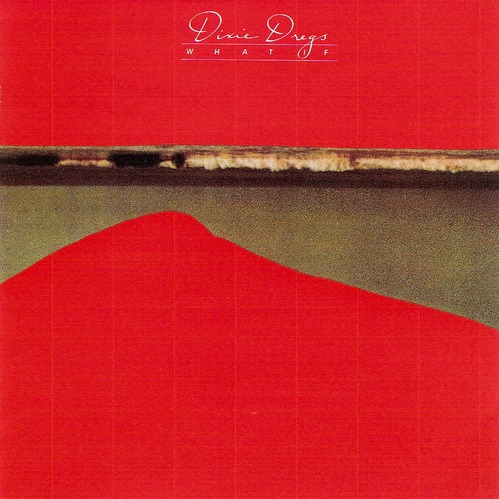
What If (1978)
The three Capricorn albums are similar, except the band got better/tighter with each release. The debut, Free Fall (1977), is remarkable in that it was a fully realized vision of the band. I purchased this album shortly after it was released and played it to death in the late 70s. The second, What If (1978), was unfamiliar to me until recently. Given my fondness for Free Fall, I don’t know why I never acquired it. I picked up a near-mint copy for 49 cents at one of the Electric Fetus (Minneapolis record store) garage sales sometime in the last five years. But even that purchase didn’t motivate me to listen, and it sat on my shelf until working on this blog post. What If is not significantly different from Free Fall; however, the band perfects the DD concept. The only personnel change is that Mark Parrish takes over from Stephen Davidowski on keyboards. The third Capricorn album, Night of the Living Dregs (1979), continues the pattern; however, the second side is selections of a live show at the Montreux Jazz Festival on July 23, 1978 (the complete show can be found on Live At The Montreux Jazz Festival 1978, available for streaming on Spotify). The live set shows this was a powerful live act, not just studio rats.
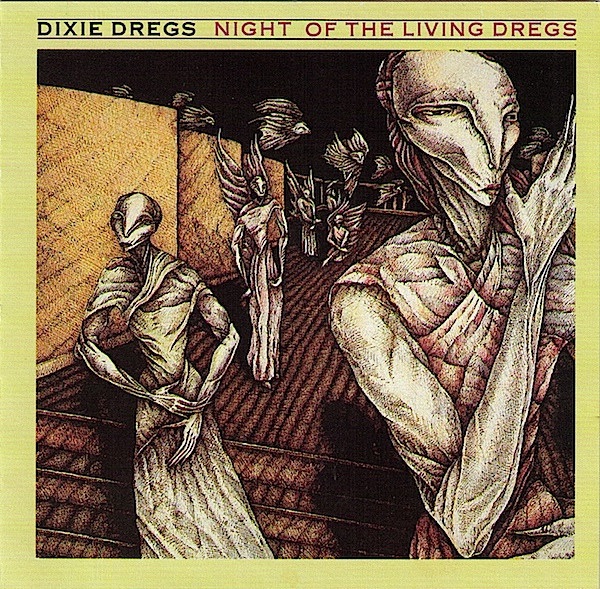
(1979)
After three studio albums, the DD were without a label. Capricorn had declared bankruptcy in the fall of 1979. Fortunately, the band was able to snag a three-album deal with Arista. In addition to the label change, keyboardist Mark Parrish left and was replaced by T Lavitz.

Steve Morse, Mark O’Connor, Rod Morgenstein, Andy West, and T Lavitz from an Arista Records photo shoot.
At the time, the move to Arista seemed like a good thing. Arista was more commercial and successful than Capricorn (they are still in business today as part of Sony), yet it was artist-friendly; for example, the label allowed Steve Morse to produce the DD albums. The downside was that Arista had expectations for an ROI; they wanted hits.
The DD were at the top of their game as they joined Arista. The band’s core had been at it for a decade; they were critically acclaimed and regularly received Grammy nominations. But it was hard to imagine how they would fit into the star-making pop machinery at Arista. Their eclectic style was going to be hard to market: it was too jazzy for the rock audience, too rock for the jazz audience, too country for the rock and jazz audiences, and the country audience was not going to go for weird improvisational instrumental music. But in the early 80s, record labels were willing to take a chance on a band like the DD, given how much money the music industry made (avant-garde saxophonist Anthony Braxton was an Arista artist during this era, for example)
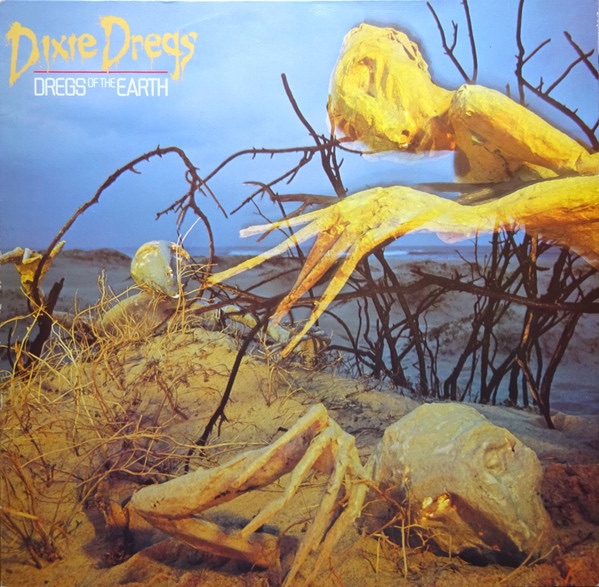
The first album on Arista was Dregs of the Earth (1980), which is similar to the Capricorn albums. It is a step forward, a bit more commercial in that it is more rock-focused but still plenty adventurous. This would be a great entry point for the band.

With Unsung Heroes (1981), Arista and the band doubled down to become an instrumental band with the album title and cover art. They ditched “Dixie” from their name and were rebranded as The Dregs. This is the “genius” of the label suits: the band is not selling well; it must be the Dixie in their name. Fortunately, the music didn’t suffer; it is the same eclectic gumbo of styles as their previous four studio albums. Unsung Heros sounds the most commercial of all of their albums thus far, yet it has an adventurous spirit that tempers it from being a sell-out. Morse is quoted as saying: “Unsung Heroes is the peak of me getting the most out of the band—certainly as a producer. I got a chance to try out all the stuff I learned from Ken Scott on previous albums. So, a lot of work and attention to detail happened. It was a very satisfying project for me.”
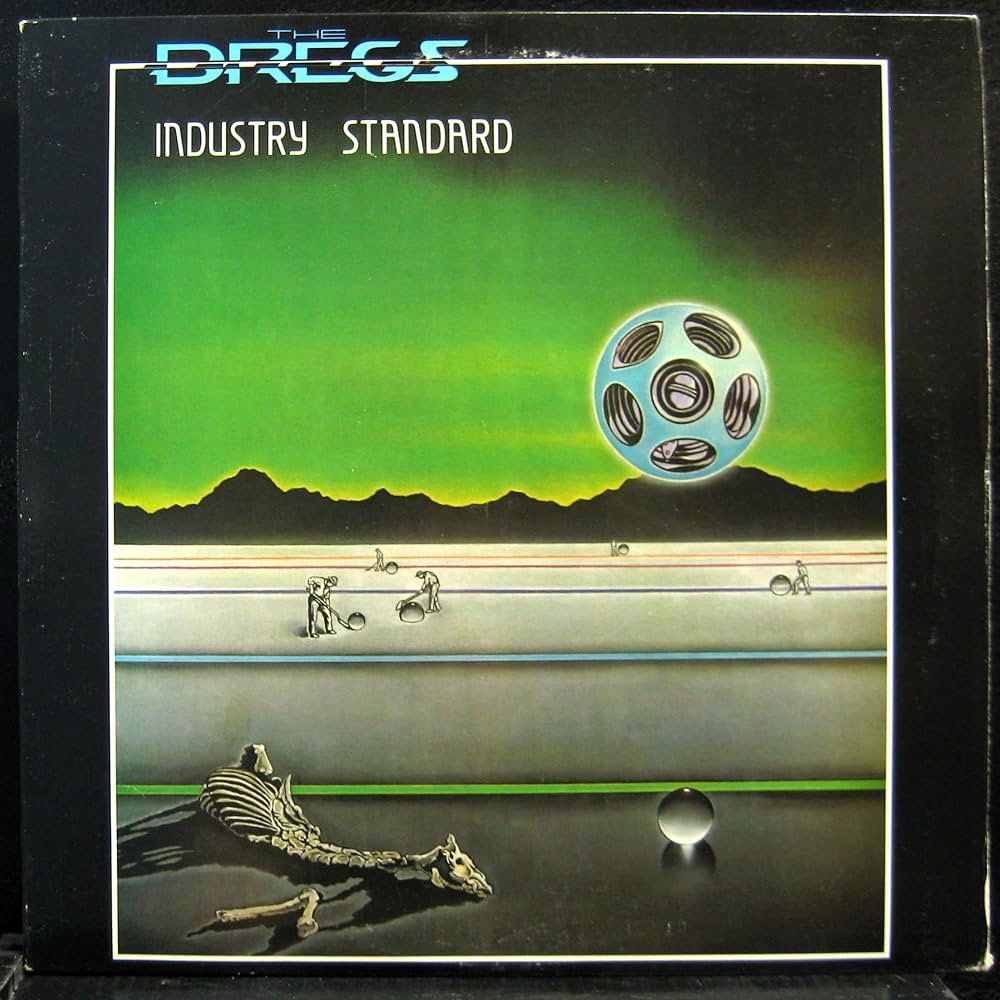
With Industry Standard (1982), their final album on Arista (and created a hiatus – their next studio album would be Full Circle in 1994), the band made their first mistake: adding vocals on two tracks. I can’t imagine the pressure the label must have put on the band to be more commercial. Morse shares the production duties with prog producer Eddy Offord (who had commercial and artistic successes with ELP and Yes). It didn’t work commercially, and Arista released the band after this album. The band disbanded; however, they have reunited occasionally, including this past spring (2024) for a tour—I missed that, but I heard they were great. The vocal tracks (“Crank It Up” featuring vocalist Alex Ligertwood, who was with Santana at the time, and “Ridin’ High” featuring Patrick Simmons of the Doobie Brothers) are generic classic rock. This is the weakest of their albums. It is not that their playing deteriorated; it is just that they were trying to be commercial, and that was just not who they were.
Today, DD would be a jam band, and there is now an audience for this kind of adventurous music. Today, it is easier for a band like the DD to make it. Not in the “hits” sense of making it, but in the sense they could do 35 shows a year (75 if ambitious) in 2500 – 5000 seat venues, making a nice living. But it was more challenging in the late ’70s and ’80s; it was a hit-on-the-radio-economy. In hindsight, it is a miracle a band like the DD made six studio albums between 1977 and 1982.
In the end, the DD had run its course. Their brand of jazz fusion was not going to generate a hit, and there wasn’t a jam band-like scene to support them. The Dregs were not a viable commercial concept in the early 80s. Jazz fusion was deteriorating into light jazz, and the DD were anything but light. But the band was not a failure; they were just at the wrong time. Steve Morse is a brilliant guitarist – he has all the soul and swagger of Jeff Beck but with a broader palette. I have spent many hours listening to the Dixie Dregs over the last month, and with every listen, I made a new discovery and grew in awe of each player. The core guitar, bass, and drum players remained constant, and the band attracted fantastic talent at the keyboard and violin. They are a band deserving more fame – they are truly unsung heroes of late 70s/early 1980s jazz fusion. They are so eclectic that it hurt their marketability at the time. I feel like their concept would work better now.
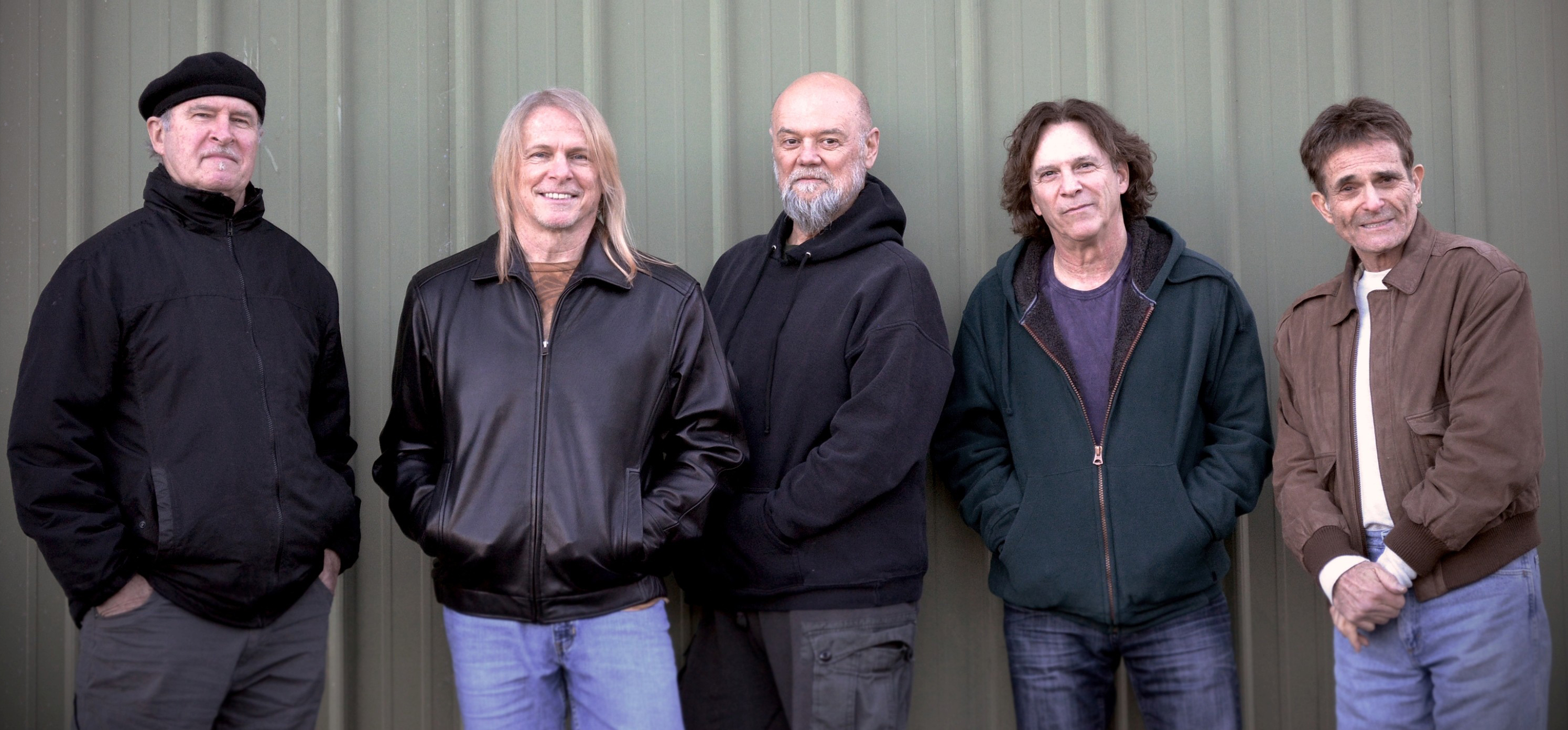
Steve Davidowski, Steve Morse, Andy West, Rod Morgenstein, and Allen Sloan
Photo: Dixie Dregs
I am grateful I never sold my vinyl records during the CD era. Even though the DD’s Capricorn and Arista catalogs are available on streaming services, having near-mint vinyl copies of these three records (and the three Capricorn records) is a beautiful legacy.
Post Script: The Great Spectacular (1975/2024)

The Great Spectacular sounds like a Greatest Hits collection for those familiar with the band. The band re-recorded The Great Spectacular songs and used them on several studio albums. These are some of their most beloved songs. Steve Morse even used one of the songs during his short stint with Kansas. On the tracklist below, I indicate what album the songs ultimately appeared in parenthesis.
“Refried Funky Chicken” (Free Fall), “Holiday” (Free Fall), “Wages of Weirdness” (Free Fall), “T.O. Witcher” (Steve Morse with Kansas on their album In The Spirit Of Things), “The Great Spectacular”(Dregs Of The Earth), “Ice Cakes” (What If), “Leprechaun Promenade” (Night of the Living Dregs), “Country House Shuffle” (Night of the Living Dregs), “What If” (What If), and “Kathreen” (never subsequently re-recorded, but it does appear on the DVD Live At The Montreux Jazz Festival 1978).
The band on the album is Rod Morgenstein (drums), Steve Morse (guitars), Allen Sloan (violin), Andy West (bass), and Frank Josephs – Fender Rhodes electric piano. Here are some comments about the album from a relatively recent interview with Steve Morse:
“The preparation for that album is the part I liked best. We were together as an ensemble and playing—usually for free—somewhere on campus at the University of Miami or around the city of Miami. The recording itself was stark and unpolished. We had to record it in one night after a long day of school and classes. It was done late at night. We were 19-20 years-old. It wasn’t really a studio. They just put the recording equipment in a live concert hall. We were set up in there with headphones. My amp was in an elevator shaft. The violin, Fender Rhodes and bass went direct. The drums were on stage. It was bizarre. We had to trudge upstairs to the very back where the projectionist would be in the movie theater and do the mix there. So, there was nothing great about the sound. But the preparation was the magic. The songs were in a good place because we had come together as a band.”
The sound on the album is way better than Morse suggests, but I get his point, as the Dixie Dregs studio albums sound fantastic. The album sounds like a high-quality demo; it is dry sonically. The biggest things I notice are the arrangements (which are more straightforward than the studio recordings), the performance of the band (they are not nearly as tight as their debut, Free Fall), and the lack of keyboards (Josephs’ playing is fine, but the Rhodes is pretty wimpy compared to the wall of keyboards the studio albums have on them). The Record Store Day vinyl is a quality pressing.

 Axl's Catch Groove
Trackbacks & Pingbacks