Book Review: Ann Powers – Traveling: On the Path of Joni Mitchell

I have been a fan of Joni Mitchell for over 50 years, and she is on my musician Mt. Rushmore. I am familiar with her biography, so it is perfect that Ann Powers’s book on Joni is not a straightforward biography. The history of Joni’s life is here, but the book is more of an exploration of her music — it is like an elaborate album review—only of her whole catalog. At times, Powers is autobiographical, but in a relevant way – she describes her relationship with the artist as a fan (but a critical fan). Powers is not a biographer but a music critic, and the value she provides here is a critical appraisal of Mitchell’s career. In Powers words:
“I’m not a biographer, in the usual definition of that term; something in me instinctively opposes the idea that one person can sort through all the facts of another’s life and come up with anything close to that stranger’s true story. Instead, I’m a critic. A kind of mapmaker, as I see it, setting down lines meant to guide others along the trajectories of artists who are always one step ahead of me. In Mitchell I found an inexhaustible subject, one who never let me put down my pen and declare my maps complete.”
Ann Powers is an excellent guide on the Joni path. She has a feminine point of view, which I appreciate as I don’t have that perspective. It provides deep insights into Joni, the person, and the music. As much as Joni wants to be considered a singer-songwriter vs. a woman singer-songwriter, it is impossible not to consider the feminine context of Joni’s art — especially because she was a creator in a male-dominated world.
In order to tell Joni’s story, Powers goes on some wonderful tangents, like when she compares Joni’s Blue to Miles Davis’ Kind Of Blue and when she explains jazz fusion (and argues that Joni is ultimately a jazz fusion musician).
Powers is not afraid to consider Joni’s questionable decisions; for example, she takes a deep dive into Mitchell’s alter ego, Art Nouveau – an African American man, more specifically, a pimp-like character Joni would occasionally impersonate (most famously on the cover of her 1977 album Don Jaun’s Restless Daugther).
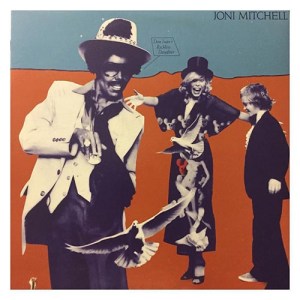
Powers does a great job of reconsidering Joni’s underrated 80s albums. She is unafraid to share her reverse schadenfreude—it bugs her that prickly Joni has turned into cuddly Joni in Mitchell’s final chapter of life.
One of the major takeaways from the book is that it has prompted me to explore my Joni fandom. As I read the book, I jotted down what I love about Joni:
- The mood her music creates, especially the melancholy but also the humor
- The lyrics and stories
- Her voice and how it ages
- Her guitar playing
- The arrangements (Joni has been her own producer for most of her career)
- Her command of multiple genres: folk, folk-rock, pop, rock, and jazz-fusion
- Her look
- Her attitude
- Recently, from the most recent iteration of Joni, her giggle
I love how Powers puts it at the end of the book in her acknowledgment section:
“Joni Mitchell, I thank you for your endless complexity. It gave me so much to explore, and I’ll never regret my time following you.”
If you are a fan of Joni Mitchell, Ann Powers’s Traveling: On the Path of Joni Mitchell is a must-read!

 Axl's Catch Groove
Ann powers couldn’t get out of her own way. She constantly interjected herself and her experiences into the narrative and apparently her experiences with men have been dismal. No couple in Joni’s story could simply have a relationship – it was always about power. She even turned graham Nash’s “Our House,” a simple uncomplicated song about love and domesticity, into another example of men lording it over women. Everything about Joni was seen as such. Oh my, It must be hard to be Ann powers. Her cynicism overshadowed much of the book.
I understand your frustration, but the point of the book was not to do a traditional biography, as that had already been done. It was like a long, critical review. I enjoyed her take, but I can see where others would not.