Lost on the shelves: Joni Mitchell – The Hissing Of Summer Lawns (1975)
I recall Joni Mitchell’s The Hissing Of Summer Lawns (1975) as a weird and artsy album. Upon revisiting it, I had misremembered it. Most of the album is accessible and in the style of its predecessor, the jazz-pop masterpiece Court and Spark. However, it has two significant weird and artsy songs: the second track, “Jungle Line,” and the final track, “Shadows and Light.” These two tracks stuck out in my memory, not the “Court and Spark Volume 2” tracks. It is a fascinating follow-up to Joni’s most commercial album, foreshadowing how seriously Joni would soon abandon the mainstream. The album’s lyrical themes are a woman’s frustration with society’s patriarchal norms and the music industry (those two things are often the same issue). One of the fascinating things about Joni’s art is its focus on romantic relationships between men and women, yet she has a healthy skepticism and criticism of men.
The album opens with “In France They Kiss On Mainstreet,” which would not have sounded out of place on the Court and Spark. Lyrically, the narrator recalls their 1950s teenage years—a time of innocence and playfulness—quite a contrast to the treacherousness of the 1970s that dominates the rest of the album.
On the second track, she takes a bizarre sonic turn with “Jungle Line,” which doesn’t sound like anything in her catalog. She samples The Drummers of Burundi (credited as “warrior drums” on the album) and mixes it with a Moog synth, guitar, and her voice. The drum sampling is one of the earliest uses of sampling in a commercial recording. This would become a convention in hip-hop a few years later. The sound is jarring after the sheen of the first track. Lyrically, Mitchell blends images of painter Henri Rousseau’s work with city life, the music industry, and drug culture. It foreshadows where she would go with her own career and where peers like Paul Simon would go (for example, Graceland). At first, this song feels out of place after the naivete of the first track, but it is an excellent transition to the darker themes of the rest of the album.
The next several songs are a sonic return to the jazz-pop of Court and Spark. “Edith and the Kingpin” tells the story of a gangster picking out a prostitute and then snorting coke with her. Things have turned dark indeed.
“Don’t Interrupt the Sorrow” is dominated by a classic Joni acoustic guitar riff. Lyrically, it is a stream-of-consciousness musing on patriarchy. Mitchell, one of her generation’s great songwriters, must have been frustrated at being dismissed as a mere “girl singer.” This song is a glimpse of that frustration. In the liner notes, Joni writes: “The poem, “Don’t Interrupt The Sorrow” was born around 4 a.m. in a New York loft. Larry Poons seeded it and Bobby Neuwirth was midwite here, but the child filtered thru Genesis at Jackfish Lake, Saskatchewan, is rebellious and mystical and insists that its conception was immaculate.”
“Shades of Scarlett Conquering” is piano-driven. This is another song of the narrator chaffing under the patriarchy. The images are based on a southern belle like Scarlett O’Hara in Gone With The Wind.
The titular song, “The Hissing of Summer Lawns,” tells the story of a Stepford Wives-like character who is owned by her husband. The song title refers to the sound of sprinklers on a perfect suburban lawn.
After several songs about the patriarchy, in “The Boho Dance,” the narrator turns to muse on an artist who betrays their artistry for commercial success. This must have been at the top of Joni’s mind after the commercial success of Court and Spark.
A common feature in Joni’s songwriting from Court and Spark and beyond is to create a collage of her songwriting with a cover song. “Harry’s House – Centerpiece” is a combination of her composition (Harry’s House) and a jazz cover (jazz standard “Centerpiece” by Harry “Sweets” Edison and Jon Hendricks). The song tells the story of a deteriorating marriage: the husband is obsessed with his job, and the wife struggles with her housewife/mother role. In the middle of the tale, she seamlessly integrates “Centerpiece.” Joni takes what is supposed to be the jazz song’s complement: “‘Cause nothing’s any good without you/Baby, you’re my centerpiece” and turns it into a backhanded compliment. This song shows the brilliance of Joni: seamlessly mixing her pop sheen with a straight jazz cover.
“Sweet Bird” updates her acoustic guitar/piano sound before Court and Spark. Lyrically, it returns to her early albums’ “confessional” singer-songwriter mode. The narrator is mourning the loss of youth—especially as a woman, where youthful beauty is so defining. In the liner notes, Joni writes: “”The Boho Dance” is a Tom Wolfe-ism from the book “The Painted Word.””
The album ends with sonic experimentation. “Shadows and Light” is a synth-based riff with Joni’s vocal overdubs. Lyrically, it is a litany of contradictions and opposites, like shadows and light. This song must be meaningful to Joni, as she named her 1980 live album after it and opened that tour’s concerts with the tune (accompanied by the acapella group The Persuasions adding gorgeous textures—I saw that tour).
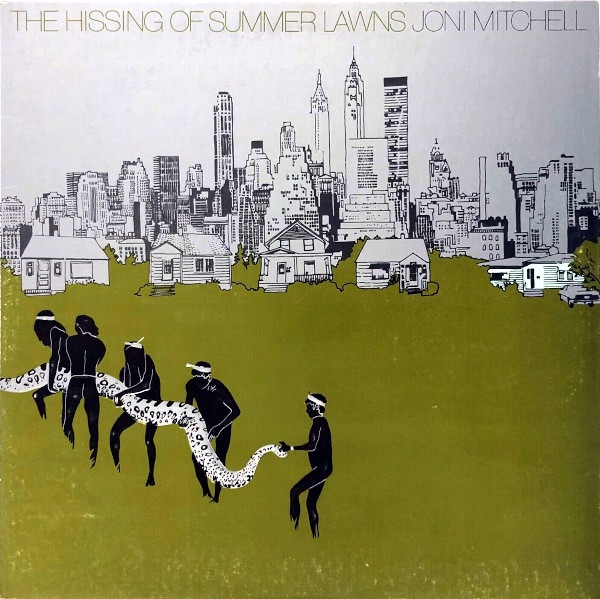
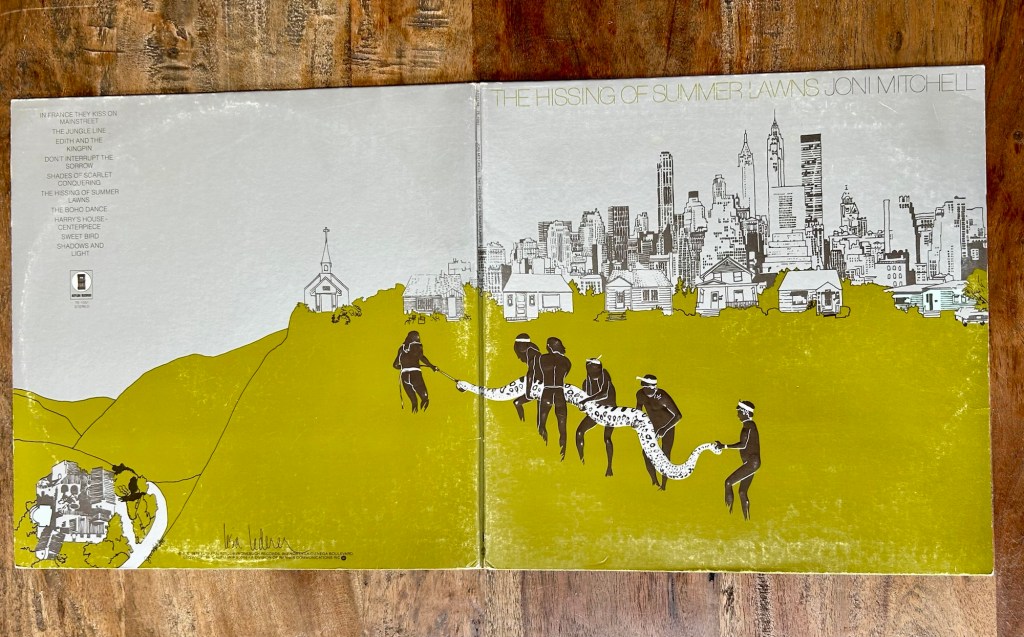
Joni always has excellent album art and packaging. This cover art is created by Joni (a common feature of her albums). It uses the African theme of “The Jungle Line” by superimposing an image of dark-skinned people carrying a giant snake (both were embossed on the original vinyl album cover) on the Los Angeles skyline, with Mitchell’s house on the back cover. On the interior of the gatefold are the lyrics, liner notes, and a swimming Joni radiating her femininity.

The album has aged well and is as solid as anything in her catalog. Prince was a huge Joni fan (Mitchell told New York Magazine in 2005: “Prince used to write me fan mail with all of the U’s and hearts that way that he writes”) and frequently gushed about Hissing in several interviews.
In the liner notes, Joni writes: “This record is a total work conceived graphically, musically, lyrically and accidentally – as a whole. The performances were guided by the given compositional structures and the audibly inspired beauty of every player. The whole unfolded like a mystery.”


 Axl's Catch Groove