Catchgroove’s Musical Memoir: The Flute
As a kid, I became fascinated with the piccolo and wanted to play it. My parents indulged my interest and found a piccolo teacher who told them that if I wanted to play the piccolo, I would first need to learn to play the flute. That sounded fine to me. I started to learn the flute when I was in third grade. I took lessons at the MacPhail Center For Music in downtown Minneapolis. My instructor was Dennis Schulte, AKA Mr. Schulte.
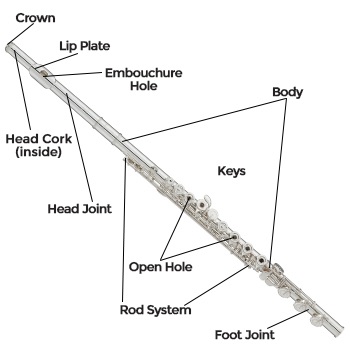
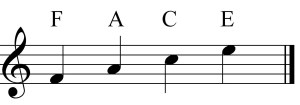
My grade school did not have a band so learning the flute was a solitary effort. My first flute was a “rent to buy” and was a Gemeinhardt student model. The first thing that Mr. Schulte did was teach me to make a sound on the flute head joint. This is not as easy as it sounds: you blow over the embouchure hole and you have to create an embouchure which is the use of the lips, teeth, tongue, and facial muscles to play a wind instrument like the flute. I bet this took a week to figure out. When I returned for my second lesson, I could make an appropriate sound. Also, part of that first lesson was learning the basics of reading music: learning the notes on a staff by the mnemonic device: Every Good Boy Does Fine and FACE.

I took to the flute like a duck to water and after a few months, my folks realized that I was not going to quit it so they actually purchased a flute for me. Mr Schulte insisted that I get an open-hole flute with a silver head joint as that would be a quality flute that would see me through the next several years. An open-hole flute has holes in the keys which are covered by the player’s fingers. The upside is that it allows for a greater range of fingerings, playing techniques, and improved tone. The downside is that it requires greater dexterity to play – AKA, it is harder to play. Mr. Schulte’s theory was to start a player young on an open hole so that you develop dexterity early in your flute playing career. I don’t remember how much the flute cost, but it must have been a lot for my parents – the equivalent of over $1000 today. I remember that McPhail sold ticket books to pay the instructor. I think it was $5 a lesson – which is roughly equivalent to $35 in today’s dollars – so a lot.
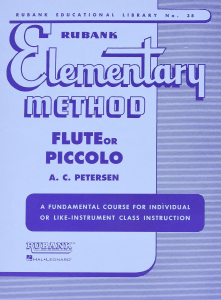
Mr Schulte was impressed with my ear: he used to have me turn my back on him and he would audition (A/B style) state-of-the-art flutes and ask me to judge which sounded better. I consistently picked the most expensive model, e.g. a wood open hole with a silver head joint. The downside of my good ear was that I could cheat and play music by ear at the expense of mastering sight reading. Mr. Schulte would give me an assignment each week from the A.C. Petersen method book by playing it for me. I relied more on remembering that demo than on reading the music. For fun, I had a music book of pop hits of the day that I ended up playing mostly by ear vs. reading the music.
I would even write my own tunes on the flute. The only one I remember was an upbeat instrumental I titled “The Dancing Tabby” – I was cat-obsessed as a kid.
The flute is a relatively easy instrument to play once you figure out how to make a noise blowing across the embouchure hole. After that, it is memorizing fingering (see fingering chart below) and adjusting your embouchure and blow to change octaves and create effects like staccato. Below is a flute-fingering chart:

I continued to improve at the flute for the next few years. When I started junior high I joined the band. I was shocked to learn that the flute was a “girl instrument.” As a seventh-grade male, I didn’t have a lot of gender confidence so I felt uncomfortable in the flute section. However, this is where I first discovered boobs – a couple of junior high girls in the flute section were beginning to blossom and I was stirred by the slightest glimpse of their cleavage.
A few months into my band career I accidentally left my flute on top of my locker at school and once I realized it and returned to my locker it was gone. My dad was furious at my carelessness, but he was also furious at the band instructor as he assumed that he had stolen the flute – a bizarre accusation – but I was fine with his misplaced blame as it took some of the heat off me for my screw-up.
I continued to play the flute in the band with a borrowed flute for a few more months, but I had lost my passion for the instrument: I wasn’t secure enough in my sexuality to play a “girl instrument,” my weak sight-reading was now a liability and the borrowed flute was a piece of crap. I ended up quitting playing the flute before the end of seventh grade.
Many years later I got together with a bunch of guys and we started a band: Whale (that is a topic that will get its own post). I was learning the guitar and it was my primary instrument in Whale. My wife had her old flute from when she was a kid and so I started to mess with it. My embouchure was still functional and my ability to play came back like riding a bike. I brought it to Whale band practice and duct taped a small microphone to the flute’s head joint and I was now Whale’s Ian Anderson.
Since Whale broke up 30 years ago I haven’t touched the flute, but now that I am retired I think about taking it up again as I have great memories of playing the flute.

 Axl's Catch Groove
Trackbacks & Pingbacks